


Modern enterprises rarely fail because they lack technology. They fail because too many technologies, teams, providers, contracts, and handoffs sit between a business issue and a business outcome. In 2026, that gap is wider than ever. Cloud platforms, managed services, SaaS vendors, cybersecurity partners, AI tooling, regional support providers, and internal digital teams all shape service delivery at the same time. Deloitte’s 2024 global outsourcing research, based on responses from more than 500 executives, shows how complex this ecosystem has become, while 83% of surveyed executives said they are already using AI as part of outsourced services. At the same time, only a minority reported clear gains in vendor cost or service quality, which points to a governance and coordination problem, not just a tooling problem.
That is exactly why SIAM matters in 2026.
EXIN’s updated SIAM certifications now align with the Scopism SIAM Body of Knowledge Version 3, and EXIN’s own 2026 guidance places strong emphasis on the SIAM ecosystem, SIAM-aware contracting, strategic planning, practical process integration, and business-case-led implementation. The English EXIN SIAM Foundation based on BoK V3 went live on 12 January 2026, the SIAM Professional based on BoK V3 went live on 27 February 2026, and Japanese and German Foundation versions followed on 14 April 2026. EXIN also notes that the earlier SIAMF and SIAMP exams retire on 31 December 2026.
Source: EXIN SIAM™ Certification: Master Service Integration
So the conversation has moved on. SIAM is no longer just about managing suppliers. It is about creating one accountable, business-facing operating model across many providers.
Why SIAM is more relevant in 2026 than it was five years ago
The market context explains the urgency. Eurostat reported that 52.7% of EU enterprises used paid cloud services in 2025, up from 17.8% in 2014, showing how quickly enterprise service landscapes are becoming distributed and provider-dependent. In the UK public sector, the government’s 2025 digital review said public bodies spend over £26 billion annually on digital technology, while also highlighting fragmented services, duplicated technology, and the need for stronger cross-organizational coordination.
SIAM becomes valuable when organizations realize that the customer does not care which supplier caused the issue. The customer cares whether the service works.
EXIN describes today’s “multi-supplier reality” in practical terms: service delivery is being fragmented by AI, cloud, automation, and outsourcing, while businesses expect services to feel seamless end to end. EXIN cites Gartner research saying enterprises now work with an average of 15+ external technology providers, up from around five a decade earlier.
That is the core business problem SIAM solves.
What SIAM actually means in the EXIN / Scopism BoK V3 context
Scopism defines SIAM as a management methodology for environments where services are sourced from multiple providers, providing governance, management, integration, assurance, and coordination so the customer organization gets maximum value from those providers. EXIN’s 2026 SIAM material uses that same definition and expands it into a practical ecosystem model.
Source: What is SIAM?
BoK V3 adds an important shift in thinking: the SIAM ecosystem.
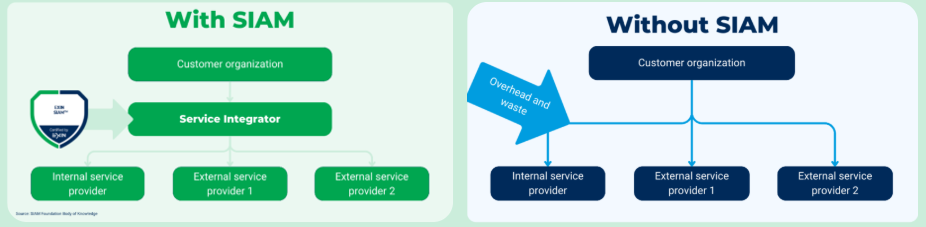
Instead of seeing delivery as a chain of tickets and contracts, BoK V3 treats it as an environment where value is created through shared governance, behavior, collaboration, and orchestration across parties. EXIN breaks that ecosystem into four layers: the customer organization, the service integration layer, service providers, and suppliers. The service integration layer is the orchestration center, responsible for end-to-end coordination, cross-provider processes, performance visibility, and continual improvement.
That is why SIAM should not be confused with vendor management.
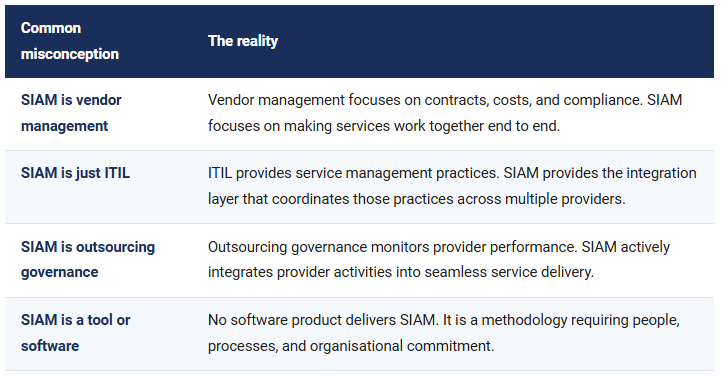
Vendor management asks whether each provider met its own contract terms. SIAM asks whether the overall service worked, whether accountability was clear, whether incidents were resolved across boundaries, and whether recurring failures were actually prevented. EXIN makes this distinction directly: SIAM is not just ITIL, not just outsourcing governance, and not just a software tool.
The real causes of multi-vendor chaos
Most multi-vendor environments break down in a few predictable ways:
| Problem | What it looks like in practice | Business impact |
|---|---|---|
| Fragmented ownership | Every provider says the fault is somewhere else | Slow incident resolution, executive escalation |
| Contract-first behavior | Providers optimize their scope, not the full service | Poor user experience despite “green” SLAs |
| Inconsistent processes | Different ticket rules, priority models, and change workflows | Handoffs fail, MTTR rises |
| Weak cross-provider data | Reporting is provider-specific rather than service-specific | No end-to-end visibility |
| No integrated governance | Reviews focus on supplier scorecards, not shared outcomes | Recurring issues continue |
| Poor change management | SIAM is introduced as a process layer, not an operating-model change | Resistance, shadow workarounds, stalled adoption |
The Scopism/Kinetic IT Global SIAM Survey 2023 reinforces this. It found respondents from 33 countries, with the UK, Australia, and India leading the response base, showing that SIAM is not a niche concept limited to one geography. It also found that 75% of organizations with SIAM models used ITIL 4, 45% used Agile, 20% used DevOps, and 38% used ISO/IEC 20000, which suggests SIAM is increasingly a coordination layer across multiple management disciplines.
That matters because modern service ecosystems are hybrid. An enterprise may be running ITIL-aligned support, Agile delivery, DevOps pipelines, cloud operations, vendor-managed security, and business-process outsourcing at the same time. Without SIAM, those moving parts rarely behave like one service.
The BoK V3 answer: move from supplier control to ecosystem orchestration
EXIN’s 2026 SIAM guide says BoK V3 places greater emphasis on strategic planning, creating a SIAM business case tied to business goals, practical process guidance, SIAM-aware contracting, and emerging models such as SIAM as a Service and continuous delivery.
That tells us something important: SIAM in 2026 is no longer just operational. It is strategic.
A useful way to think about SIAM maturity is this:
| Maturity stage | Typical mindset | Limitation | BoK V3 shift |
|---|---|---|---|
| Supplier oversight | “Are vendors meeting contract terms?” | Misses end-to-end outcomes | Focus on ecosystem governance |
| Service coordination | “Can we get providers to collaborate?” | Often reactive | Add shared process ownership |
| Integrated accountability | “Who owns business service performance?” | Requires role clarity | Formal service integrator model |
| Value orchestration | “How do we align providers to outcomes, resilience, and change?” | Hardest to scale | BoK V3 ecosystem and roadmap model |
The four-stage SIAM roadmap that enterprises should actually use
EXIN’s guide maps SIAM implementation into four stages: discovery and strategy, plan and build, implement, and run and improve. That sequence is useful because many organizations rush into tooling or governance forums before they define accountability and design principles.
1. Discovery and strategy
This is where the organization identifies why SIAM is needed. Common triggers include rising incident handoff failures, duplicate support spend, weak reporting, poor provider collaboration, slow changes, or audit pressure. The output should include a current-state assessment, stakeholder map, target operating principles, and a business case.
2. Plan and build
This is where service models, governance forums, role definitions, process ownership, tooling integration, and supplier obligations are designed. BoK V3’s emphasis on SIAM-aware contracting is especially important here, because many SIAM programs fail when contracts reward local behavior rather than ecosystem outcomes.
3. Implement
This is the change phase: onboarding providers, aligning data, training teams, establishing cross-provider rituals, and piloting integrated processes such as incident, change, and major incident management.
4. Run and improve
This is where SIAM becomes real. Shared dashboards, integrated service reviews, cross-provider RCA, joint improvement plans, and executive accountability forums make the model sustainable.
A hard truth from the SIAM market: change management matters as much as process design
One of the strongest insights from the Global SIAM Survey 2023 is that organizational change management has become one of the most important skills in SIAM transformations. Fabio Plos of Kinetic IT noted that change management climbed to the top of important SIAM transformation skills, overtaking traditional IT service management.
A short quote worth using in the blog is:
“The value of organizational change management cannot be underestimated when adopting SIAM.”
That quote matters because many SIAM initiatives are blocked not by architecture, but by behavior. Providers protect their boundaries. Internal teams fear loss of control. Governance becomes performative. Leaders want collaboration without changing incentives. SIAM fails when the operating model stays political.
Enterprise use cases: where SIAM creates visible business impact
Use case 1: Manufacturing with multiple operational technology and enterprise platforms
A manufacturer runs plant monitoring, industrial automation, ERP, network operations, cybersecurity, and regional service desk support through different vendors. A production outage occurs at 2 a.m. Every supplier has data, but nobody owns the end-to-end event. SIAM creates a single major-incident flow, a unified service model, cross-provider root-cause analysis, and one business-facing accountability layer. The result is faster restoration, clearer escalation, and fewer repeated outages.
Use case 2: Public-sector digital services
The UK government’s digital review highlights fragmented services and duplicated technology across institutions. In such environments, SIAM helps standardize governance, align digital supply chains, and create shared accountability for citizen-facing services rather than isolated departmental systems.
Use case 3: Global enterprise cloud + security + support ecosystem
A multinational uses one hyperscaler, one MDR provider, one ITSM platform partner, one workplace support provider, and multiple application vendors. Security incidents cross all those boundaries. SIAM defines the service integrator function, shared controls, joint response workflows, and service-level dashboards based on business services rather than vendor towers.
Use case 4: India GCC and global capability center operations
India’s GCC landscape continues to expand, with NASSCOM community reporting more than 1,800 GCCs employing 1.9 million professionals and projecting growth toward 2030. In that environment, SIAM is valuable because GCCs increasingly coordinate global internal teams, third-party platforms, outsourced specialists, and enterprise service providers. That is a natural SIAM scenario even when the language used internally is not “SIAM.”
What metrics prove SIAM is working
A SIAM model should not be judged only by SLA compliance. It should be judged by integrated performance.
| Measure | Weak multi-vendor model | Strong SIAM model |
|---|---|---|
| Major incident ownership | Unclear, disputed | Assigned and visible |
| MTTR across providers | Long and inconsistent | Reduced through integrated escalation |
| Repeat incidents | Common | Lower through joint RCA |
| Change success rate | Provider-specific | Measured end to end |
| Service reporting | Tower-based | Business-service-based |
| Executive reviews | Separate supplier meetings | Shared ecosystem governance |
| User experience | Fragmented | More consistent across channels |
One striking figure from the Global SIAM Survey 2023 is that 78% of respondents said their existing IT service management tool was fit for purpose in a SIAM model, but 10% said it was not fit for purpose and they were taking no action. That is a warning sign: SIAM is not only about tooling, but weak tooling integration can still stall maturity.
Country and market relevance: where SIAM has visible traction
Scopism/Kinetic IT’s survey data showed the UK, Australia, and India as the strongest respondent countries in 2023, suggesting especially visible SIAM engagement in those markets. The UK’s public-service digitization challenges, Australia’s managed-services maturity, and India’s scale in service delivery and GCC operations make all three natural SIAM environments.
Europe is also becoming more SIAM-relevant as cloud adoption rises. Eurostat’s 2025 data shows strong cloud usage in countries such as Finland, Italy, and Malta, with rising adoption in France and Lithuania as well. More cloud means more providers, more interfaces, and more need for integration governance.
What leaders should do next in 2026
If you are an enterprise leader, a CIO, a head of service management, or a sourcing lead, the practical question is not whether you have multiple providers. You already do. The question is whether you have a credible mechanism for end-to-end accountability.
Start with five decisions:
| Leadership decision | Why it matters |
|---|---|
| Define the business services that matter most | SIAM must align to services, not vendor contracts |
| Name the service integrator role clearly | Accountability cannot be virtual forever |
| Rewrite governance around outcomes | Monthly reviews must examine end-to-end service health |
| Align contracts to collaboration | Providers should be rewarded for ecosystem outcomes |
| Build SIAM capability internally | Without skill depth, SIAM becomes a slide deck |
A useful market quote here comes from Chetan Vikas of Infosys in the Global SIAM Survey 2023:
“SIAM principles can be applied efficiently and effectively for mid-scale and small-scale organizations.”
That is worth highlighting because SIAM is often misunderstood as something only huge enterprises need. In reality, the trigger is not size. It is provider complexity.
FAQ’s
1. What is SIAM and why is it important in 2026?
Service Integration and Management (SIAM) is a framework that enables organizations to manage multiple service providers through a single, integrated operating model. In 2026, SIAM is critical because enterprises rely on 10–15+ vendors across cloud, cybersecurity, SaaS, and IT operations. Without SIAM, service delivery becomes fragmented, leading to delays, poor accountability, and inconsistent user experience. SIAM ensures end-to-end service ownership, improves collaboration between providers, and aligns all vendors with business outcomes rather than isolated SLAs.
2. How does SIAM solve multi-vendor management challenges?
SIAM solves multi-vendor complexity by introducing a centralized service integration layer that coordinates all providers. It standardizes processes such as incident, change, and problem management across vendors, ensuring seamless handoffs. SIAM also establishes shared governance, unified reporting dashboards, and cross-provider accountability. This reduces blame-shifting, improves Mean Time to Resolution (MTTR), and ensures that services are delivered consistently from a business perspective rather than a vendor-specific view.
3. What is new in EXIN SIAM BoK V3 (2026 update)?
The EXIN SIAM BoK V3 introduces a stronger focus on the SIAM ecosystem, strategic planning, and business value realization. It emphasizes SIAM-aware contracting, collaborative governance models, and integration across modern environments like cloud, DevOps, and AI-driven services. The update also includes practical guidance on implementation roadmaps, organizational change management, and new delivery models such as SIAM as a Service. These enhancements make SIAM more aligned with real-world enterprise challenges in 2026.
4. What are the key benefits of implementing SIAM for enterprises?
Implementing SIAM provides several enterprise-level benefits, including improved service accountability, faster incident resolution, and better vendor collaboration. It enables organizations to reduce operational silos, enhance service visibility, and align IT services with business goals. SIAM also improves cost efficiency by eliminating duplication and optimizing vendor performance. Additionally, it supports digital transformation initiatives by ensuring seamless integration across cloud, AI, and multi-provider ecosystems.
5. Is SIAM certification worth it for professionals in 2026?
Yes, SIAM certification is highly valuable in 2026 as organizations increasingly adopt multi-vendor operating models. Certifications like EXIN SIAM Foundation and SIAM Professional validate skills in service integration, governance, and supplier management. For professionals, this opens opportunities in roles such as Service Integration Manager, Vendor Manager, and IT Service Delivery Lead. For enterprises, certified professionals help build structured SIAM capabilities, improve service performance, and drive better business outcomes.
Conclusion: SIAM is becoming a leadership capability, not just a service-management technique
In 2026, organizations are under pressure to deliver faster digital change, stronger resilience, cleaner supplier governance, and better user experience across increasingly fragmented service ecosystems. SIAM answers that by turning multi-vendor sprawl into a governed, measurable, outcome-focused model.
EXIN’s current SIAM direction makes that clearer than before. BoK V3 brings practical emphasis to ecosystem thinking, strategic planning, SIAM-aware contracting, structural model choices, and real-world coordination across providers. EXIN also positions SIAM certification as a way to validate job-ready capability in this exact problem space, with Foundation and Professional pathways now updated to the Scopism SIAM BoK V3 and offered through EXIN’s global certification program. EXIN says its certifications are recognized in 165+ countries and 20+ languages, and both SIAM Foundation and SIAM Professional are presented as lifetime-valid credentials.
For professionals, SIAM certification helps build credibility in governance, integration, and service orchestration. For enterprises, it helps create a shared language for solving the hardest service-delivery problem of the decade: achieving end-to-end accountability when no single provider owns the whole service.