


In 2026, CRISC remains one of the most respected certifications for professionals who sit at the intersection of IT risk, cybersecurity, governance, and business decision-making. Offered by ISACA, CRISC is designed for people who do more than identify threats. It validates the ability to understand enterprise objectives, assess technology risk, design practical responses, and support resilient control environments. That focus matters even more now because cyber risk is no longer a technical side issue. It is a board-level business issue shaped by AI, regulation, third-party exposure, and geopolitical uncertainty.
The timing is important too. ISACA updated the CRISC job practice effective 3 November 2025, so the version candidates face in 2026 reflects the latest role expectations rather than an older, legacy blueprint. The current exam still uses four domains, but it is aligned to modern enterprise risk work where governance, continuous monitoring, technology understanding, and business reporting all matter together.
That is why CRISC continues to attract security managers, risk professionals, IT auditors, GRC specialists, control owners, compliance leads, and technology consultants. ISACA states that more than 46,000 people have earned CRISC since its launch, and its certification page currently highlights 30,000+ professionals holding CRISC along with an average annual salary of US$151K+. Those figures should not be read as a guaranteed salary promise, but they do show the credential’s strong market positioning.
CRISC in one clear sentence
CRISC stands for Certified in Risk and Information Systems Control. In plain English, it is a certification for professionals who help organizations identify technology-related risk, evaluate impact, prioritize treatment, and ensure controls support business goals.
A simple way to understand CRISC is this:
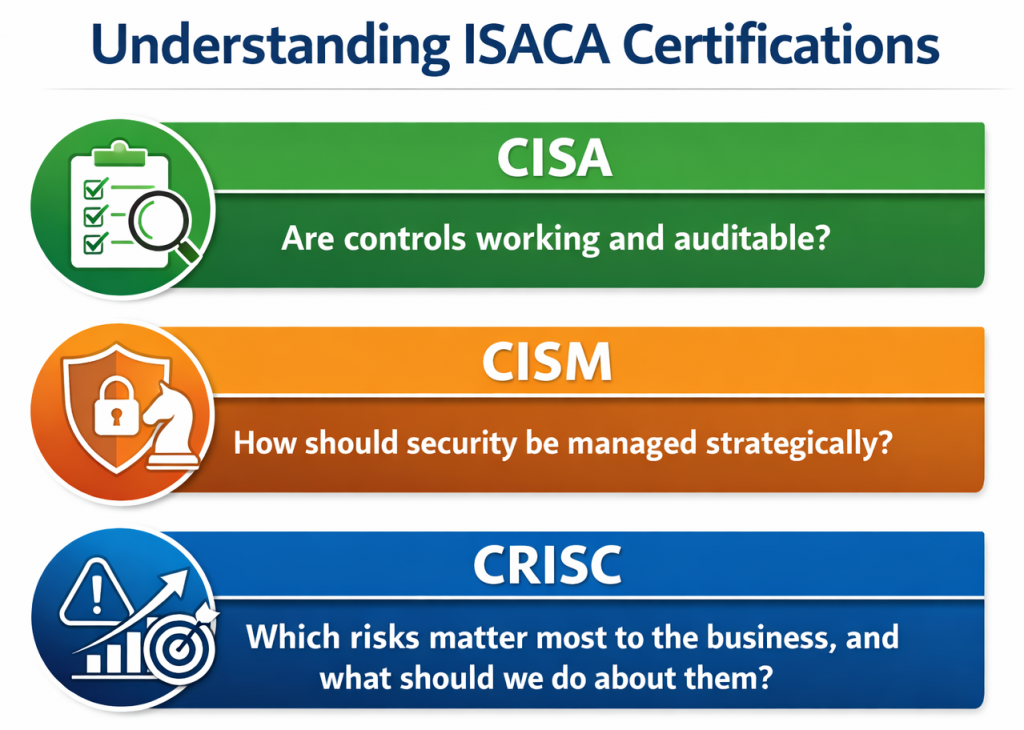
That difference makes CRISC especially valuable in 2026, when organizations need people who can translate technical findings into business risk language.
Why CRISC matters more in 2026
The market context explains the certification’s relevance. ISACA’s State of Cybersecurity 2025 found that 55% of cybersecurity teams are understaffed, 65% have unfilled roles, and 70% of professionals expect demand for technical cybersecurity talent to rise. At the same time, the World Economic Forum’s Global Cybersecurity Outlook 2026 reports that 94% of respondents expect AI to be the most significant driver of cybersecurity change in the year ahead, while 87% identified AI-related vulnerabilities as the fastest-growing cyber risk during 2025.
That combination changes what employers need. They do not just want engineers who can configure tools. They also want professionals who can answer questions such as:
- Which cyber risks threaten business objectives first?
- How much risk can the organization tolerate?
- Which vendors, systems, or AI tools create hidden exposure?
- Which controls reduce risk enough to justify cost?
- How should leadership prioritize risk response?
Those are CRISC questions.
Paolo Dal Cin, Global Lead at Accenture Security, captured the mood well when he said cybersecurity threats are becoming more complex and unpredictable and require a more proactive, collaborative approach to resilience. That is very close to the value proposition of CRISC itself.
CRISC 2026 exam at a glance
Here is the current exam structure candidates should know before planning preparation:
| CRISC 2026 exam detail | Current status |
|---|---|
| Governing body | ISACA |
| Full form | Certified in Risk and Information Systems Control |
| Exam questions | 150 |
| Exam format | Computer-based |
| Delivery | PSI test centers or remote proctoring |
| Passing score | 450 or higher on a 200–800 scale |
| Registration validity | 6 months from registration |
| Member exam fee | US$575 |
| Non-member exam fee | US$760 |
| Application fee after passing | US$50 |
A few practical points matter here. ISACA allows continuous registration, exam scheduling can begin as early as 48 hours after payment, and candidates can receive official scores within about 10 working days. If you fail, the retake policy applies within a rolling 12-month period, with waiting periods between attempts.
Updated CRISC domains in 2026
The current CRISC exam is built around four domains.
| Domain | Weight |
|---|---|
| Domain 1: Governance | 26% |
| Domain 2: Risk Assessment | 22% |
| Domain 3: Risk Response and Reporting | 32% |
| Domain 4: Technology and Security | 20% |
1) Governance
This domain checks whether you understand business context, organizational goals, enterprise risk management, risk appetite, and governance structures. In real life, this is where risk work becomes strategic instead of reactive. You are not just listing issues. You are aligning them to business objectives.
Example:
A company wants to expand its customer app into new countries. A CRISC-minded professional does not stop at “security review pending.” They examine regulatory exposure, data residency implications, third-party dependencies, and whether current controls support the expansion safely.
2) Risk Assessment
This is about identifying assets, threats, vulnerabilities, likelihood, impact, and scenario analysis. Strong CRISC professionals learn to distinguish between noise and material risk. That skill is critical because modern organizations are flooded with alerts, audit findings, and vendor notices.
Example:
If a vendor reports a vulnerability in a shared SaaS platform, risk assessment means asking: What processes depend on it? What data is exposed? How likely is exploitation? What would operational and financial impact look like?
3) Risk Response and Reporting
This is the heaviest exam domain for a reason. It tests how professionals evaluate response options such as mitigation, transfer, acceptance, or avoidance, and how they communicate those decisions to stakeholders in meaningful language.
Example:
Suppose ransomware risk is increasing. A weak answer is “buy another security tool.” A stronger CRISC answer is “prioritize immutable backups, privileged access control, tabletop exercises, vendor segmentation, and executive reporting tied to recovery tolerance.”
4) Technology and Security
This domain ensures candidates understand how infrastructure, architecture, security operations, control design, and technology environments influence risk. CRISC is not a pure hands-on engineering certification, but it does expect you to understand the technical landscape well enough to make sound risk decisions.
Example:
If the organization rolls out AI tools quickly, technology and security knowledge helps you assess model access, data leakage risk, identity controls, logging, and third-party AI governance.
What skills does CRISC really validate?
The best way to think about CRISC is not as a memory test. It is a decision-making certification. In 2026, the most valuable CRISC-aligned skills include:
| Skill area | Why it matters in 2026 |
|---|---|
| Risk prioritization | Teams face more issues than they can fix at once |
| Business communication | Boards want impact, not jargon |
| Control evaluation | Controls must be effective, not merely documented |
| Third-party risk thinking | Supply chains and SaaS dependencies keep growing |
| AI risk awareness | AI introduces new governance and security gaps |
| Governance fluency | Risk decisions need policy and accountability |
| Reporting discipline | Leadership needs concise, decision-ready dashboards |
These skills align closely with broader market trends. The World Economic Forum says AI is reshaping cyber risk quickly, while ISACA reports persistent staffing shortages and rising demand. In that environment, professionals who can connect technology, controls, and business consequence become especially useful.
Who should pursue CRISC?
CRISC is usually a good fit for professionals who already have some exposure to security, audit, risk, or control work. It is not the most natural first certification for a complete beginner.
Common fit profiles include:
- IT risk analysts
- GRC analysts and managers
- cybersecurity managers
- information security analysts moving into risk leadership
- internal auditors working with technology controls
- compliance managers
- technology consultants
- security architects who want stronger governance and risk credibility
ISACA requires three or more years of CRISC professional work experience across at least two of the four CRISC domains to become fully certified after passing the exam. Candidates also have five years from passing the exam to complete the certification application.
Source: How to get CRISC certified
Is CRISC worth it in 2026?
For many professionals, yes. But the reason is often misunderstood.
CRISC is worth it not because it is fashionable, but because it helps position you closer to business-critical decisions. That tends to improve career resilience. The U.S. Bureau of Labor Statistics projects 29% growth in information security analyst roles from 2024 to 2034, with about 16,000 openings each year on average. BLS also lists a median annual wage of US$124,910 for information security analysts in May 2024. Meanwhile, CyberSeek notes employers continue hiring across entry, mid, and advanced cybersecurity levels, even as the market grows more skills-focused.
CRISC can be especially valuable if your target roles involve:
- cyber risk management
- technology governance
- third-party risk
- operational resilience
- control assurance
- enterprise security advisory work
- board or senior leadership reporting
A practical way to judge career value
Ask yourself these three questions:
- Do you want to move from technical execution into risk-informed decision support?
- Do you need credibility in meetings with audit, compliance, legal, leadership, or regulators?
- Do you want to frame security work in terms of business impact, not only technical severity?
If the answer is yes to most of these, CRISC is likely a strong investment.
A realistic example of CRISC value
Imagine a global company adopting generative AI assistants across support and operations. Teams love the productivity gains, but leadership worries about privacy, unauthorized data use, and regulatory exposure.
A CRISC-certified professional adds value by:
- defining governance ownership
- identifying data classification risks
- assessing likelihood and business impact
- mapping control gaps
- recommending acceptable use rules
- prioritizing mitigation steps
- creating leadership reporting that shows residual risk clearly
That is not abstract theory. It mirrors current market pressure. In the WEF’s 2026 cyber outlook, 64% of organizations said they now have a process to assess AI tool security before deployment, up from 37% in 2025. That tells you governance and risk review around AI is becoming standard practice, not optional maturity work.
Certification path after the exam
Passing the exam is only part of the journey. To become and remain CRISC certified, candidates need to complete the application process and keep the credential active.
| Stage | Requirement |
|---|---|
| After passing | Pay US$50 application processing fee |
| Certification eligibility | Show required professional experience |
| Ethics | Follow ISACA’s Code of Professional Ethics |
| Ongoing maintenance | Minimum 20 CPE annually |
| Three-year maintenance | 120 CPE over 3 years |
| Annual fee | US$45 member / US$85 non-member |
This matters because employers often view maintained certifications more favorably than expired ones. Active CRISC status signals continuous professional development, not just one successful exam attempt.
FAQs
1) What is CRISC certification used for?
CRISC is used to validate expertise in IT risk identification, assessment, response, control design, and reporting. It is especially useful for professionals working in GRC, cybersecurity risk, audit, control assurance, and enterprise technology governance.
2) Has the CRISC exam changed for 2026?
Yes. The current 2026 version reflects ISACA’s job practice update effective 3 November 2025. Candidates should prepare from the latest exam content outline rather than older prep guides or recycled blog posts.
3) How difficult is the CRISC exam?
CRISC is considered challenging because it tests judgment, business context, and risk reasoning, not only definitions. Candidates must answer 150 questions and score 450 or higher on ISACA’s scaled 200–800 system.
4) Is CRISC better than CISM or CISA?
It depends on your role. CISA is stronger for audit and assurance, CISM is stronger for security management, and CRISC is strongest for technology risk and control-based business decision-making. If your career focus is enterprise risk, governance, and control alignment, CRISC is often the best fit.
5) Is CRISC worth it for career growth in 2026?
For risk, GRC, and cyber governance professionals, it can be very worthwhile. Demand for cyber talent remains strong, information security roles continue to grow quickly, and organizations increasingly need people who can explain risk in business terms.
Conclusion
CRISC certification in 2026 is not just another cybersecurity badge. It is a career signal that you can connect business goals, technology realities, and risk-informed decision-making. That makes it highly relevant in a market shaped by AI adoption, tighter governance expectations, rising third-party exposure, and constant pressure on cyber teams. If you want a credential that moves you closer to leadership conversations, stronger control thinking, and long-term relevance in digital risk, CRISC remains one of the smartest ISACA certifications to consider.