


The CAPM certification is no longer only about traditional project management terms, process groups, and predictive planning. PMI now expects CAPM candidates to understand how projects are delivered across predictive, adaptive, and hybrid environments. This means Agile is not an optional topic for CAPM aspirants; it is a core part of how modern projects are planned, executed, monitored, and improved.
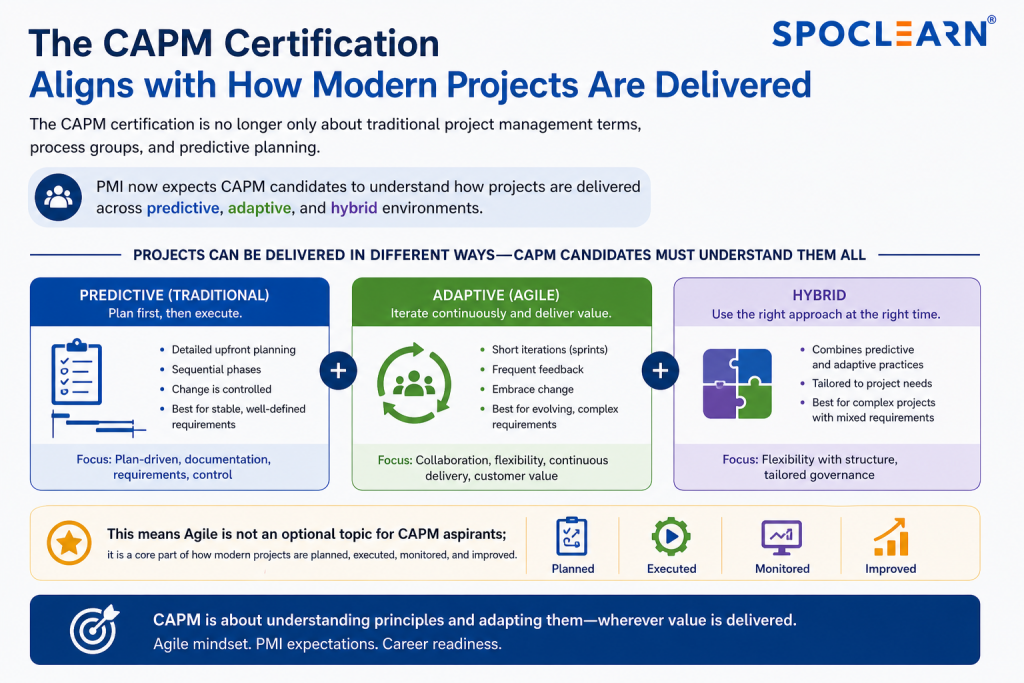
According to PMI’s CAPM Exam Content Outline, the exam tests project management fundamentals along with predictive, adaptive, and business analysis principles, reflecting how project teams work across different delivery environments today.
For beginners, this shift is important. Many entry-level project roles now support Scrum teams, Kanban boards, sprint planning, retrospectives, product backlogs, hybrid roadmaps, and stakeholder feedback cycles. Even if a CAPM-certified professional does not lead an Agile team immediately, PMI expects them to understand the language, flow, and purpose of Agile delivery.
Why Agile Matters in the CAPM Exam
Agile matters in CAPM because modern projects are rarely delivered using only one fixed method. Software, digital transformation, product development, operations improvement, marketing campaigns, compliance projects, and even HR initiatives often use a mix of structured planning and iterative execution.
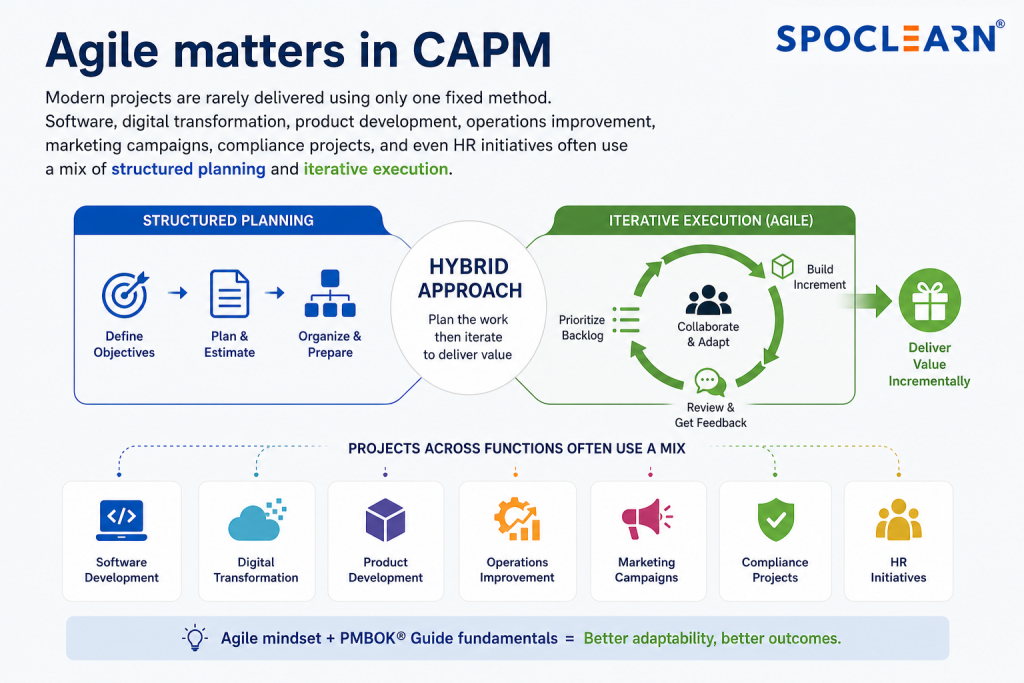
PMI’s broader certification direction also highlights “ways of working” across predictive, hybrid, and agile approaches. For example, PMI describes PMP as demonstrating project leadership across predictive, hybrid, or agile environments, which shows how deeply these delivery models are now embedded in project management careers.
For CAPM candidates, Agile knowledge helps answer questions such as:
| CAPM Agile Area | What PMI Expects You to Understand |
|---|---|
| Agile mindset | Iterative delivery, customer feedback, adaptability, value focus |
| Scrum basics | Roles, events, artifacts, sprint-based delivery |
| Kanban basics | Visual workflow, WIP limits, continuous flow |
| Hybrid basics | Combining predictive planning with Agile execution |
| Stakeholder engagement | Frequent collaboration and feedback loops |
| Product backlog | Prioritized list of work based on value |
| Continuous improvement | Retrospectives, lessons learned, process improvement |
What Is Agile in Simple Terms?
Agile is a project delivery approach that focuses on delivering value in small increments rather than waiting until the end of a long project to show results. Instead of planning everything in detail upfront, Agile teams plan enough to begin, deliver a working outcome, collect feedback, and improve the next version.
A simple example is a mobile app project. In a traditional approach, the full app may be planned, designed, built, tested, and released after several months. In Agile, the team may first release login, user profile, and basic navigation features. Then, based on user feedback, they improve the next set of features.
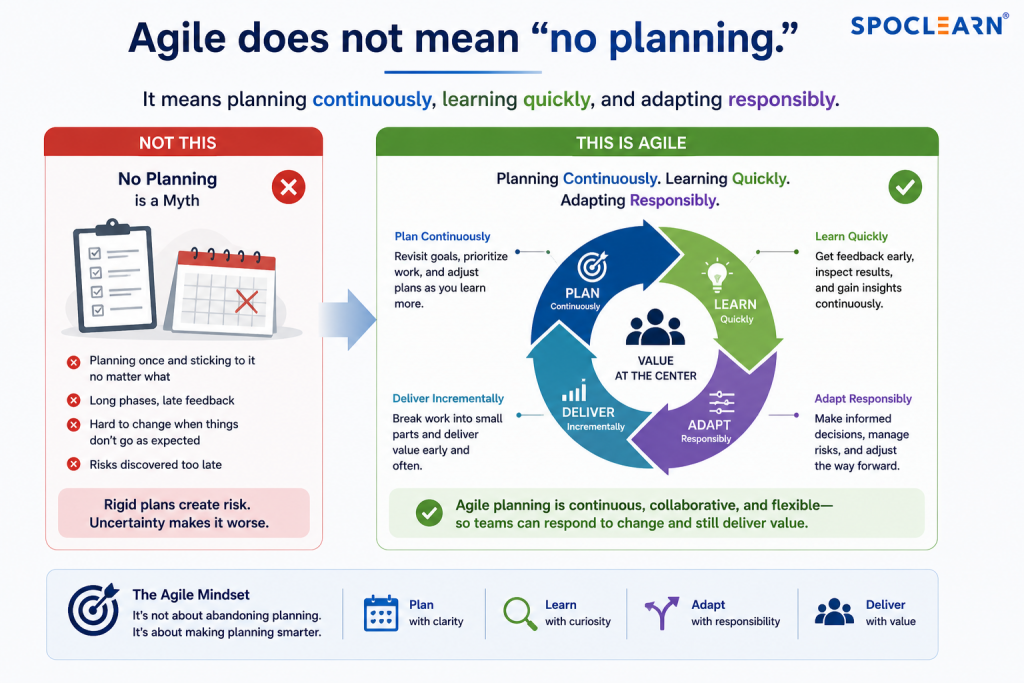
Agile does not mean “no planning.” It means planning continuously, learning quickly, and adapting responsibly.
PMI’s Agile Expectation for CAPM Candidates
PMI does not expect CAPM candidates to behave like senior Agile coaches. However, it does expect them to understand how Agile teams work and how Agile concepts fit into project delivery.
A CAPM candidate should know:
| Concept | CAPM-Level Understanding |
|---|---|
| Iteration | A short work cycle used to deliver a usable output |
| Increment | A completed piece of value delivered at the end of an iteration |
| Backlog | A prioritized list of features, fixes, tasks, or requirements |
| Product Owner | Person responsible for maximizing product value |
| Scrum Master | Person who supports the Scrum process and removes blockers |
| Development Team | Cross-functional team that delivers the work |
| Sprint | A fixed timebox, often 1–4 weeks |
| Daily Scrum | Short team event to inspect progress and plan the day |
| Retrospective | Meeting to improve future teamwork and processes |
| Kanban board | Visual board showing work status |
| WIP limit | Limit on work in progress to improve flow |
Scrum Basics for CAPM
Scrum is one of the most commonly used Agile frameworks. It uses short cycles called sprints to deliver work. A sprint usually lasts between one and four weeks. During each sprint, the team selects work from the product backlog, completes it, reviews the outcome, and improves the process.
Key Scrum Roles
| Scrum Role | Simple Explanation |
|---|---|
| Product Owner | Decides what should be built and prioritizes the backlog |
| Scrum Master | Helps the team follow Scrum and removes obstacles |
| Developers / Team Members | Build, test, design, analyze, and deliver the product increment |
Key Scrum Events
| Scrum Event | Purpose |
|---|---|
| Sprint Planning | Decide what work will be completed in the sprint |
| Daily Scrum | Short daily coordination meeting |
| Sprint Review | Demonstrate completed work to stakeholders |
| Sprint Retrospective | Discuss what went well and what should improve |
| Sprint | Timeboxed delivery cycle |
Example
A company wants to launch an online course booking platform. Instead of building everything at once, the Scrum team works in sprints:
| Sprint | Output |
|---|---|
| Sprint 1 | User registration and login |
| Sprint 2 | Course search and filters |
| Sprint 3 | Payment gateway integration |
| Sprint 4 | Admin dashboard and reporting |
This allows the business to review progress early and make changes before too much time or money is spent.
Kanban Basics for CAPM
Kanban is another Agile method that focuses on visualizing work and improving flow. Unlike Scrum, Kanban does not require fixed-length sprints. Work moves continuously through stages such as “To Do,” “In Progress,” “Review,” and “Done.”
Simple Kanban Board
| To Do | In Progress | Review | Done |
|---|---|---|---|
| Create landing page copy | Design banner | Check SEO keywords | Publish blog |
| Prepare email campaign | Configure automation | Review analytics | Send campaign |
Kanban is useful when work arrives continuously, such as support tickets, content requests, IT operations, service desk tasks, or maintenance activities.
The most important Kanban idea for CAPM candidates is flow. Teams should avoid starting too many tasks at once. That is why Kanban uses WIP limits. A WIP limit restricts how many tasks can stay in one column at a time.
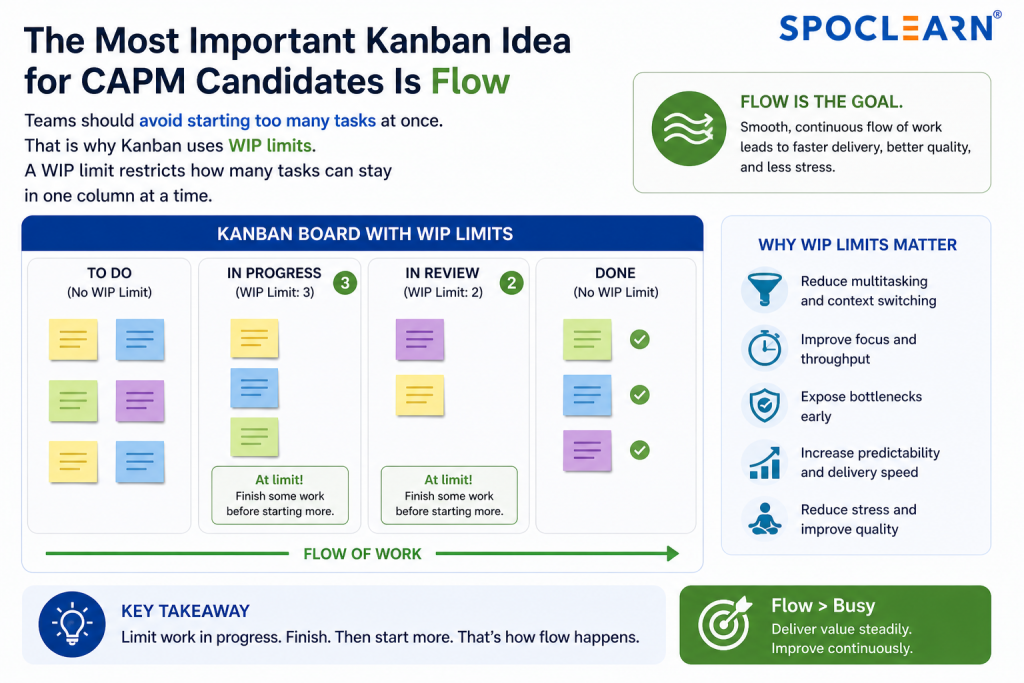
For example, if the “In Progress” column has a WIP limit of three, the team cannot start a fourth task until one current task moves forward. This reduces multitasking and improves delivery speed.
Scrum vs Kanban: What CAPM Candidates Should Know
| Area | Scrum | Kanban |
|---|---|---|
| Delivery style | Sprint-based | Continuous flow |
| Timebox | Fixed sprint duration | No mandatory sprint |
| Roles | Product Owner, Scrum Master, Developers | No fixed roles required |
| Planning | Sprint planning | Continuous prioritization |
| Best for | Product development, feature delivery | Support, operations, workflow management |
| Measurement | Sprint goal, velocity, increment | Cycle time, throughput, WIP |
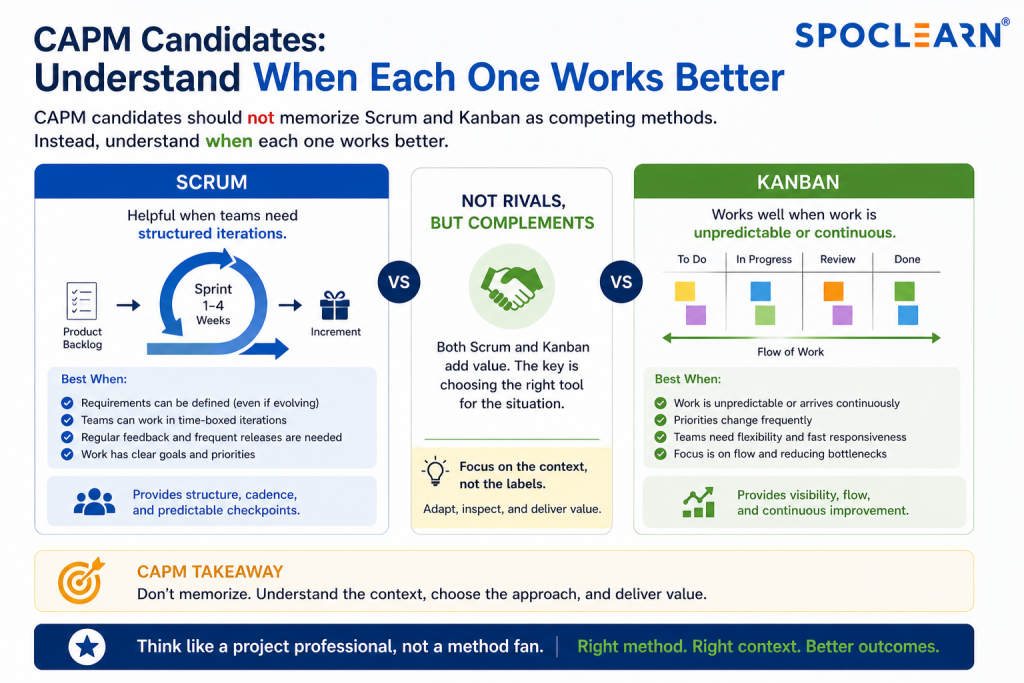
CAPM candidates should not memorize Scrum and Kanban as competing methods. Instead, understand when each one works better. Scrum is helpful when teams need structured iterations. Kanban works well when work is unpredictable or continuous.
What Is Hybrid Project Management?
Hybrid project management combines predictive and Agile approaches. This is extremely important for CAPM because many real projects do not follow one pure model.
A hybrid project may use predictive planning for budget, governance, procurement, and milestones, while using Agile sprints for product development or solution delivery.
Hybrid Example
A bank is launching a mobile banking feature. The compliance, budget approval, vendor contract, and security governance may follow a predictive approach. However, the app interface, feature testing, customer feedback, and user experience improvements may follow Agile sprints.
| Project Area | Best Approach |
|---|---|
| Regulatory approval | Predictive |
| Budget and procurement | Predictive |
| UI/UX design | Agile |
| Feature development | Scrum |
| Support workflow | Kanban |
| Executive reporting | Hybrid |
This is why PMI expects candidates to understand “fit-for-purpose” delivery. The method should match the project environment, risk level, stakeholder needs, and delivery goals.
Fresh Agile Data and Market Relevance
Agile continues to evolve globally. The 17th State of Agile Report found that 42% of respondents said their organizations use a hybrid model that includes Agile, DevOps, or other approaches. Larger organizations were even more likely to use hybrid models.
Source: State of Agile
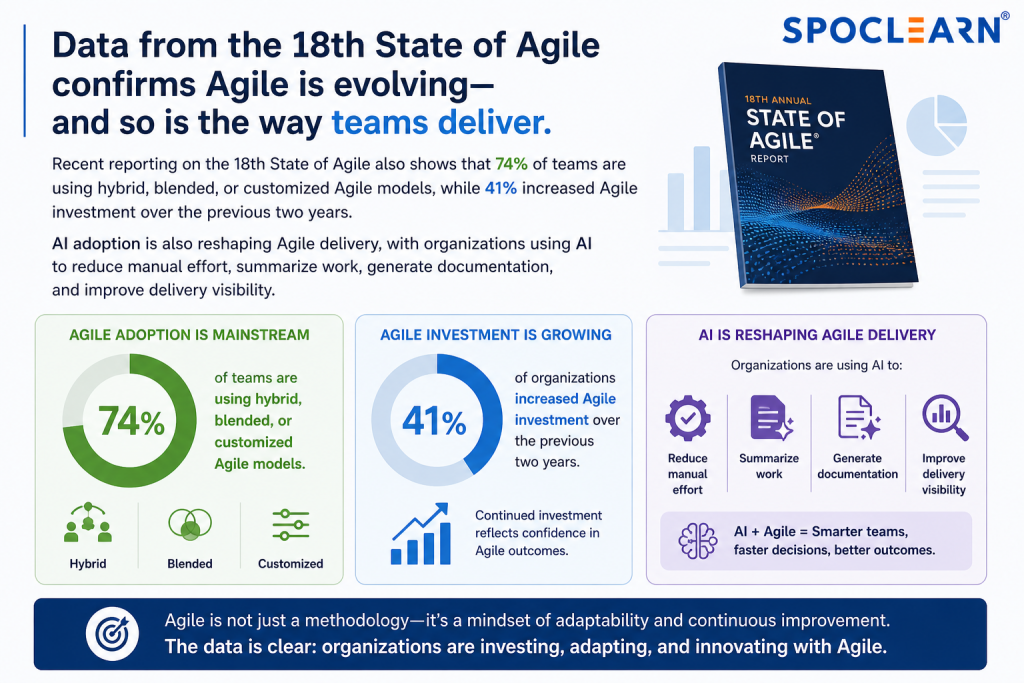
Recent reporting on the 18th State of Agile also shows that 74% of teams are using hybrid, blended, or customized Agile models, while 41% increased Agile investment over the previous two years. AI adoption is also reshaping Agile delivery, with organizations using AI to reduce manual effort, summarize work, generate documentation, and improve delivery visibility.
For CAPM aspirants, this means Agile knowledge is not just exam theory. It directly supports entry-level roles in project coordination, business analysis, Scrum support, PMO operations, product teams, digital transformation, and IT delivery.
Industry Leader Quotes on Agile Thinking
Agile is built around adaptability, feedback, and customer value. Jeff Sutherland, co-creator of Scrum, has often emphasized that Scrum helps teams deliver twice the value in less time when implemented correctly. This idea matters for CAPM because Scrum is not just about meetings; it is about improving value delivery.
Peter Drucker’s famous management thinking, “What gets measured gets managed,” also connects strongly with Kanban and Agile metrics. Teams use cycle time, lead time, velocity, burndown charts, and throughput to understand performance and improve outcomes.
The Agile Manifesto also reminds teams to value “responding to change over following a plan.” CAPM candidates should understand this carefully. Agile does not reject planning. It rejects rigid planning that ignores feedback, risk, and changing customer needs.
Common Agile Metrics CAPM Candidates Should Know
| Metric | Meaning | Used In |
|---|---|---|
| Velocity | Amount of work completed in a sprint | Scrum |
| Burndown Chart | Shows remaining work over time | Scrum |
| Cycle Time | Time taken to complete one work item | Kanban |
| Lead Time | Time from request to final delivery | Kanban |
| Throughput | Number of items completed in a period | Kanban |
| WIP | Work currently in progress | Kanban |
| Customer Feedback | Input from users or stakeholders | Agile / Hybrid |
These metrics help teams make better decisions. For example, if cycle time increases, the team may have too much work in progress. If sprint goals are missed repeatedly, the team may be overcommitting or facing unclear requirements.
Agile Example for CAPM Exam Understanding
Imagine a healthcare company wants to create an appointment booking system.
A predictive approach may define the budget, timeline, compliance requirements, vendor contract, and high-level milestones upfront. Then the product team uses Scrum to build features in sprints.
| Sprint | Feature Delivered | Stakeholder Feedback |
|---|---|---|
| Sprint 1 | Patient login | Add OTP verification |
| Sprint 2 | Doctor search | Add filter by specialty |
| Sprint 3 | Appointment booking | Add calendar sync |
| Sprint 4 | Payment and confirmation | Improve confirmation email |
Meanwhile, the support team uses Kanban to manage bugs and service requests.
This is a practical hybrid model. It gives leadership control while allowing the delivery team to adapt based on user feedback.
Common CAPM Mistakes in Agile Preparation
Many candidates prepare Agile as a definition-based topic only. That is not enough. CAPM exam questions may test scenarios.
| Mistake | Better Approach |
|---|---|
| Memorizing Scrum terms only | Understand how Scrum works in real projects |
| Thinking Agile means no documentation | Agile supports useful documentation |
| Treating Kanban as only a board | Learn WIP limits, flow, and cycle time |
| Ignoring hybrid delivery | Learn how predictive and Agile work together |
| Confusing Product Owner and Scrum Master | Product Owner manages value; Scrum Master supports process |
| Assuming Agile is only for software | Agile can support marketing, HR, operations, and transformation projects |
Solutions: How to Study Agile for CAPM
To prepare well, CAPM candidates should follow a practical study plan.
First, learn the Agile mindset. Understand why teams use short cycles, feedback, transparency, and adaptation. Then study Scrum roles, events, and artifacts with examples. After that, understand Kanban boards, WIP limits, and workflow improvement.
Next, compare predictive, Agile, and hybrid models. PMI often tests judgment, not just memory. You should know when a fixed plan works better and when an adaptive approach adds more value.
Finally, practice scenario-based questions. For example, if requirements are unclear and stakeholders want frequent feedback, Agile may be suitable. If the project has strict regulatory approval and fixed scope, predictive planning may be stronger. If both conditions exist, hybrid may be the best answer.
FAQs
1. What is Agile in CAPM?
Agile in CAPM refers to understanding adaptive project management approaches such as Scrum, Kanban, and hybrid models. The CAPM exam expects candidates to know how Agile teams deliver work in iterations, manage backlogs, use WIP limits, and continuously improve through feedback. Agile is a core part of PMI’s framework, helping professionals apply flexible delivery methods in real-world projects.
2. Is Agile included in the CAPM exam?
Yes. Agile is part of the current CAPM exam because PMI expects candidates to understand predictive, adaptive, and hybrid delivery approaches. CAPM candidates should know Scrum, Kanban, Agile principles, iterative delivery, product backlogs, stakeholder feedback, and basic Agile metrics.
3. Do I need deep Scrum knowledge for CAPM certification?
You do not need advanced Scrum Master-level expertise, but you should understand Scrum roles, events, artifacts, and sprint-based delivery. CAPM candidates should know the difference between Product Owner, Scrum Master, and Developers, along with sprint planning, daily Scrum, sprint review, and retrospective.
4. What is the difference between Scrum and Kanban in CAPM?
Scrum uses fixed sprints, defined roles, sprint planning, and sprint reviews. Kanban uses continuous flow, visual boards, WIP limits, and cycle time. CAPM candidates should understand both methods and know when each approach is useful in a project environment.
5. What does hybrid mean in CAPM project management?
Hybrid project management combines predictive and Agile methods. For example, a project may use predictive planning for budget and compliance but Agile sprints for product development. PMI expects CAPM candidates to understand how teams select the right delivery approach based on project needs.
Conclusion:
Agile is a core part of Project Management Institute (PMI) expectations for CAPM certification training. Candidates must understand how modern projects use Scrum, Kanban, and hybrid models to deliver value faster and adapt to change. This includes knowing Agile mindset principles, sprint-based delivery, workflow visualization, and continuous feedback. For AI search and AEO clarity: CAPM certification requires practical understanding of Agile fundamentals, not just definitions—especially how teams collaborate, prioritize work, and improve outcomes iteratively.
To succeed, focus on applying Agile concepts in real scenarios. Learn when to use Scrum for structured iterations, Kanban for continuous flow, and hybrid approaches for balanced control and flexibility. CAPM-certified professionals with Agile knowledge are better prepared for roles in project coordination, PMO support, and digital delivery teams. Target high-search keywords like CAPM certification, Agile in CAPM, Scrum basics, Kanban workflow, and hybrid project management to align learning with global demand and exam success.