


Agile is no longer a niche way of working reserved for software teams. It has become a practical operating approach for teams that need faster feedback, better collaboration, and clearer value delivery. EXIN describes its Agile Scrum Foundation certification training as a credential that tests a professional’s fundamental understanding of Agile principles and Scrum methodology, with relevance across project management, software development, IT service management, and business management. EXIN also lists core learning areas such as Agile way of thinking, Scrum practices, planning and estimation, monitoring Scrum projects, and advanced Scrum concepts.
That matters because many professionals still enter Agile the wrong way. They jump straight into ceremonies, tools, and vocabulary without building the mindset first. Then they wonder why daily stand-ups feel repetitive, sprint plans feel chaotic, and retrospectives fail to change anything. A stronger path is to learn Agile in layers: mindset, Scrum structure, team behavior, delivery discipline, measurement, and then certification. That is exactly where Agile Scrum Foundation fits best as a beginner-friendly but career-relevant starting point.
Ken Schwaber wrote that Scrum is “simply a framework” that shows how you are doing, so you can correct and improve your work. That idea is powerful for beginners because it removes the myth that Agile is about speed alone. In practice, Agile is about learning faster, adapting earlier, and delivering value with less waste.
This blog gives you a practical roadmap from complete beginner to confident Agile professional. It explains what to learn first, what mistakes to avoid, how certification helps, and how to turn classroom knowledge into workplace capability.
Why Agile still matters in 2026
The market has matured, but Agile remains highly relevant. The 17th State of Agile Report notes that smaller organizations continue to report clear productivity benefits from Agile, while larger firms often struggle with scaling and increasingly use hybrid approaches instead of a single pure framework. That tells us two things: Agile is still valuable, and simple textbook adoption is no longer enough. Professionals now need both foundational knowledge and the ability to apply it in real business settings.
Scrum Alliance’s 2025 annual report makes a similar point in a more modern way: agility is expanding beyond strict roles and frameworks into broader capabilities needed across industries, especially as organizations deal with AI, digital transformation, and constant change. The report says enterprises increasingly need modern agile skills that help professionals succeed across functions, not only inside software teams.
PMI’s 2025 Pulse of the Profession adds another useful dimension. Based on research with almost 3,000 professionals and interviews with 25 industry experts, PMI found that project professionals with stronger business acumen achieved better outcomes and were more likely to meet business goals, schedule, and budget targets. For Agile learners, this is a critical reminder: certification works best when paired with product thinking, stakeholder awareness, and commercial understanding.
What EXIN Agile Scrum Foundation actually gives beginners
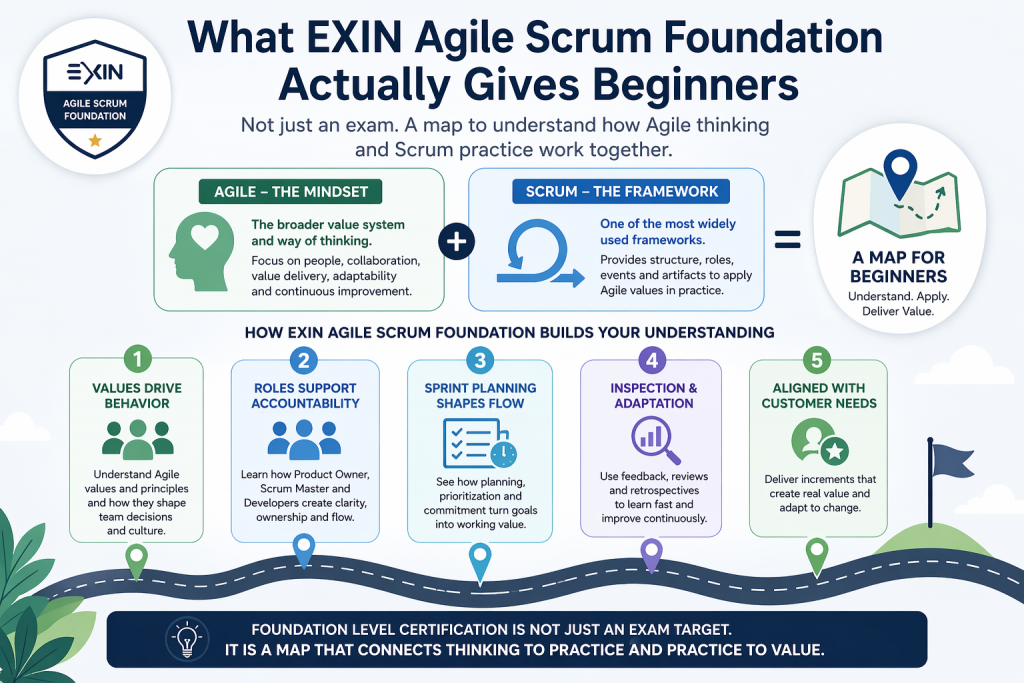
EXIN positions Agile Scrum Foundation as an entry-level certification that combines Agile principles with Scrum practices in one track. That combination is useful for beginners because many people confuse Agile and Scrum. Agile is the wider mindset and value system. Scrum is one of the most widely used frameworks used to apply that mindset in a structured way. EXIN’s syllabus reflects that distinction by covering both thinking and practice.
For a beginner, that creates a cleaner learning curve. Instead of memorizing terms in isolation, you start to understand how values drive team behavior, how roles support accountability, how sprint planning shapes flow, and how inspection and adaptation keep work aligned with customer needs. This is why foundation-level certification is not just an exam target. It is a map.
The beginner-to-pro roadmap
Below is a practical roadmap that works for fresh graduates, career changers, project coordinators, business analysts, QA professionals, delivery leads, and team members entering Agile environments.
| Stage | Goal | What to Learn | Output You Should Have |
|---|---|---|---|
| Stage 1 | Understand the mindset | Agile values, iterative delivery, customer feedback, adaptability | You can explain Agile in plain language |
| Stage 2 | Learn Scrum basics | Roles, events, artifacts, timeboxes, backlog flow | You can participate in a Scrum team discussion |
| Stage 3 | Build work habits | Prioritization, estimation, visual tracking, collaboration | You can work in sprints without confusion |
| Stage 4 | Practice in small projects | User stories, sprint goals, reviews, retrospectives | You can connect theory to delivery |
| Stage 5 | Earn foundation certification | EXIN Agile Scrum Foundation exam prep | You validate your fundamentals |
| Stage 6 | Apply in the workplace | Facilitation, stakeholder communication, team improvement | You start showing measurable Agile behavior |
| Stage 7 | Grow into an Agile pro | Product thinking, coaching mindset, metrics, scaling awareness | You influence outcomes, not just ceremonies |
Stage 1: Learn the Agile mindset before the mechanics
Many beginners rush to questions like: What is a sprint? How long should a stand-up be? What tool should we use? Those questions matter, but not first.
Start with these core ideas:
- deliver in small increments
- get feedback early
- adapt based on evidence
- collaborate across roles
- focus on customer value over internal activity
- treat change as a normal condition, not a failure of planning
McKinsey describes Agile operating models as characterized by rapid learning and decision-making cycles. That phrase captures the mindset well. Agile teams do not wait for perfect certainty. They move in short loops, inspect the result, and improve.
Example:
A beginner project team building an employee onboarding portal could spend three months documenting every possible feature. An Agile team would release a smaller version first: welcome workflow, document upload, and manager checklist. Then it would refine based on actual employee and HR feedback. The second team usually learns faster and wastes less effort.
Stage 2: Understand Scrum as the beginner’s operating system
The Scrum Guide says each element of the framework serves a specific purpose and that changing the core design or leaving out elements can hide problems and reduce benefits. This is why beginners should learn Scrum properly instead of using diluted versions like “daily stand-up only” or “sprints without reviews.”
Here is the simplest way to understand Scrum:
Roles
- Product Owner: owns priorities and value
- Scrum Master: supports the process and removes impediments
- Developers: build the increment
Events
- Sprint
- Sprint Planning
- Daily Scrum
- Sprint Review
- Sprint Retrospective
Artifacts
- Product Backlog
- Sprint Backlog
- Increment
EXIN’s official page aligns with this by emphasizing Scrum practices, planning and estimation, project monitoring, and advanced concepts as key subject areas in the foundation certification.
Solution for beginners:
Do not try to master all advanced Agile frameworks at once. Learn one clean Scrum cycle first. If you can run one healthy sprint, you are already ahead of many teams that only use Agile vocabulary.
Stage 3: Build practical beginner skills that employers actually notice
Certification helps, but visible work habits matter more in the first 90 days of an Agile role.
Focus on these skills:
| Skill | What beginners often do | What Agile pros do |
|---|---|---|
| Prioritization | Treat every task as urgent | Rank work by value and urgency |
| Estimation | Guess effort casually | Use a shared team method consistently |
| Communication | Report activity | Explain progress, blockers, and next steps |
| Collaboration | Work in silos | Seek quick feedback from peers and stakeholders |
| Retrospectives | Discuss problems only | Turn lessons into one or two clear actions |
| Delivery | Wait for big handoff moments | Ship small, useful increments often |
A useful beginner mantra is this: clarity beats complexity. If you cannot explain the sprint goal, the backlog priority, and the current blocker in one minute, your team probably needs better alignment.
Stage 4: Practice Agile in a low-risk way
The best transition from beginner to confident practitioner is not theory alone. It is repeated practice in small scenarios.
Try this four-week learning sprint:
Week 1: Learn Agile values and Scrum structure
Week 2: Write 10 sample user stories for a familiar product
Week 3: Run a mock sprint plan and daily sync
Week 4: Conduct a review and retrospective on your own learning project
Example project ideas
- redesign a training registration workflow
- create a blog publishing calendar
- improve a customer support ticket queue
- plan a website landing page release
- build a simple internal knowledge hub
This works because Scrum is easier to understand when tied to real deliverables. EXIN also recommends the Agile Scrum Handbook and the 2020 Scrum Guide as required reading for the foundation certification, which makes practical study even more important.
Stage 5: Use EXIN Agile Scrum Foundation as your validation point
At this stage, certification becomes valuable. Not because the certificate alone makes you an expert, but because it confirms that your basics are structured and credible.
EXIN presents Agile Scrum Foundation as suitable for professionals leading or participating in projects, and not just for dedicated Scrum Masters. That broad positioning helps beginners because it fits multiple career paths: coordinator, analyst, team member, delivery support, service management, or early-career project professional.
Why the certification helps
- It gives your learning a defined syllabus.
- It proves baseline understanding to employers and clients.
- It reduces confusion between Agile concepts and Scrum practices.
- It creates a bridge to more advanced Agile roles later.
- It helps non-technical professionals enter Agile conversations with confidence.
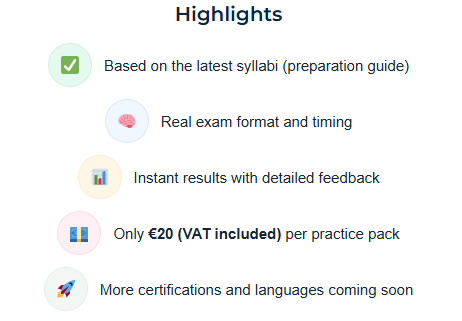
EXIN has also launched a Practice Portal and notes that practice packs are currently available for the Agile Scrum Foundation exam in English. That is useful for learners who want realistic preparation before sitting the exam.
Source: EXIN Practice Portal
Stage 6: Move from certified learner to workplace contributor
This is where many people stall. They pass the exam, add the badge to LinkedIn, and stop there. But the real jump from beginner to pro happens after certification.
Here is what you should do next:
1. Join actual delivery conversations
Volunteer to support backlog reviews, sprint planning sessions, or release check-ins.
2. Track one improvement metric
For example:
- cycle time
- carry-over work
- blocked tasks
- review feedback turnaround
- story clarity defects
3. Ask stronger questions
Instead of “What am I supposed to do?” ask:
- What is the user outcome here?
- What is the sprint goal?
- What is blocking flow?
- What can we simplify?
4. Improve one ceremony at a time
A pro does not add noise. A pro improves signal.
Scrum Alliance’s 2025 report stresses the rise of the “modern agile professional” with broader skills that support organizations through disruption, AI adoption, and change. That is a strong cue for certified beginners: your future value will come from adaptability and practical impact, not from jargon alone.
Stage 7: What an Agile pro looks like
An Agile pro is not just someone who knows terms like product backlog, velocity, and timebox. A true Agile professional usually does five things well:
- turns ambiguity into prioritized work
- keeps teams focused on customer value
- encourages transparency without blame
- improves team learning through inspection and adaptation
- understands that Agile must serve business outcomes, not ceremony compliance
PMI’s 2025 findings on business acumen are especially relevant here. High-performing professionals achieved better outcomes not simply through process discipline, but by combining delivery capability with business understanding. That is exactly the growth path from foundation learner to trusted Agile practitioner.
Common beginner mistakes and how to fix them
| Mistake | Why it hurts | Better approach |
|---|---|---|
| Copying ceremonies without mindset | Teams go through motions without learning | Start with purpose, then process |
| Treating Scrum Master as a boss | Creates dependency and weak ownership | Keep accountability distributed |
| Overloading every sprint | Reduces predictability and morale | Commit less, finish better |
| Skipping retrospectives | Problems repeat silently | Use one action item per sprint |
| Measuring only speed | Teams may ship low-value work | Track value, quality, and learning |
| Assuming AI will solve coordination | Human collaboration gaps remain | Use AI as support, not replacement |
Scrum Alliance’s guidance on scaling challenges in 2025 warns against teams drifting away from inter-team collaboration because they assume AI will handle dependency management and communication. It will not. Human clarity, trust, and decision-making still matter.
A simple 90-day action plan
First 30 days
- study Agile values and Scrum basics
- read the Scrum Guide
- map one sample project into backlog, sprint, review, and retro
- begin EXIN Agile Scrum Foundation preparation
Days 31–60
- take practice assessments
- shadow or observe Agile team meetings if possible
- write user stories and acceptance criteria
- learn estimation and sprint goal setting
Days 61–90
- take the certification exam
- apply one Agile practice in a real project
- run or support one retrospective
- document one measurable improvement you helped create
That sequence is realistic, fast enough for momentum, and structured enough for retention.
FAQs
1. Is Agile Scrum Foundation good for beginners?
Yes. EXIN positions Agile Scrum Foundation as a certification for professionals who need fundamental understanding of Agile principles and Scrum methodology. It fits beginners, project participants, and professionals moving into Agile environments.
2. What is the difference between Agile and Scrum?
Agile is the broader mindset and value system focused on adaptability, customer feedback, and iterative delivery. Scrum is a structured framework used to apply Agile principles through defined roles, events, and artifacts.
3. Do I need coding knowledge for Agile Scrum Foundation?
No. EXIN says the certification is relevant not only to software development but also to project management, IT service management, and business management. That makes it useful for both technical and non-technical professionals.
4. Does Agile certification help in non-software roles?
Yes. Scrum Alliance’s 2025 report highlights that agility is expanding beyond narrow roles into broader cross-functional capabilities. Many business, operations, service, delivery, and transformation roles now benefit from Agile knowledge.
5. What should I do after passing Agile Scrum Foundation?
Use the certification as a starting point, not the finish line. Practice backlog prioritization, sprint planning, reviews, and retrospectives in real work. Then build business acumen, stakeholder skills, and delivery metrics to move toward advanced Agile roles.
Conclusion
The journey from beginner to Agile pro does not happen through vocabulary, tools, or certificates alone. It happens when you combine Agile thinking, Scrum discipline, real project practice, and business awareness. EXIN Agile Scrum Foundation is a strong place to start because it gives structure to your learning, validates your fundamentals, and helps you enter Agile conversations with confidence. From there, the real growth comes from how you apply it: prioritizing better, learning faster, collaborating more clearly, and delivering value in smaller, smarter increments.