

Introduction
ITIL has entered a new phase with ITIL Foundation (Version 5), and many certified professionals are asking one important question: Do I need to upgrade from ITIL 4 to ITIL 5 immediately? The simple answer is no, but the smarter answer is that professionals and organizations should plan the transition carefully.
PeopleCert explains that ITIL Version 5 builds on ITIL 4 rather than replacing the value of existing certifications. Existing ITIL knowledge remains relevant, while the new version reflects today’s AI-enabled, product-centric, and digital service management environment.
Source: Bridge your skills, elevate your impact
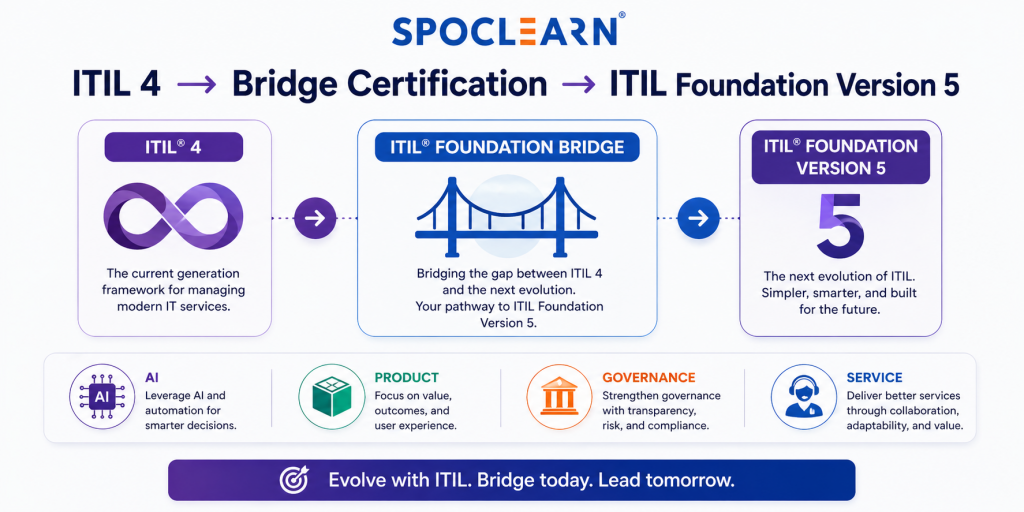
For ITIL 4 certified professionals, the ITIL Foundation Bridge (Version 5) is the most practical transition route. It focuses only on what has changed, including updated terminology, digital product and service management, AI complexity, and enhanced value creation.
What is ITIL Foundation Version 5?
ITIL Foundation Version 5 is the updated entry-level ITIL certification designed for modern digital product and service management. PeopleCert describes the new ITIL as AI-native by design, with guidance for scaling AI responsibly, improving governance, and aligning digital products and services with measurable business value.
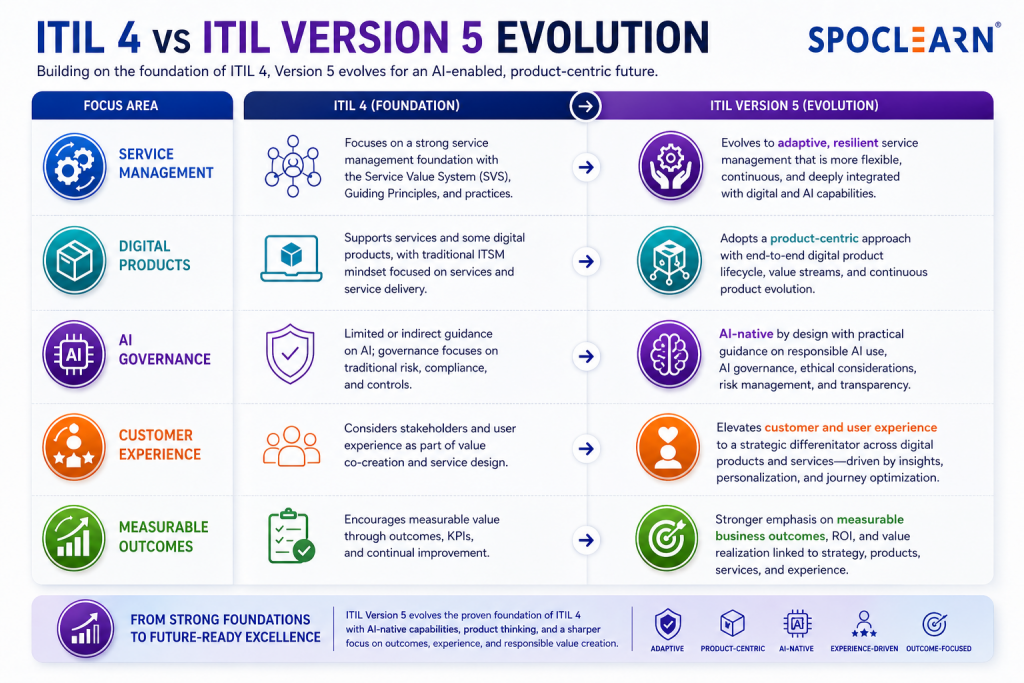
Unlike older ITSM-focused interpretations, ITIL Version 5 expands the conversation from “managing IT services” to “managing digital products, services, experiences, and transformation.” This matters because businesses now operate with cloud platforms, automation, AI-enabled workflows, data products, customer experience platforms, and cross-functional product teams.
A service desk example explains this well. Under ITIL 4, a company may focus on incident management, service request handling, and continual improvement. Under ITIL Version 5, the same company must also think about AI-driven ticket triage, digital experience, product lifecycle, governance, responsible automation, and outcome-based value.
ITIL 4 vs ITIL Version 5: Key Differences
| Area | ITIL 4 Focus | ITIL Version 5 Focus |
|---|---|---|
| Core direction | Service value system and ITSM practices | Digital product and service management |
| Technology context | Digital transformation, Agile, DevOps, cloud | AI-enabled, product-centric, adaptive operations |
| Value creation | Co-creating value through services | Connecting strategy, products, services, experience, and measurable outcomes |
| Professional relevance | ITSM, service delivery, operations | Product, service, experience, strategy, transformation, and AI governance |
| Learning path | ITIL 4 Foundation and advanced modules | Foundation, Product, Service, Experience, Transformation, and future modules |
PeopleCert states that ITIL Version 5 provides guidance across leadership, strategy, and day-to-day operations, helping teams collaborate and create value in both stable and fast-changing environments.
What is the ITIL Foundation Bridge Version 5 Certification?
The ITIL Foundation Bridge (Version 5) is designed for professionals who already hold ITIL 4 Foundation and want a faster, more focused upgrade route. PeopleCert describes it as a cost-effective way for ITIL 4 Foundation holders to catch up on the latest Foundation-level updates and upgrade to ITIL Foundation Version 5 Certification by passing a short exam.
ITIL Foundation Bridge Exam Details
| Exam Component | Details |
|---|---|
| Exam name | ITIL Foundation Bridge (Version 5) |
| Target audience | ITIL 4 certified professionals |
| Questions | 20 multiple-choice questions |
| Duration | 30 minutes |
| Format | Closed book |
| Passing score | 65% |
| Languages listed by PeopleCert | English, Chinese, Portuguese (Brazil), Spanish |
| Focus | ITIL Version 5 updates only |
PeopleCert lists the Bridge exam as 20 multiple-choice questions, 30 minutes, closed book, with a 65% minimum passing score.
ITIL 5 Bridge Certification Cost
The official PeopleCert UK listing shows the ITIL Foundation Bridge Version 5 exam bundle at £146 including VAT. Pricing may vary by country, tax rules, currency, partner, and whether learners choose self-study, eLearning, classroom training, or corporate batch delivery.
| Cost Element | What to Consider |
|---|---|
| Exam bundle | Official PeopleCert pricing varies by country |
| Training cost | Depends on ATO, delivery mode, batch size, and location |
| eBook/materials | Usually included in official bundles |
| Resit option | May require additional Take2/resit cost |
| Corporate batches | Often priced per learner or per batch |
| Rescheduling | PeopleCert lists rescheduling fees if changes are made late, including USD 60 from 48h to 4h before the exam and USD 120 after that window. |
Are There Any ITIL 4 to ITIL 5 Deadlines?
As of the latest official PeopleCert information, there is no universal public deadline requiring all ITIL 4 certified professionals to move to ITIL Version 5 immediately. PeopleCert states that ITIL 4 remains available for those who want to continue their current certification journey, while ITIL Version 5 is being introduced through a gradual, phased release.
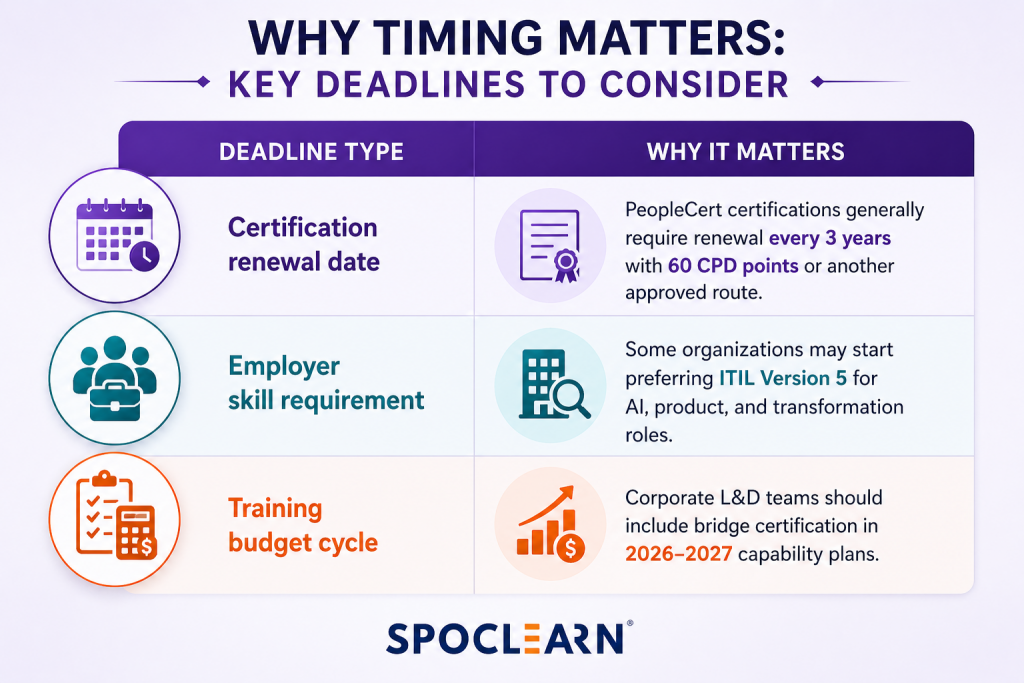
However, professionals should watch three practical deadlines:
Strategic Upgrade Plan for Individuals
Step 1: Check your current ITIL status.
If you only have ITIL 4 Foundation, the Bridge exam is likely the fastest route. If you already hold advanced ITIL 4 certifications, map your next career goal before choosing Version 5 modules.
Step 2: Decide your career direction.
Choose ITIL Product if you work with product owners, digital product managers, enterprise architects, or service delivery leaders. PeopleCert states that ITIL Product Version 5 focuses on lifecycle management, stakeholder alignment, evidence-based decisions, and digital product/service outcomes.
Step 3: Study only the differences.
The Bridge exam exists because ITIL 4 professionals do not need to repeat the full Foundation syllabus. Focus on updated language, digital product/service management, AI-enabled complexity, and value-focused practice.
Step 4: Take mock tests.
Because the Bridge exam has only 20 questions, each question carries high weight. A small error rate can affect the result quickly.
Step 5: Update your profile.
After passing, add “ITIL Foundation (Version 5)” and keywords such as ITSM, digital product management, AI governance, service management, value streams, and digital transformation.
Strategic Upgrade Plan for Enterprises
| Phase | Action | Outcome |
|---|---|---|
| Phase 1 | Audit current ITIL 4 certified employees | Identify bridge-ready professionals |
| Phase 2 | Group learners by role | Separate service desk, service managers, product owners, transformation leaders |
| Phase 3 | Run 1-day bridge workshops | Reduce disruption and training time |
| Phase 4 | Align Version 5 with AI governance | Improve responsible AI adoption |
| Phase 5 | Build internal playbooks | Convert certification learning into operational improvement |
For enterprises, the upgrade should not be treated only as a certification exercise. It should connect to practical business goals such as lower incident recurrence, faster service delivery, better digital experience, improved AI governance, and clearer product ownership.
Gartner forecasted worldwide IT spending to reach $6.15 trillion in 2026, up 10.8% from 2025, with AI infrastructure growth remaining rapid. This reinforces why ITIL Version 5’s AI-native and product-service lifecycle focus is timely for enterprise IT teams.
Industry Leader Perspective
Satya Nadella has repeatedly emphasized responsible AI and trust. In a 2025 annual letter report, he wrote that “people want technology they can trust,” highlighting respect, integrity, and accountability as essential principles for AI innovation.
That idea fits strongly with ITIL Version 5. The future of ITSM is not only about speed. It is about trusted digital operations, transparent governance, measurable value, and responsible AI-enabled service delivery.
Accenture also reported that generative AI could affect 44% of working hours across industries in the U.S. and create at least $8 trillion in global economic value. For ITIL professionals, this means AI will reshape service desks, incident management, knowledge management, change enablement, product lifecycle decisions, and customer support models.
Common Transition Mistakes to Avoid
| Mistake | Better Approach |
|---|---|
| Assuming ITIL 4 is obsolete | Treat ITIL 4 as the foundation and Version 5 as an evolution |
| Waiting until employer mandates it | Upgrade early if you work in AI, cloud, product, or transformation roles |
| Buying the wrong exam | Choose Bridge only if you already hold eligible ITIL 4 certification |
| Studying the full Foundation again unnecessarily | Focus on what changed in Version 5 |
| Ignoring renewal | Track CPD and 3-year renewal requirements |
FAQs
1. Is ITIL 5 officially available?
Yes. PeopleCert now offers ITIL Foundation Version 5, ITIL Foundation Bridge Version 5, ITIL Product Version 5, and additional Version 5 pathways. The rollout is phased, with several certifications already available while others are scheduled for future release.
2. Do I need to retake full Foundation if I already have ITIL 4?
The ITIL Foundation Bridge Version 5 exam requires a minimum 65% score to pass. It consists of 20 multiple-choice questions, must be completed within 30 minutes, and is closed book, meaning no study materials or external references are allowed.
3. What is the ITIL Foundation Bridge Version 5 pass mark?
The ITIL Foundation Bridge Version 5 exam is designed for existing ITIL 4 Foundation holders and requires a minimum score of 65% to pass. Candidates must answer 20 multiple-choice questions within 30 minutes. The exam is closed book, meaning no study materials or reference guides are allowed during the assessment. Because of the short format, each question carries significant weight, making focused preparation on Version 5 updates essential for success.
4. Is ITIL 4 still valid?
Yes. PeopleCert confirms ITIL 4 certifications remain valid, respected, and professionally valuable. Current ITIL 4 holders do not lose their credentials, as ITIL 4 continues alongside the phased rollout of ITIL Version 5, allowing professionals and organizations to transition strategically.
5. Who should upgrade first?
Service managers, IT operations leaders, digital product managers, enterprise architects, transformation specialists, product owners, and AI-enabled ITSM professionals should prioritize ITIL Version 5 early, as it strengthens expertise in AI governance, digital product lifecycle, customer experience, strategic transformation, and measurable business outcomes.
Conclusion
The ITIL 4 to ITIL 5 transition is not a forced reset; it is a strategic upgrade. ITIL 4 professionals already have a strong base in service management, value co-creation, practices, and continual improvement. ITIL Foundation Version 5 adds the next layer: AI-native thinking, digital product and service lifecycle management, stronger value alignment, and clearer relevance for modern enterprise roles.
For individuals, the ITIL Foundation Bridge Version 5 certification is the fastest route to stay current, improve employability, and align with high-demand roles in ITSM, digital transformation, AI governance, product management, service delivery, and enterprise architecture. For organizations, the upgrade plan should connect certification with business outcomes such as better service reliability, improved digital experience, faster transformation, responsible AI adoption, and measurable value delivery.