


Cybersecurity, IT governance, compliance, and digital risk management are evolving faster than ever. As organizations strengthen their security posture and regulatory frameworks, demand for Certified Information Systems Auditor (CISA) professionals continues to grow globally. From banking and healthcare to cloud computing and government sectors, companies actively seek professionals who can audit, assess, and secure enterprise systems.
According to ISACA, more than 151,000 professionals worldwide now hold the CISA certification, while certified professionals report average salaries exceeding $149K globally in senior roles.
If you are planning to build a career in IT audit, cybersecurity assurance, governance, compliance, or risk management, this guide explains the exact roadmap to become CISA certified in 2026 — from beginner level to expert career growth.
What is CISA Certification?
The Certified Information Systems Auditor (CISA) certification is one of the world’s most recognized credentials for professionals involved in:
- IT Auditing
- Information Security
- Risk Management
- Governance
- Compliance
- IT Controls
ISACA introduced CISA to validate expertise in auditing and controlling enterprise information systems. Today, global enterprises consider it a benchmark certification for IT audit and governance professionals.
Why CISA Certification Matters in 2026
The cybersecurity and compliance landscape has changed significantly after the rise of:
- AI-driven cyberattacks
- Cloud-native infrastructure
- Global compliance regulations
- Enterprise digital transformation
- Zero Trust security models
As a result, organizations now prioritize professionals who understand both technical systems and governance frameworks.
Recent industry projections also show cybersecurity and information assurance roles continuing to grow strongly through 2030.
Who Should Pursue CISA Certification?
CISA is ideal for professionals working in:
- IT Audit
- Cybersecurity
- Governance, Risk & Compliance (GRC)
- IT Assurance
- Internal Audit
- Information Security
- Risk Advisory
- Cloud Security Governance
It is also highly valuable for:
- Fresh graduates entering cybersecurity
- SOC analysts transitioning into governance
- Compliance professionals
- Consultants
- ERP auditors
- IT managers
Step-by-Step CISA Certification Roadmap for 2026
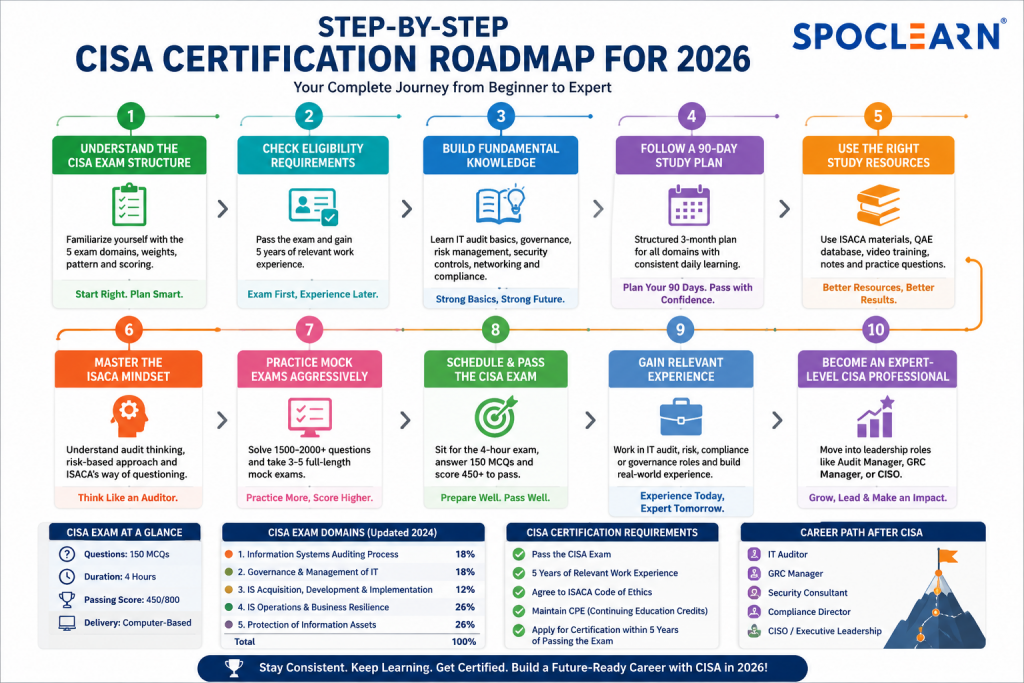
Step 1: Understand the CISA Exam Structure
Before starting preparation, understand the exam domains and pattern.
The current CISA exam follows the updated ISACA blueprint implemented after August 2024.
CISA Exam Domains
| Domain | Weightage |
|---|---|
| Information Systems Auditing Process | 18% |
| Governance & Management of IT | 18% |
| IS Acquisition, Development & Implementation | 12% |
| IS Operations & Business Resilience | 26% |
| Protection of Information Assets | 26% |
Step 2: Learn the CISA Eligibility Requirements
Many beginners believe they cannot start CISA without experience. That is incorrect.
You can take the exam first and complete experience requirements later.
Official Requirements
According to ISACA, candidates need:
- Pass the CISA Exam
- 5 years of relevant work experience
- Agree to ISACA Code of Ethics
- Maintain continuing education credits (CPE)
- Submit certification application within 5 years of passing the exam
Experience Waivers
ISACA allows waivers up to 3 years for:
- University degrees
- Related certifications
- Relevant teaching experience
Step 3: Build Fundamental Knowledge (Beginner Phase)
If you are new to IT audit or cybersecurity, begin with fundamentals.
Focus Areas
- Networking basics
- Information security principles
- Risk management
- Compliance frameworks
- IT governance
- Cloud fundamentals
- Security controls
This foundation makes advanced CISA concepts significantly easier.
Step 4: Create a 90-Day CISA Study Plan
A structured study strategy dramatically improves passing chances.
Recommended Timeline
Month 1
- Study Domain 1 & 2
- Understand audit methodology
- Learn governance frameworks
Month 2
- Study Domain 3 & 4
- Focus on operations, resilience, DR, and business continuity
Month 3
- Study Domain 5
- Solve mock exams
- Practice time management
Step 5: Use the Right CISA Study Resources
The quality of your preparation materials directly impacts exam performance.
Recommended Resources
Official Resources
- ISACA Review Manual
- QAE Database
- Official practice tests
Supplementary Resources
- Video training
- Live instructor-led classes
- Domain summary notes
- Flashcards
- Case studies
Step 6: Master the “ISACA Mindset”
This is where many candidates struggle.
The CISA exam does not simply test technical knowledge. It evaluates:
- Audit judgment
- Risk prioritization
- Governance thinking
- Control effectiveness
Several expert guides emphasize that successful candidates learn how ISACA expects professionals to think during audit scenarios.
Step 7: Practice Mock Exams Aggressively
Mock tests improve:
- Time management
- Question interpretation
- Domain confidence
- Weak area identification
Recommended Target
- 1500–2000 practice questions
- 3–5 full-length mocks
- Domain-based revision tests
Step 8: Schedule and Pass the CISA Exam
CISA Exam Format
| Component | Details |
|---|---|
| Questions | 150 MCQs |
| Duration | 4 Hours |
| Passing Score | 450/800 |
| Delivery | Computer-Based |
Step 9: Gain Relevant Experience
After passing the exam, focus on practical exposure.
Recommended Roles
- IT Auditor
- Information Security Analyst
- Risk Analyst
- Compliance Specialist
- GRC Consultant
- Cybersecurity Auditor
- Internal Auditor
Step 10: Become an Expert-Level CISA Professional
Once certified, continue expanding into advanced governance and cybersecurity leadership roles.
Advanced Career Paths
| Career Path | Growth Direction |
|---|---|
| IT Audit Manager | Enterprise Audit Leadership |
| GRC Manager | Governance & Risk |
| Security Consultant | Advisory Services |
| Compliance Director | Regulatory Leadership |
| CISO Track | Executive Security Leadership |
CISA Salary Trends in 2026
CISA-certified professionals continue to command strong salary growth worldwide.
Global Salary Insights
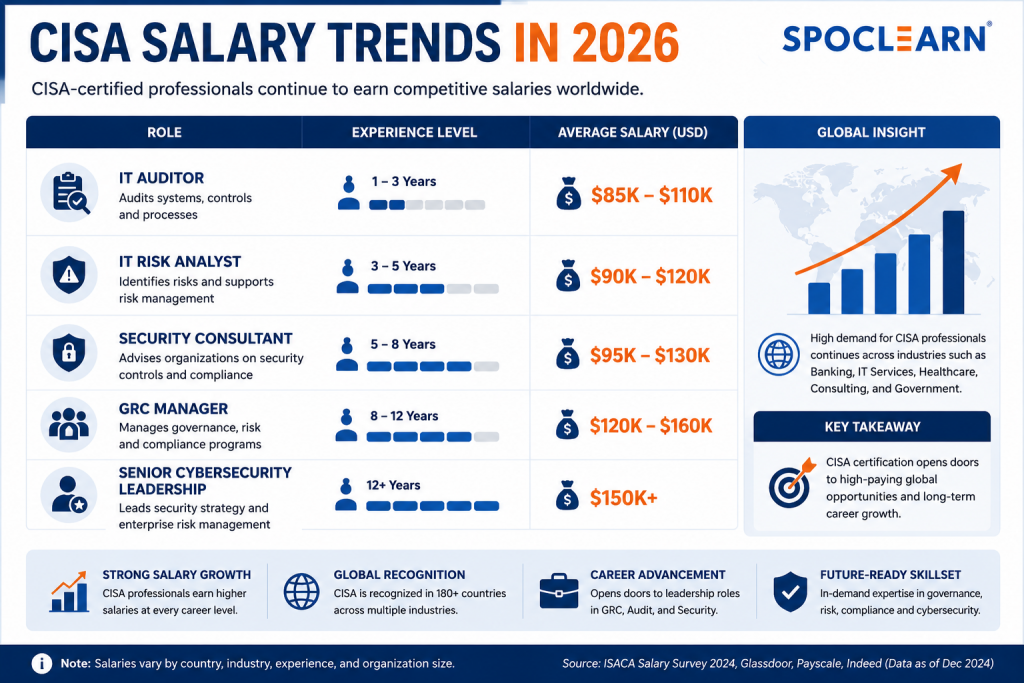
Source: ISACA Salary Insights, Glassdoor, Payscale, and Indeed Global Salary Trends (2025–2026 Estimates).
Common Mistakes to Avoid During CISA Preparation
1. Memorizing Instead of Understanding
The exam focuses heavily on practical judgment.
2. Ignoring Governance Concepts
Many candidates over-focus on technical security topics.
3. Skipping Mock Tests
Practice exams are essential for success.
4. Poor Time Management
The 4-hour exam becomes difficult without pacing strategies.
5. Not Understanding ISACA Language
ISACA questions often prioritize governance and risk-based thinking.
Best Career Opportunities After CISA
CISA opens opportunities across multiple industries:
- Banking & Financial Services
- Consulting
- Healthcare
- Government
- Cloud & SaaS
- Telecom
- Manufacturing
- Enterprise Technology
Organizations globally continue hiring professionals who understand IT governance, auditing, and cybersecurity compliance.
Future Scope of CISA Certification
The future looks exceptionally strong for CISA-certified professionals because enterprises now prioritize:
- Risk visibility
- Cyber resilience
- AI governance
- Cloud audit readiness
- Regulatory compliance
As AI adoption increases, governance and assurance professionals will become even more important.
FAQ’s
1. Is CISA certification worth it in 2026?
Yes, CISA certification remains one of the most valuable credentials for professionals working in IT audit, cybersecurity governance, risk management, and compliance. Organizations worldwide continue hiring CISA-certified professionals to strengthen security controls, regulatory compliance, and enterprise risk management. The certification also helps professionals access higher-paying roles in banking, consulting, healthcare, cloud security, and government sectors.
2. Can beginners take the CISA certification exam without experience?
Yes. Beginners can take the CISA exam before completing the required work experience. According to ISACA, candidates can pass the exam first and later gain the required professional experience within five years. This flexibility makes CISA an excellent certification for students, fresh graduates, and early-career cybersecurity professionals.
3. How long does it take to prepare for the CISA exam?
Most candidates prepare for the CISA exam within 2 to 4 months depending on their professional background and study consistency. Professionals with prior experience in cybersecurity, IT governance, auditing, or compliance may require less preparation time. A structured study plan combined with mock exams and practice questions significantly improves passing chances.
4. What jobs can I get after earning a CISA certification?
After earning CISA certification, professionals can pursue roles such as IT Auditor, Information Security Analyst, GRC Consultant, Risk Analyst, Compliance Manager, Cybersecurity Auditor, and IT Governance Specialist. Many global enterprises also prefer CISA-certified candidates for senior governance and audit leadership positions because of their expertise in risk assessment and information system controls.
5. Which is better: CISA, CISM, or CISSP?
The best certification depends on your career goals. CISA focuses primarily on IT auditing, governance, risk management, and compliance. CISM emphasizes cybersecurity management and leadership, while CISSP concentrates on advanced technical cybersecurity architecture and operations. Professionals interested in IT audit and governance generally choose CISA, whereas security leadership professionals often pursue CISM or CISSP later in their careers.
6. Does CISA require coding knowledge
No, CISA certification does not require coding knowledge. The exam focuses on IT auditing, governance, cybersecurity controls, compliance, and risk management rather than programming. Basic understanding of networking, cloud, and security concepts helps, but non-technical professionals can also successfully pursue ISACA CISA certification.
Conclusion
The Step-by-Step CISA Certification Roadmap for 2026 helps professionals build expertise in IT auditing, cybersecurity governance, risk management, and compliance from beginner to expert level. As organizations strengthen cloud security, AI governance, and enterprise risk frameworks, demand for CISA-certified professionals continues to rise globally across banking, healthcare, consulting, telecom, and technology sectors. By following a structured study plan, understanding ISACA methodologies, and practicing audit-based scenarios, candidates can improve career opportunities, salary growth, and long-term professional credibility in the cybersecurity and governance industry.
Professionals searching for the best cybersecurity certifications, IT audit roadmap, governance certifications, compliance certifications, and risk management training increasingly choose CISA because of its strong global recognition and career value. Alongside CISA preparation, Microsoft Excel certification can also help professionals strengthen audit reporting, compliance tracking, dashboard management, and enterprise data analysis capabilities. Combining governance expertise with analytical and reporting skills creates a stronger foundation for future leadership roles in cybersecurity, IT governance, and digital risk management.