

If you’ve tried to coordinate a “team of teams” and felt the strain of shifting dependencies, uneven cadence, and stakeholder pressures, you’ve met the challenge the SAFe® Release Train Engineer (RTE) is built to solve. In the Scaled Agile Framework (SAFe), the RTE is the servant leader and program-level coach who orchestrates the Agile Release Train (ART)—facilitating key events, unblocking flow, and guiding continuous improvement across multiple Agile teams. In simple terms, the RTE is the conductor who keeps dozens (often hundreds) of practitioners moving in step toward customer value. [framework….dagile.com], [storiesonboard.com]

Why the RTE role exists (and why it matters now)
Enterprises don’t ship outcomes through a single team; they coordinate teams of teams. SAFe provides an operating model to do that predictably, with the ART as a long‑lived unit (typically 5–12 teams) delivering in Program Increments (PI) of 8–12 weeks. The RTE exists because program-level coordination, impediment management, and synchronized cadence are essential to delivering at scale with fewer surprises and higher business predictability. [storiesonboard.com], [framework….dagile.com]
Beyond facilitation, RTEs coach leaders and teams to adopt Lean‑Agile ways of working—habits and metrics that sustain flow of value across complex systems. This aligns with broader digital‑transformation trends (AI, cloud, data) that demand fast, coordinated delivery across IT and business. [framework….dagile.com], [statista.com]

What is SAFe RTE? (Release Train Engineer) — A concise definition
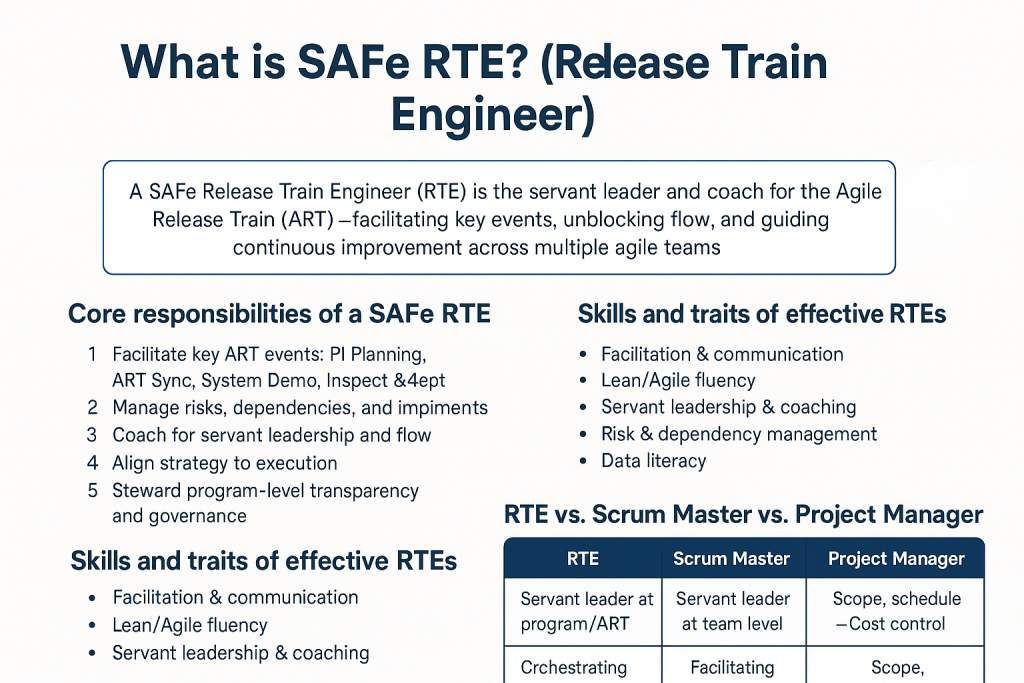
A SAFe Release Train Engineer (RTE) is the servant leader and coach for the ART. The RTE facilitates program-level events (PI Planning, ART Sync/Scrum of Scrums, PO Sync, System Demos, Inspect & Adapt), helps manage risks and dependencies, escalates impediments, maintains program visibility, and promotes relentless improvement. [framework….dagile.com], [agility.ac]
The Agile Release Train (ART) in brief
The ART is a long‑lived, cross‑functional “team of teams” that plans and delivers value in fixed‑length Program Increments. It synchronizes multiple teams around a shared cadence and backlog, reducing variability and exposing dependencies early. RTEs are central to keeping this train running on time and focused on outcomes. [storiesonboard.com]

Core responsibilities of a SAFe RTE
1) Facilitate key ART events
- PI Planning (every 8–12 weeks): The RTE prepares logistics and inputs (vision, roadmap, architecture runway), guides dependency mapping, enables risk identification, and ensures clear, measurable PI Objectives and a visible Program Board. [framework….dagile.com], [storiesonboard.com]
- ART Sync / Scrum of Scrums & PO Sync: Regular cross‑team alignment meetings to surface issues early and synchronize delivery with Product Management. [agility.ac]
- System Demos & Inspect & Adapt (I&A): Demonstrate integrated value and run structured problem‑solving workshops to drive actionable improvements for the next PI. [agility.ac]
2) Manage risks, dependencies, and impediments
The RTE visualizes cross‑team dependencies, tracks resolution, escalates surgically, and maintains program-level governance (risk registers, compliance checks). [framework….dagile.com], [leanwisdom.com]
3) Coach for servant leadership and flow
RTEs model servant leadership, nurture psychological safety, and use flow metrics (cycle time, WIP, throughput, predictability) to enable relentless improvement across the ART. [framework….dagile.com], [agility.ac]
4) Align strategy to execution
The RTE helps connect product vision, architecture runway, and capacity with iteration plans—so teams build the right things at the right cadence. [leanwisdom.com]
5) Steward program-level transparency
RTEs maintain visibility of program Kanban, feature flow, risks, and commitments, and collaborate with Business Owners on outcomes and compliance. [framework….dagile.com]

What the RTE does not do
- Does not prioritize features (that’s Product Management).
- Does not assign tasks (teams self‑organize).
- Does not micro‑control team processes beyond enforcing essential SAFe elements and enabling continuous improvement. [agility.ac]

Skills and traits of effective RTEs
- Large‑group facilitation & communication: running high‑stakes workshops, timeboxing, synthesis. [agility.ac]
- Lean/Agile fluency: systems thinking, value stream awareness, DevOps pipeline context. [framework….dagile.com]
- Servant leadership & coaching: enabling self‑management, cross‑functional collaboration, and psychological safety. [framework….dagile.com]
- Risk & dependency management: early visualization and structured escalation. [leanwisdom.com]
- Data literacy: using program flow and predictability metrics to drive improvement. [agility.ac]

Real‑world mini‑case: Coordinating omnichannel fulfillment
A retail platform plans omnichannel fulfillment across web, mobile, and partner marketplaces. Ten teams must deliver capabilities in the next PI. The RTE:
- Pre‑PI readiness: convenes Product Management & System Architect to clarify vision and architecture runway; drafts agenda and inputs. [framework….dagile.com]
- PI Planning Day 1: facilitates feature breakdown, dependency mapping, and risk identification; teams draft measurable PI Objectives. [agility.ac]
- Program Board: visualizes dependencies (inventory sync, payment gateway upgrade) and risk mitigations with owners and dates. [agility.ac]
- During the PI: runs ART Syncs; monitors flow metrics; escalates integration impediments; ensures timely System Demos. [agility.ac]
- Inspect & Adapt: leads problem‑solving on late defects; captures improvement actions and assigns owners for the next PI. [agility.ac]

Geo‑targeted insights: What is SAFe RTE? (Release Train Engineer) in India/APAC
Distributed delivery realities: ARTs in India/APAC (e.g., Bengaluru, Pune, Hyderabad; Singapore; ANZ) often collaborate across time zones and vendor ecosystems. The RTE should design timezone‑inclusive cadences, alternate event timings, and apply virtual PI Planning practices to preserve equal participation and decision quality. [framework….dagile.com], [scaledagil…ations.com]
Regulatory landscape: BFSI and telecom programs require strict compliance checkpoints at PI boundaries. The RTE should formalize governance in the ART calendar and ensure Business Owner sign‑off at System Demos and I&A. [framework….dagile.com]
Talent density and partner delivery: India’s tech hubs frequently blend internal squads with partner vendors. RTEs benefit from standardized dependency visualization (Program Board) and explicit escalation paths that include vendor representatives. [agility.ac]

Business value: Why RTEs improve outcomes
Google’s Helpful Content guidance rewards people‑first, reliable content—a principle that mirrors people‑first delivery in product organizations. RTEs who focus on user value, transparency, and flow consistently drive better outcomes and predictability (less firefighting, more measurable business value). [developers…google.com]
From the marketing lens, independent data shows that websites/blog/SEO drive ROI for B2B brands, while email/content marketing performs strongly for B2C—evidence that disciplined, user‑focused delivery (mirrored by disciplined ART execution) aligns with growth. [hubspot.com]
Meanwhile, macro digital transformation trends underscore the need for scaled, coordinated delivery across IT and business—precisely where RTEs operate. [statista.com]
Metrics every RTE should track
- ART predictability: % of planned business value achieved per PI (rolled up from team objectives). [framework….dagile.com]
- Flow metrics: cycle/lead time, WIP, throughput, blocked time, and cumulative flow analysis at program level. [agility.ac]
- Dependency & risk trends: discovered at PI Planning vs. surfaced mid‑PI; time to resolution and escalation outcomes. [leanwisdom.com]
- Demo/release readiness: defects found post‑demo; % features meeting Definition of Done with compliance checks. [agility.ac]

RTE vs. Scrum Master vs. Project Manager (at a glance)
- Scrum Master: servant leader at team level—facilitates team ceremonies and improvement.
- RTE: servant leader at program/ART level—runs PI cadence, manages cross‑team flow and dependencies, and ensures program transparency.
- Traditional Project Manager: scope/schedule/cost control; in SAFe contexts, PM responsibilities are distributed among Product Management, RTE, and Business Owners to emphasize flow of value over task control. [framework….dagile.com], [agility.ac]
Actionable tips for businesses (India/APAC and global)
- Appoint the right RTE early
Select a facilitator‑coach with demonstrated servant leadership, comfort with large events, and literacy in program flow metrics; avoid command‑and‑control instincts. [framework….dagile.com] - Standardize your ART calendar and operating rhythm
Publish and protect the cadence: PI Planning, ART Syncs, System Demos, I&A. In distributed contexts (India–US/EU), alternate event times and record artifacts to equalize participation. [agility.ac] - Make dependencies visible from day zero
Use a Program Board and program Kanban; track resolution time and escalation paths. Involve vendors and compliance stakeholders as first‑class actors. [agility.ac] - Coach for outcomes, not outputs
Insist on measurable PI Objectives tied to customer value (e.g., conversion lift, latency reduction, CSAT). This echoes Google’s emphasis on helpful outcomes. [developers…google.com], [framework….dagile.com] - Instrument flow and learning
Adopt a small set of flow metrics; use System Demos and I&A workshops to close feedback loops. Reward early risk discovery, not late heroics. [agility.ac] - Connect delivery with discoverability
For customer‑facing releases, ensure product pages and docs reflect search intent and first‑hand experience (E‑E‑A‑T principles). That improves discoverability and trust. [moz.com], [moz.com]

FAQ on SAFe RTE (Release Traun Engineer)
Q1. What is SAFe RTE and what do they do?
The SAFe Release Train Engineer (RTE) is the servant leader and coach for the ART, facilitating PI Planning and program events, managing cross‑team risks/dependencies, and driving continuous improvement to deliver predictable value.
Q2. How often does an ART run PI Planning?
Typically every 8–12 weeks, establishing synchronized plans and measurable PI Objectives across teams.
Q3. RTE vs. Scrum Master—what’s the difference?
Scrum Masters serve a single team; RTEs serve the team of teams and coordinate program‑level flow, dependencies, and events.
Q4. Which metrics should an RTE track?
ART predictability (% business value achieved), flow (cycle/lead time, WIP, throughput), dependency/risk resolution time, and demo/release readiness.
Q5. Any special tips for India/APAC distributed ARTs?
Design timezone‑inclusive events, alternate session times, standardize escalation paths, and maintain a live Program Board to keep vendors and compliance stakeholders visible.
Final word
The SAFe RTE becomes indispensable the moment your organization shifts from agile teams to agile programs. By blending facilitation mastery, servant leadership, and a relentless focus on flow, RTEs enable synchronized delivery that’s more predictable, transparent, and outcome‑driven. Whether you’re scaling in India/APAC or globally, appoint the role early, standardize your ART cadence, make dependencies visible, and measure what matters—you’ll feel the difference in your next PI.