


Do you recall the moment when your office went paperless? Someone might have even celebrated the change. And yet, an expense approval still took nine days, except now the papers are not sitting on someone’s desk but waiting in an inbox.
Definition of Digital Waste in Business
Digital waste refers to any tool, task, or data that consumes money, attention, or time without generating value for the customer or organization. It can contribute to many inefficiencies in business.
The concept connects with Lean methodology, including the seven wastes commonly associated with Taiichi Ohno and the Toyota Production System. Many later Lean frameworks add an eighth waste: underused human talent. The same idea can also be applied to digital work and software-related waste.
Where Can Digital Waste Be Found in Business Processes?
You will find digital waste in business processes that have no clear owner. For example, an employee transferring numbers from one system to another is effectively acting as a human integration layer in the process. Paying for licenses assigned to employees who left a year ago, maintaining idle test servers without a clear purpose, or keeping dashboards created for a meeting held in 2022 may be a waste of money today.
Approval processes that have not rejected anything for a long time should be reviewed rather than automatically removed. If no one has reviewed a control for many years, find out whether it still manages a meaningful risk.
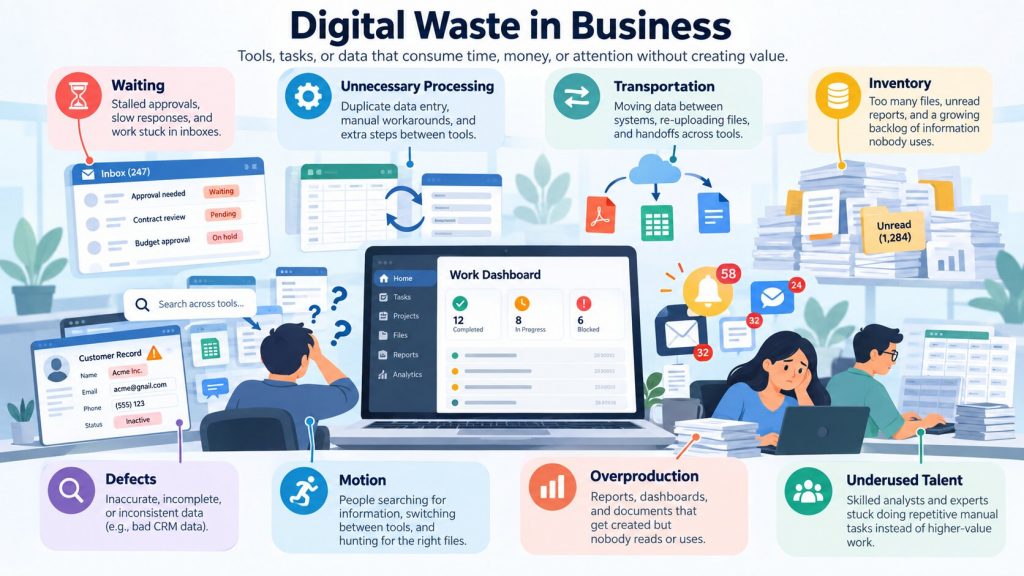
One often-overlooked digital transformation challenge is that software can speed up or automate parts of a process, including an unproductive one. A six-signature procedure may simply become digital and faster to route, but that does not make it more efficient or valuable.
| Lean waste | Digital equivalent |
| Waiting | Authorizations stalled in emails |
| Unnecessary processing | Repeated validation and duplicate data entry |
| Transportation | Transferring information from one app to another |
| Inventory | Unopened emails, files with no owner, and data that is not up to date |
| Defects | Incorrect data in the CRM and broken system connectivity |
| Motion | Searching for a file through various software programs |
| Overproduction | Documents no one reads |
| Underused talent | Analysts doing mundane tasks instead of providing solutions |
Several studies illustrate the scale of these inefficiencies. In its 2023 Anatomy of Work report, Asana reported that “work about work”- work coordination rather than skilled or strategic work—accounted for 58% of workers’ day. The report surveyed more than 9,615 knowledge workers across six countries.
How to reduce digital waste
- Pick a single genuine request. Follow its entire journey from trigger to completion. Take note of every system involved, every step along the way, and every delay. Compare the total lead time with the time taken to complete the actual task to identify where time is being spent.
- First, question whether each step is necessary, then simplify the steps that remain and finally automate suitable activities. Required legal, safety, security and compliance controls should not be removed merely to make a process faster. Automating a flawed process may simply speed up the mistakes, which is why this order matters in digital process improvement.
- Assign ownership to everything. Each integration, dashboard and shared folder should have a named owner and, where appropriate, a review date.
- Start with a small set of relevant metrics, such as process cycle efficiency, the number of manual touches, and license utilization. Process cycle efficiency compares value-added processing time with total lead time. Add quality, risk, compliance, or customer-experience measures when they matter to the process. A big dashboard that nobody looks at is also a form of overproduction.
Why Senior Managers Should Take Notice of Lean
Lean methodology asks whether a particular step creates value. It does not matter whether that step involves transporting a pallet or sending a document. Formal Lean training programs teach employees to recognize waste that is often overlooked, while training or certification in process improvement can provide a structured framework for questioning established practices.
Spoclearn’s Lean process improvement certification course can help professionals develop these skills.
FAQs
How do digital waste and technical debt differ?
Technical debt refers to the future cost created when a software or technical solution is designed or implemented with shortcuts, compromises, or deferred maintenance. Digital waste includes factors such as unnecessary approvals, duplicate data, unused subscription services, and unproductive electronic work.
How is a small business expected to handle process waste effectively without investing too much money in it?
As a first step, it makes sense to assess subscriptions and identify duplicate tools. Then, the next step is to choose a process based on its volume, delays, costs, errors, customer impact, etc., and analyze it. Getting rid of unnecessary tools and duplicated processes may be time-consuming but does not always require a considerable amount of money.
Is Lean methodology applicable outside of manufacturing?
Absolutely! Lean principles can be applied in a variety of repetitive administrative and service processes, including finance, healthcare, IT, customer support, and the public sector as well.