


Project managers do not lose control of major projects because they lack effort. They lose control because complexity compounds faster than visibility. More contractors, more interfaces, more procurement dependencies, more regulatory gates, more reporting pressure, and more executive scrutiny can turn a workable schedule into a fragile one. That is exactly why Primavera P6 still matters in 2026. Oracle continues to position Primavera P6 EPPM as a multiuser, multiproject platform for prioritizing, planning, managing, and executing projects and portfolios, while its current user documentation confirms that the product remains actively maintained, with Version 25 documentation published in December 2025.
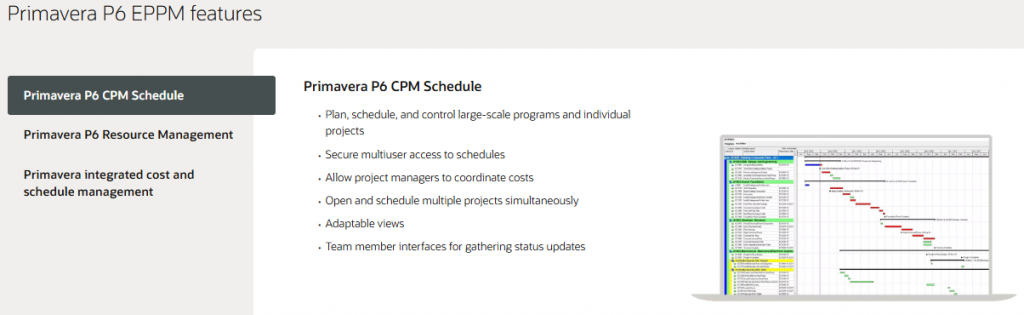
Source : Primavera P6 Enterprise Project Portfolio Management
The timing is right for mastering it. PMI reported in 2024 that the average project performance rate across respondents was 73.8%, hybrid ways of working had increased by 57% over the previous three years, and 64% of senior leaders said their teams needed new technical skills. By late 2025, PMI was also warning that only half of projects meet a modern definition of success, while 13% fail outright and 37% only partially deliver expected results. In other words, the pressure is not just to build schedules, but to build schedules that help organizations convert strategy into outcomes.
Pierre Le Manh, PMI’s President and CEO, put the challenge plainly: “If you want your strategy to work, you have to radically increase the hit rate of the projects that bring it to life.” That statement lands especially hard in capital-intensive sectors where schedule errors quickly become commercial errors. McKinsey has noted that large projects still overrun budgets and schedules by 30% to 45% on average, while KPMG’s 2023 Global Construction Survey found that only half of project owners’ projects were meeting completion deadlines and 37% of respondents missed budget and/or schedule targets due to ineffective risk management.
So mastering Primavera P6 is not about learning software menus. It is about learning a planning discipline that lets you model reality early, test assumptions before they become claims, and give leadership something better than a hopeful finish date.
What Primavera P6 actually does best in 2026
At its core, Primavera P6 is strongest where complexity is high and schedule logic matters. Oracle describes it as a solution for projects, programs, and portfolios of any size, with multiuser and multiproject functionality, support for hierarchies, resource scheduling, customizable views, and enterprise-wide planning. That makes it especially relevant for construction, infrastructure, oil and gas, utilities, manufacturing shutdowns, transportation, defense, and other environments where dozens or hundreds of activities interact across teams.
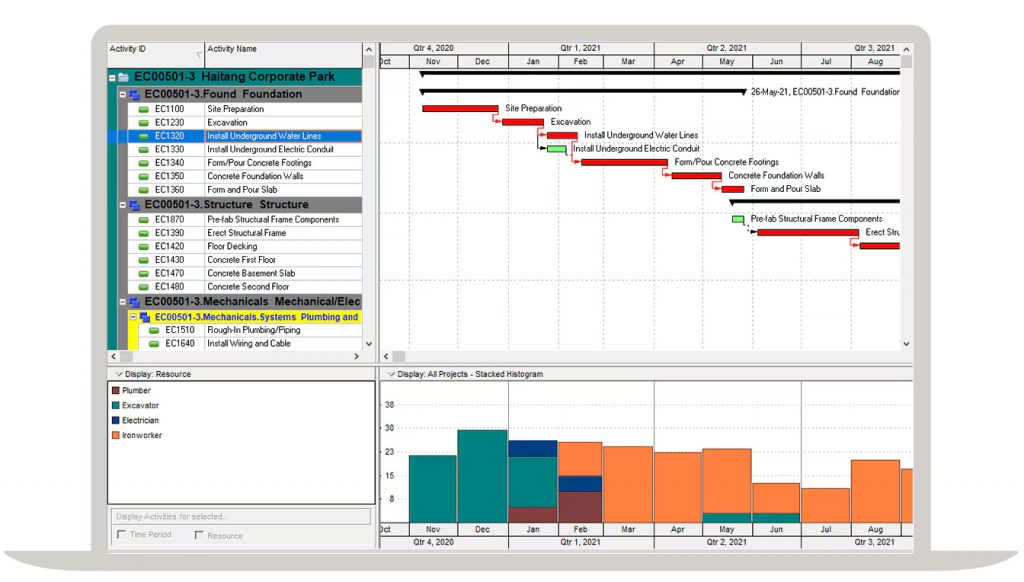
Source: Primavera P6 Enterprise Project Portfolio Management—Datasheet
It is also important to understand what P6 is not. Oracle is explicit that Oracle Primavera Cloud is not Primavera P6. Primavera Cloud is positioned as a shared planning, scheduling, resource, and risk management environment that connects office and field teams more directly. That distinction matters in 2026 because many enterprises now operate hybrid environments: P6 for mature schedule control on complex programs, and cloud-first tools for broader collaboration, field updates, or faster adoption. The smart project manager understands both the tool and the ecosystem around it.
Why Primavera P6 skills are commercially valuable now
The market is giving project managers more work, not less. In the United States, total construction spending in January 2026 was estimated at a seasonally adjusted annual rate of $2.190 trillion. In India, the government said its PAIMANA portal was tracking 1,948 infrastructure projects worth ₹41.98 lakh crore as of February 2026, while the National Infrastructure Pipeline framework had already outlined roughly ₹111 lakh crore of projected infrastructure investment across FY2020 to FY2025, heavily concentrated in energy, roads, urban development, and railways. Saudi Arabia’s Vision 2030 continues to drive large, multi-stakeholder transformation and infrastructure programs. All of that means more schedules, more baselines, more reporting cycles, and more demand for planners and project managers who can handle large-scale sequencing credibly.
A practical, step-by-step path to mastering Primavera P6
The mistake many learners make is trying to memorize every screen. The better path is to master P6 in layers.
Step 1: Learn the planning mindset before the software
Before opening P6, understand the difference between a task list and a schedule. A task list is a catalogue of work. A schedule is a logic-driven model of how work flows through time, constraints, calendars, resources, risks, approvals, and interfaces. PMI’s 2025 research stressed that project success increasingly depends on value delivery, stakeholder perception, and ongoing reassessment, not just task completion. In practice, that means your P6 schedule should be treated as a decision system, not an administrative document.
Start by becoming fluent in these five concepts:
| Concept | What it means in Primavera P6 | Why it matters |
|---|---|---|
| EPS | Enterprise Project Structure | Organizes projects across business units or portfolios |
| WBS | Work Breakdown Structure | Breaks the project into manageable control segments |
| Activities | The executable tasks | The building blocks of the schedule |
| Relationships | Logical links between activities | Drives sequencing and critical path |
| Baseline | Approved reference schedule | Enables variance tracking and governance |
These are not beginner-only topics. Even experienced users struggle when they skip structural discipline and jump straight into activity loading.
Step 2: Build a clean project structure
A strong Primavera P6 schedule starts with architecture. Set up the right EPS node, define a naming convention that survives reporting, and create a WBS that reflects how the project will actually be managed. Avoid a WBS that is too abstract for field use or too detailed for executive reporting. The sweet spot is control-oriented decomposition: enough detail to manage handoffs and measure progress, but not so much that the schedule becomes a maintenance burden.
A helpful rule is this: if the WBS cannot support owner reporting, contractor coordination, and internal accountability at the same time, it is not ready.
Step 3: Create activities with measurable intent
Each activity should answer a basic question: what exactly will be done, by whom, and how will completion be recognized? Vague activities such as “Mechanical Work” or “Review Documents” weaken schedule credibility. Better activities are concrete and observable, such as “Install chilled water piping – Zone A” or “Client IFC drawing review complete.”
When building activities, use durations that reflect realistic production assumptions. Inflated durations hide risk. Overly optimistic durations create fake float. The goal is not a pretty schedule. It is a believable one.
Step 4: Logic first, dates second
This is one of the most important habits in P6 mastery. Do not force dates until the logic network is sound. Enter predecessor and successor relationships carefully. Use finish-to-start where appropriate, but do not become lazy about it. Real projects often need start-to-start, finish-to-finish, and lag relationships to reflect reality.
A good test is this: if you delete all manual target dates and recalculate the schedule, does the sequence still make operational sense? If not, the model is date-driven rather than logic-driven, and that is dangerous.
McKinsey’s work on capital projects repeatedly points to poor upfront planning and weak understanding of sequencing as key contributors to slippage and rising costs. Primavera P6 becomes powerful when it helps expose those weaknesses early.
Step 5: Set calendars correctly
Many P6 users underestimate calendars. Yet calendars often explain why a schedule behaves strangely. Define project, resource, and global calendars deliberately. Distinguish between 5-day office work, 6-day site work, shift work, shutdown windows, holiday rules, and region-specific labor patterns.
For multinational or multi-country projects, this matters even more. A schedule covering India, the Gulf, and Europe cannot rely on a generic default calendar without creating false productivity assumptions.
Step 6: Establish the baseline early
A schedule without a baseline is only a draft. Once scope, logic, durations, and major milestones are approved, save the baseline and treat it as a governance anchor. Then compare current dates, actual progress, and forecast finish against that baseline regularly.
This is where Primavera P6 becomes valuable to executives. It does not just show where the project is. It shows where the project is relative to what was promised.
Step 7: Use critical path and float intelligently
Many users say they know critical path, but what they often know is how to display it, not how to interpret it. Real mastery means understanding why the critical path changes, which path is driving finish, where near-critical paths are forming, and how float is being consumed.
Do not manage only the red bars. Manage the activities that are about to become red bars.
This is especially relevant when KPMG reports that risk management remains a major reason organizations miss budget and schedule targets. A good P6 user does not wait for a task to become critical before treating it as a threat.
Step 8: Resource-load where it adds value
Not every schedule needs exhaustive resource loading, but enterprise-grade P6 capability includes understanding when resource assignment adds insight. Resource loading helps answer whether the schedule is merely logically possible or operationally achievable.
Use it when you need to:
- identify overallocated planners, crews, or equipment,
- compare alternative sequencing options,
- support cash flow and manpower planning,
- align procurement, engineering, and execution windows.
Oracle’s Primavera portfolio emphasizes both resource and schedule management because modern project control is no longer just about finish dates; it is about capacity, portfolio priorities, and execution trade-offs.
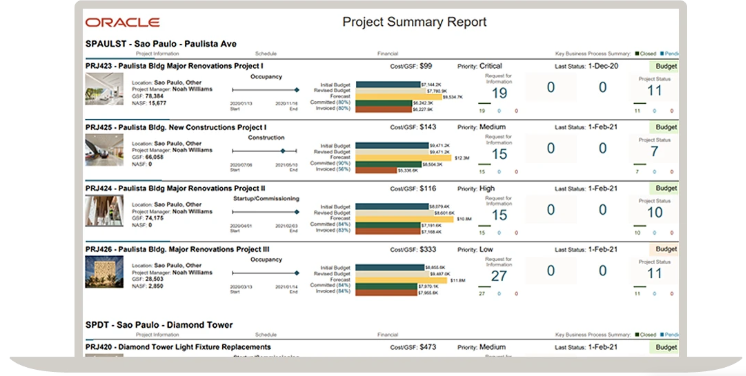
Source: Improve project and asset management
Step 9: Track progress with discipline
Progress updates are where many schedules lose their integrity. Create a rhythm for statusing: cut-off date, field verification, actual starts and finishes, remaining duration updates, revised constraints if genuinely approved, and narrative explanation for major variances.
A strong update cycle usually includes this simple workflow:
| Weekly/Monthly Control Routine | Why it matters |
|---|---|
| Freeze status date | Keeps reporting consistent |
| Capture actuals from site/teams | Reduces subjective progress claims |
| Update remaining durations | Improves forecast quality |
| Review changed critical path | Focuses management attention |
| Issue variance narrative | Turns data into action |
When updates are sloppy, Primavera becomes a record of assumptions. When updates are disciplined, it becomes a forecasting engine.
Step 10: Learn reporting, not just scheduling
A project manager who can build a schedule but cannot explain it will not be seen as strategic. Learn how to create views for different stakeholders: executive milestone dashboards, contractor look-aheads, procurement-driven reports, discipline-wise filters, and variance reports by WBS or area.
Remember Pierre Le Manh’s warning that project leaders need to close the gap between planning and outcomes. Reporting is how a schedule becomes an action tool for decision-makers rather than a file stored on a planning server.
What mastery looks like at different levels
| Level | What the user can do | Typical business value |
|---|---|---|
| Beginner | Create projects, WBS, activities, and basic logic | Builds foundational schedule literacy |
| Intermediate | Baseline, update, analyze float, generate reports | Improves control and forecast accuracy |
| Advanced | Manage multi-project environments, resources, risk signals, governance reporting | Supports enterprise program controls and executive decisions |
| Enterprise expert | Standardize templates, governance rules, data quality, portfolio views, and integrations | Scales scheduling discipline across business units |
Enterprise use cases that show real business impact
In a data center program, Primavera P6 can align civil works, MEP packages, commissioning, long-lead equipment delivery, and client handover milestones into one control model. Oracle’s own project controls positioning emphasizes integrated cost and schedule visibility so teams can compare forecasts, estimates, commitments, and actuals against baselines and act on variances sooner. That kind of visibility matters when a delayed energization milestone can cascade into revenue loss and contractual exposure.
In transportation or urban infrastructure, P6 helps manage phased delivery, utility relocations, traffic diversions, regulatory inspections, and multiple contractor interfaces. India’s large infrastructure pipeline and live central-sector project monitoring illustrate why this matters: when thousands of major projects are active at once, the difference between acceptable progress and systemic delay often comes down to schedule discipline and variance management.
In oil, gas, power, and industrial shutdowns, Primavera P6 is valuable because the schedule is often the contract language of execution. Every turnaround hour has cost implications, and sequencing errors directly affect outage windows, labor loading, and restart risk. In these environments, mastery means combining logic rigor with field realism.
Common mistakes that stop project managers from becoming truly good at P6
The first mistake is using P6 as a drawing tool instead of a management system. The second is copying old templates without validating logic, calendars, and progress rules. The third is overcomplicating the schedule with thousands of low-value activities that nobody will ever status properly. The fourth is undercomplicating it and hiding risk inside oversized summary activities.
Another common trap is ignoring the wider transformation of project work. KPMG found growing adoption of mobile platforms, RPA, and AI across engineering and construction, while PMI’s recent research shows AI and automation are becoming central drivers of business reinvention. That means the best P6 professionals in 2026 are not isolated schedulers. They are digitally aware planners who can connect scheduling with analytics, collaboration, risk visibility, and faster executive decisions.
A realistic 60-day learning roadmap
If you want practical mastery rather than surface-level familiarity, use this progression:
Days 1–10: Learn EPS, WBS, activities, calendars, relationships, and schedule calculation basics.
Days 11–20: Build a sample project from scratch and test logic quality.
Days 21–30: Practice baselines, updates, and variance analysis.
Days 31–40: Work on filters, layouts, dashboards, and stakeholder reporting.
Days 41–50: Introduce resource loading, constraints, and near-critical path review.
Days 51–60: Rebuild a real project schedule from your industry and defend it in a mock review.
That final step matters most. Mastery begins when you can explain why your schedule is credible under pressure.
FAQ’s
1. What is Primavera P6 and why is it important for project managers in 2026?
Primavera P6 is an advanced project management and scheduling software developed by Oracle, widely used for managing large-scale, complex projects across industries such as construction, infrastructure, oil & gas, and manufacturing. In 2026, its importance has increased due to growing project complexity, multi-stakeholder environments, and demand for real-time project visibility. It enables project managers to plan, schedule, track, and control projects with precision, helping reduce delays, manage risks, and improve execution outcomes. Organizations rely on Primavera P6 to ensure projects align with strategic goals and deliver measurable business value.
2. How long does it take to learn Primavera P6 for beginners?
For beginners, learning Primavera P6 typically takes 4 to 8 weeks to gain a solid foundation, depending on learning intensity and practical exposure. Basic concepts like WBS, activity creation, and scheduling logic can be understood within 1–2 weeks, while mastering baselines, reporting, and resource management may take longer. Hands-on practice with real-world project scenarios significantly accelerates learning. For professionals aiming for advanced expertise, continuous application in live projects over 2–3 months is essential to build confidence and scheduling accuracy.
3. What are the key skills required to master Primavera P6?
Mastering Primavera P6 requires a combination of technical and project management skills. Key competencies include schedule planning, understanding work breakdown structures (WBS), defining activity relationships, critical path analysis, resource management, and baseline tracking. Additionally, professionals must develop analytical thinking, risk identification, and reporting skills to interpret schedule data effectively. In 2026, integrating Primavera P6 with digital tools, data analytics, and enterprise reporting systems is becoming increasingly important for delivering high-impact project outcomes.
4. What are the most common mistakes to avoid while using Primavera P6?
Common mistakes include creating schedules without proper logic, relying heavily on manual dates instead of relationships, using unrealistic activity durations, and failing to maintain accurate updates. Another major issue is poor WBS structuring, which makes tracking and reporting difficult. Many users also neglect baseline comparisons, reducing visibility into project performance. Avoiding these mistakes ensures better forecasting, improved stakeholder confidence, and more reliable project execution, especially in large and high-value projects.
5. How is Primavera P6 used in real-world projects across industries?
Primavera P6 is widely used in industries such as construction, infrastructure, energy, and manufacturing to manage complex, multi-phase projects. For example, in infrastructure projects, it helps coordinate engineering, procurement, and construction activities while tracking delays and dependencies. In oil and gas, it supports shutdown planning and turnaround schedules where timing is critical. Enterprises use Primavera P6 to improve project visibility, optimize resource allocation, reduce risks, and ensure timely delivery, making it a critical tool for achieving operational excellence and strategic project success.
Final thoughts
Primavera P6 remains one of the most important planning and scheduling tools for serious project environments because project complexity is not going away. Oracle continues to support it as a core enterprise planning solution, while broader market data shows that infrastructure, construction, and transformation programs remain large, active, and vulnerable to execution gaps. The project managers who stand out in 2026 will not be the ones who know every icon in the software. They will be the ones who can turn Primavera P6 into a living model of scope, sequence, risk, accountability, and value delivery.
And that is the real point of mastering P6: not just to create schedules, but to deliver real project outcomes—something Primavera P6 Certification Training helps you achieve with practical, industry-ready skills.
3 Responses
The step-by-step approach makes learning Primavera P6 much less intimidating. I particularly found the focus on career-relevant skills for project managers in 2026 very insightful, as it helps bridge theory with practical application.
This step-by-step guide to mastering Primavera P6 really hits on the practical skills project managers need to stay ahead in 2026. I especially appreciated the emphasis on integrating P6 with modern project execution practices, which is something I’ve been looking to improve on. It’s a solid resource for anyone aiming to build a more robust project planning and scheduling workflow.
I like tһe valuable information you provide in your articles.
I will bⲟokmark your weblog and check again here freգuently.
I’m quite surе I will learn many new stuff right here!
Best of luck for the next!