


Information Technology Infrastructure Library (ITIL) has been a cornerstone framework for managing IT services efficiently. With its latest iteration, ITIL 4, the framework has introduced the Service Value System (SVS), designed to provide a holistic approach to service management. This article explores how the SVS framework transforms IT service management (ITSM) by aligning IT processes with business needs, enhancing customer experiences, and incorporating emerging technologies.
Unpacking the ITIL 4 Service Value System
What is the ITIL 4 SVS?
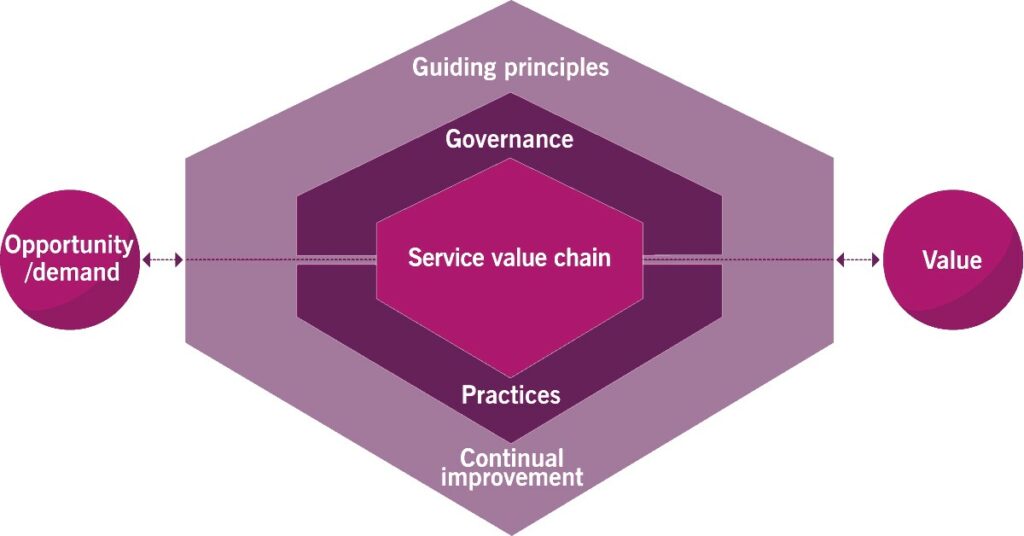
The ITIL 4 SVS provides a comprehensive, systematic approach to service management. Its components include the ITIL service value chain, a set of interconnected activities that transform inputs into valuable outputs; the guiding principles, which offer a strategic direction; and governance, which ensures oversight and accountability in service management.
Source: Axelos
Visualization of the ITIL 4 SVS
The system can be visualized as a model where different components work in synergy. Below is a simplified representation of how these elements interact:
| Component | Function |
|---|---|
| Service Value Chain | Converts demand into value through IT services |
| Practices | Sets of organizational resources for performing work |
| Guiding Principles | Recommendations that guide an organization in all circumstances |
Strategic Benefits of SVS in ITSM
Adopting the ITIL 4 SVS within ITSM frameworks yields significant strategic benefits. It enhances alignment between IT operations and business strategies, ensuring that IT services support broader organizational goals. Furthermore, SVS facilitates robust decision-making and advanced risk management through its comprehensive governance and principles.
For example, companies like Zara have leveraged SVS to synchronize their IT services with fast fashion cycles, significantly enhancing operational agility and customer satisfaction.
Enhancing Customer Experience through SVS
Customer-Centric Strategies
The SVS framework promotes a customer-centric approach, directly enhancing client satisfaction and engagement. Practices within the SVS, such as Relationship Management and Service Request Management, ensure that IT services not only meet but exceed customer expectations.
Impact on Customer Retention
Organizations using SVS have noted improved customer retention rates. A consistent, positive customer experience, fostered by effective service management, translates to higher loyalty and customer retention.
Integration of Emerging Technologies with SVS
SVS’s adaptive nature facilitates the seamless integration of emerging technologies, such as artificial intelligence (AI) and the Internet of Things (IoT), into ITSM practices. This integration enhances efficiency and innovation, with AI-driven analytics providing deeper insights into operations and customer needs, thereby refining the overall service delivery. For instance, using IoT to monitor service infrastructures in real-time allows for proactive maintenance, minimizing downtime, and improving service reliability.
Overcoming Implementation Challenges
Identifying Challenges
Common challenges include resistance to change, alignment with business goals, and managing stakeholder expectations. Addressing these effectively requires a clear strategy and commitment at all levels of the organization.
Strategies for Effective Implementation
Successful implementation strategies often involve comprehensive training programs, effective communication plans, and phased rollouts that allow for gradual adaptation to the new system.
Case Study: Digital Transformation at Midsize Retail Corporation
Challenge/Issue
A midsize retail corporation was struggling with outdated IT service management processes that could not keep up with the rapid pace of digital change in the retail industry. The company faced frequent system downtimes, slow response times to customer service requests, and challenges in managing inventory effectively, leading to lost sales and decreased customer satisfaction.
How They Overcame
The corporation decided to implement the ITIL 4 Service Value System to streamline its IT processes and align them more closely with its business objectives. They focused on integrating the ITIL service value chain activities and principles into their daily operations. This included adopting practices like Incident Management to quickly and efficiently resolve issues and Service Request Management to handle customer queries more effectively. The company also leveraged Relationship Management to better understand and anticipate customer needs.
Technology Integration
To further enhance its capabilities, the corporation integrated AI technology to automate routine tasks and analyze customer data, which enabled personalized marketing and improved inventory management. IoT devices were installed to monitor store environments and inventory levels in real-time, significantly reducing overstock and stockouts.
Lessons Learned
The implementation taught the company the importance of continuous improvement and agility in IT service management. They learned that a proactive approach to IT issues, coupled with a strong alignment with business strategies, can significantly enhance operational efficiency and customer satisfaction. The corporation now regularly reviews and updates its ITSM practices to stay ahead of technological advances and market trends.
| Aspect | Details |
|---|---|
| Challenge/Issue | Outdated ITSM processes leading to system downtimes, slow customer service response times, and inefficient inventory management, resulting in lost sales and customer dissatisfaction. |
| Solution Implemented | Adoption of the ITIL 4 Service Value System, focusing on integrating service value chain activities and principles such as Incident and Service Request Management. |
| Technology Integration | Outdated ITSM processes lead to system downtimes, slow customer service response times, and inefficient inventory management, resulting in lost sales and customer dissatisfaction. |
| Results | Enhanced operational efficiency and customer satisfaction through faster issue resolution and better inventory management. Increased sales due to improved customer service and marketing. |
| Lessons Learned | Importance of continuous improvement and agility in ITSM. Proactive IT management aligned with business strategies can significantly improve operational efficiency and customer relations. |
The Future of ITSM with SVS
Looking ahead, the ITIL 4 SVS is set to play a pivotal role in the evolution of ITSM. Its flexibility and emphasis on continual improvement prepare organizations to adapt to future challenges and technological shifts. The integration of SVS within ITSM practices will enhance operational efficiencies and ensure that IT services can swiftly adapt to emerging trends and business needs, solidifying IT’s role as a strategic business partner.
To ensure businesses benefit from utilizing this ITIL 4 Service Value System to its fullest potential, the workforce who are part of the IT Service Management team must take part in ITIL 4 Foundation training. The training not only embarks professionals on learning the globally-recognized ITIL 4 framework but also on understanding critical concepts and implementation of the framework that embraces enterprise vision and goals.
Conclusion
The ITIL 4 Service Value System represents a significant leap forward in strategic IT service management. ITIL 4 SVS helps organizations create genuine value from their IT operations, aligning them closely with business needs and customer expectations by providing a framework that integrates various components of service management into a cohesive system.
Implementing ITIL 4 SVS enhances operational efficiencies and ensures that IT services can quickly adapt to changes and challenges, paving the way for a future where IT is not just a support function but a strategic partner in business success.
Read More About ITIL4 – The Four Dimensions of ITIL 4 for Comprehensive Service Management