


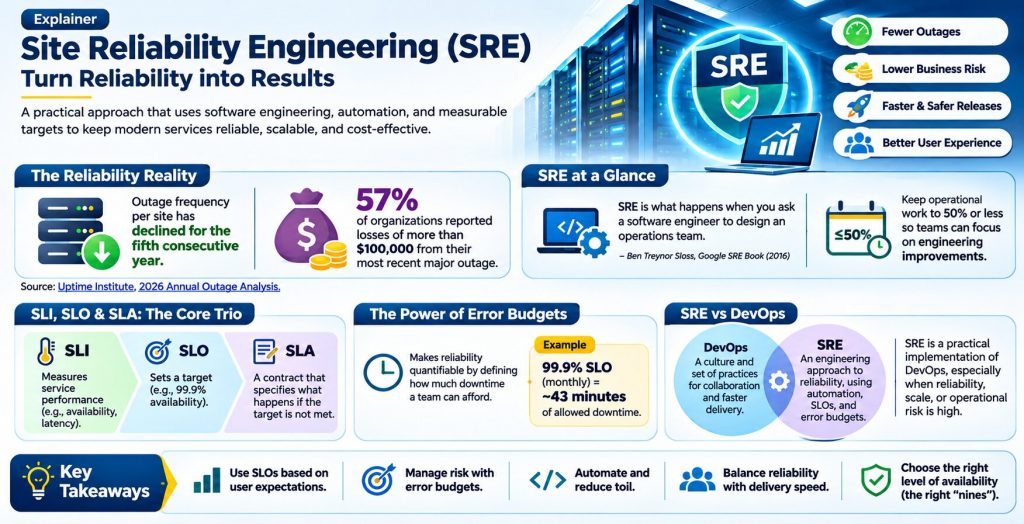
Data-center outages are becoming less frequent per site, though they remain costly. Uptime Institute’s 2026 Annual Outage Analysis indicates that outage frequency per site has declined for the fifth consecutive year. However, 57% of respondents to its 2025 survey still reported that their most recent major outage resulted in losses of more than $100,000.
This leads us to the question: how reliable is reliable? Site reliability engineering, or SRE, provides a quantifiable answer to that question instead of just arguing about it.
What Are the Responsibilities of SRE Engineers?
Ben Treynor Sloss began working at Google in 2003, and he defines SRE in Google’s 2016 book Site Reliability Engineering: “SRE is what happens when you ask a software engineer to design an operations team.” An SRE engineer uses software engineering and automation to minimize operational tasks.
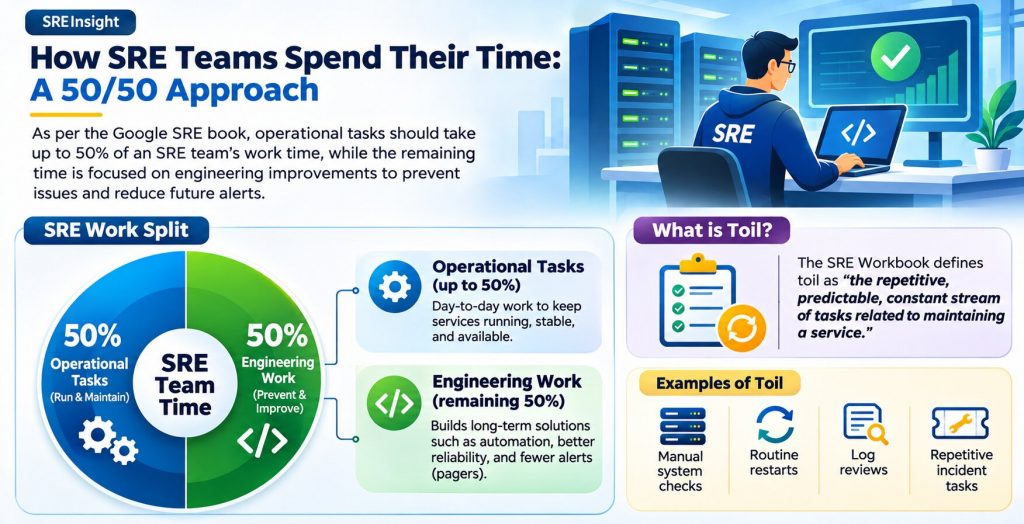
According to the book, operational tasks take up to 50% of SRE teams’ work time, while the remainder goes into engineering to prevent pagers from ringing in the first place. The SRE Workbook defines toil as “the repetitive, predictable, constant stream of tasks related to maintaining a service.”
SLO vs SLA: What Should You Know?
Essentially, you can think of SLI as a thermometer and SLO as the desired temperature, and SLA as the rent agreement that penalizes you if the temperature falls.
The above table depicts three concepts: SLI, SLO, and SLA. To summarize,
- SLI is a measure of service performance.
- SLO is a target for that measure.
- SLA is a contract that says what will happen if you miss the target.
Why are error budgets significant?
The idea of an error budget makes reliability quantifiable by how much time ‘unreliability’ a team can ‘spend’ on its systems. In a scenario with a 99.9% monthly SLO, for example, a team can afford about 43 minutes of downtime. Thus, if something happens that burns 30 minutes of the 60 minutes between two releases, the team is left with 13 minutes.
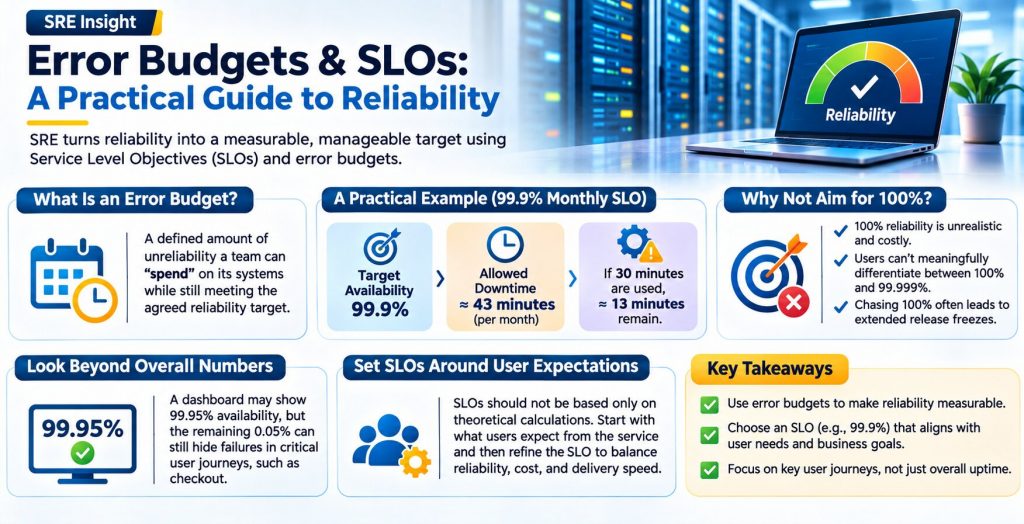
The book argues that 100% is the wrong target. It is too idealistic a number because users cannot distinguish between a system’s 100% reliability and its 99.999% reliability. Chasing the elusive 100% will only lead to extended release freezes.
The SLO sets a 99.9% requirement, but if the dashboard reads 99.95%, everyone will relax until it turns out that the remaining 0.05% budget hides failures in a critical process such as checkout.
SLO should not be calculated from first principles alone. Instead, it is better to start with user expectations and then adjust the SLO.
SRE vs DevOps
DevOps is a culture. SRE is a software engineering approach related to operations. As Ben Treynor Sloss explained, SRE is considered a particular implementation of DevOps with certain extensions.
SRE becomes essential when reliability requirements, scale, or operational risk necessitate treating operations as an engineering problem.
FAQs
Do you need programming skills to become an SRE?
Although it’s usually required when working as an SRE, it is not required by foundation courses.
Who has ownership of the error budget?
The error budget is co-owned by the product and SRE teams.
How many nines are considered sufficient?
Sufficient nines are those that meet user expectations. Each additional nine reduces the downtime factor tenfold.
How Do You Earn SRE Certification?
The DevOps Institute offers the SRE certification at the Foundation and Practitioner levels, with examinations administered through PeopleCert. The Foundation examination consists of 40 multiple-choice questions to be completed in 60 minutes, with 65% set as the minimum passing score.
Spoclearn is an accredited training provider by PeopleCert and offers a two-day SRE Foundation course in the USA. The course can be taken without prior learning. The training also includes an additional 4-day, 32-hour combined SRE Foundation and Practitioner course.