


Let’s say you finish your sprint review. You already have an AI assistant that summarizes the meeting, ranks the backlog, and prepares user stories for the upcoming week. That is good; however, somewhat creepy.
Does this mean that all that’s left for the Product Owner is to perform their routine duties? Of course not. The role has changed from managing the backlog and ceremonies to evaluating machine output.
Definition of AI Product Management
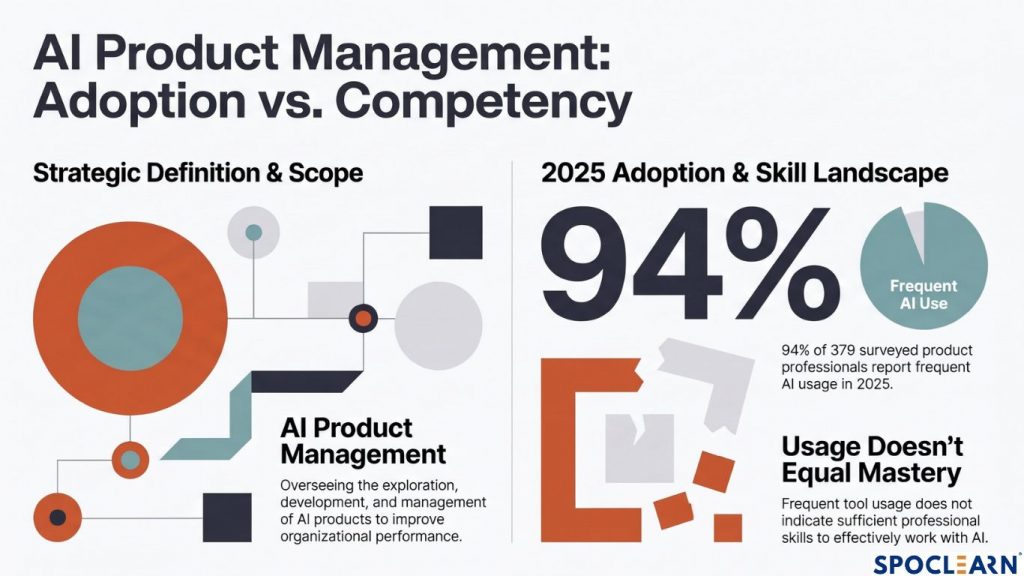
AI product management refers to the effective oversight of the exploration, development, and management of AI-driven products that deliver results or improve performance. According to a Productboard survey conducted in 2025, 94% of 379 surveyed product professionals said they use AI frequently. However, it should be noted that using AI does not mean one possesses enough skills to work with AI.
Product Owner vs Product Manager
In SAFe, the division between the engagement of a product manager and product owner is relatively clear. Product managers are responsible for strategic planning and execution at the Agile Release Train level. Meanwhile, product owners focus their activities at the team level and attend to writing stories and prioritizing.
| Description | Product Owner | Product Manager |
| Position | Team | Agile Release Train |
| Possesses | Team backlog, user stories | Vision, roadmap, features |
| Everyday AI implementation | Drafting stories, improving the team backlog | Collecting customer and market information |
Tasks for both positions become simpler. The only thing that is difficult is judgment. So will AI make the gap between the two positions smaller?
Five Skills Needed for AI Product Management in 2027
Consider a backlog to be like a garden. AI acts like a hose that waters whatever is in its path. The skills listed here determine what kinds of things will grow.
Prompt crafting: Defining context, constraints, and format is very important. The current AI-Empowered SAFe POPM certification exam involves testing the ability to craft AI prompts.
Output evaluation: Being able to describe what makes good output based on examples, expected output, and edge cases is essential.
Responsible AI judgment: Issues of bias and privacy will end up on the backlog at some point. The challenges for responsible AI are also being raised now as part of the exam.
Data literacy: It is necessary to question where the training data came from and what was used with it.
Outcome and cost thinking: Maintaining an AI feature comes with certain costs, and one should understand that. Budgeting should begin in sprint 1, rather than waiting until the first invoice arrives.
SAFe POPM Certification
SAFe updated this certification in 2026.
With that, the SAFe POPM certificate is provided as an AI-Empowered SAFe Product Owner/Product Manager Certificate. The program runs for 2 days. To pass the exam, one should answer 37 of 45 questions in 90 minutes, with the new topics covering AI practices.
Questions Often Asked
What does it mean to get a SAFe POPM certification?
SAFe POPM certification shows that one can work as a Product Owner or Product Manager on an Agile Release Train. The present version is AI-Empowered.
What AI skill is recommended to start learning at first?
Consider starting with prompt crafting, followed by output evaluation and responsible AI.
Will AI replace the position of the Product Owner?
Not really soon, since while AI can draft and summarize very effectively, the responsibility for value and ethical issues still stays with humans.