


Introduction
Global construction and infrastructure companies operate in one of the most schedule-sensitive environments in the world. A road project delayed by three months, a metro rail package missing utility coordination, or a power plant facing procurement slippage can create cost overruns, legal disputes, idle resources, and public dissatisfaction. That is why large contractors, EPC firms, public infrastructure authorities, oil and gas companies, utility providers, and real estate developers depend on Oracle Primavera P6 for planning, scheduling, resource control, and project visibility.
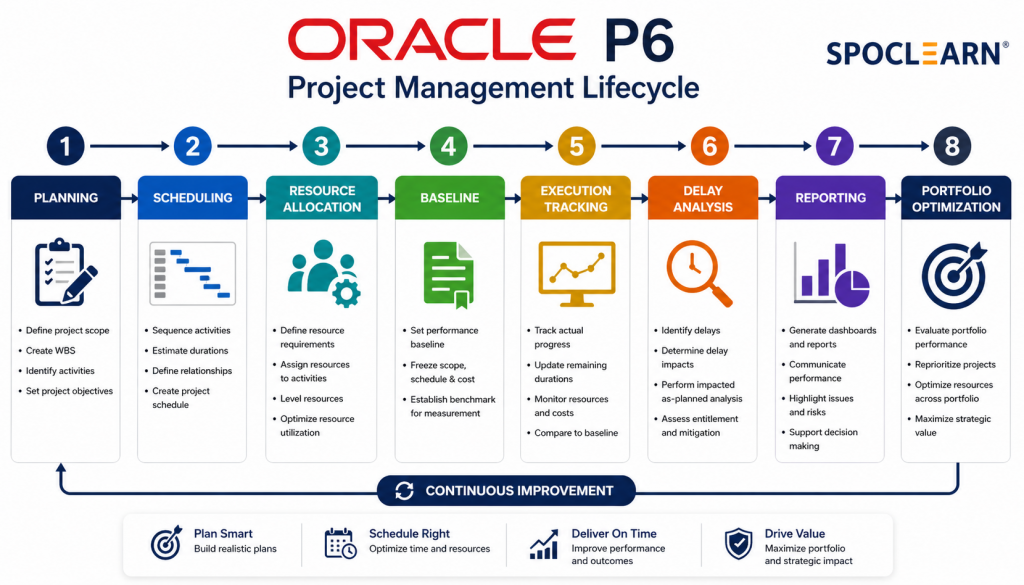
Oracle describes Primavera P6 Enterprise Project Portfolio Management as a solution for “prioritizing, planning, managing, and executing projects, programs, and portfolios,” and positions it as suitable for projects of any size. In construction, this matters because projects are rarely simple. They involve thousands of activities, multiple contractors, government approvals, procurement milestones, design changes, safety constraints, cash flow dependencies, and contractual deadlines.
The global construction market is also expanding rapidly. RICS reports that global construction spending is projected to rise from about $13 trillion in 2023 to $22 trillion by 2040, making productivity improvement a global priority. At the same time, McKinsey notes that construction costs have risen faster than general inflation in many regions, with construction becoming 1% to 3% more expensive each year globally on top of inflation. For companies delivering complex capital projects, better scheduling is no longer optional; it is a survival requirement.
Why Primavera P6 Matters in Large Construction Projects
Oracle Primavera P6 is not just a digital calendar. It is a project controls platform that helps organizations break large projects into manageable work packages, define dependencies, assign resources, manage baselines, track progress, and forecast delays before they damage the project.
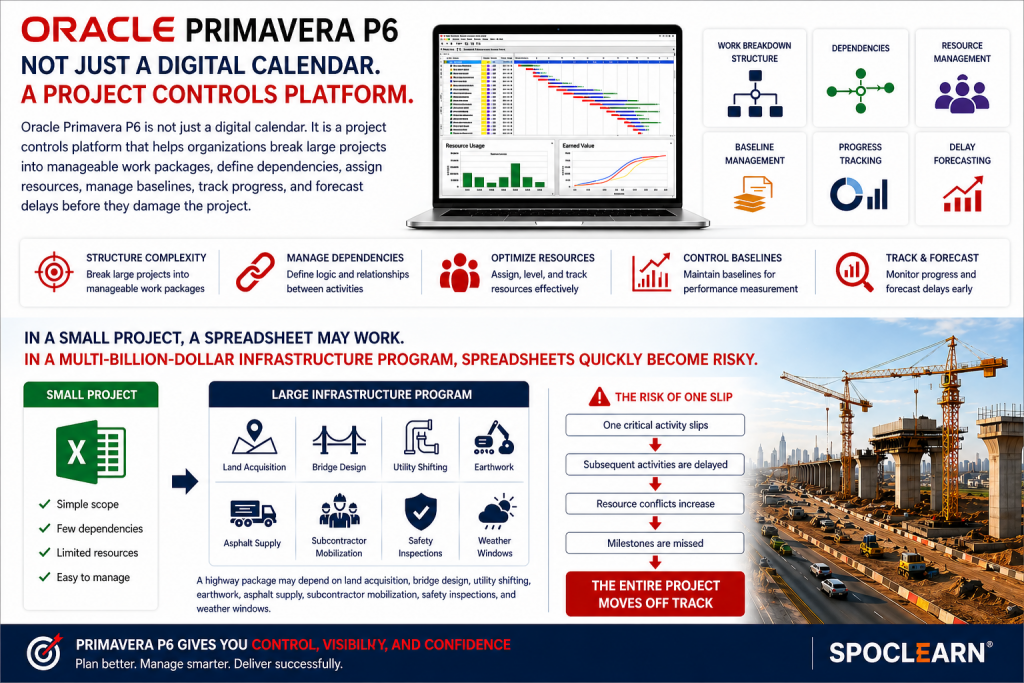
In a small project, a spreadsheet may work. In a multi-billion-dollar infrastructure program, spreadsheets quickly become risky. A highway package may depend on land acquisition, bridge design, utility shifting, earthwork, asphalt supply, subcontractor mobilization, safety inspections, and weather windows. If one critical activity slips, the entire project can move off track.
Primavera P6 helps project teams answer questions such as:
| Project Question | Why It Matters |
|---|---|
| Which activities are on the critical path? | Helps teams protect the completion date. |
| Which contractor is delaying progress? | Supports accountability and corrective action. |
| Are resources overloaded? | Prevents unrealistic execution plans. |
| What happens if material delivery is delayed? | Helps simulate impact before the delay spreads. |
| Are we ahead or behind the approved baseline? | Supports client reporting and claims management. |
| Which projects deserve priority funding? | Helps owners manage portfolios strategically. |
For global construction and infrastructure companies, these answers are essential because project failure often begins with poor visibility.
The Industry Problem: Complexity, Delays, and Productivity Pressure
Construction is facing a serious productivity challenge. McKinsey has highlighted that low productivity growth continues to affect the industry, while global demand for infrastructure, energy, real estate, and industrial projects keeps rising. KPMG’s 2025/2026 Global Construction Survey also shows that industry leaders are optimistic, with 71% of respondents positive about the industry’s direction, but they remain cautious because risks are increasing.
This combination creates a difficult reality: more projects, higher expectations, tighter budgets, and greater delivery risk.
Common Challenges Faced by Global Construction Companies
| Challenge | Impact on Projects | How Primavera P6 Helps |
|---|---|---|
| Poor schedule visibility | Teams react late to delays | Creates structured schedules and critical path visibility |
| Resource conflicts | Equipment and labor remain idle or overloaded | Supports resource allocation and leveling |
| Weak baseline control | Project teams cannot prove delay impact | Tracks baseline vs. actual performance |
| Procurement delays | Materials arrive after planned installation dates | Links procurement milestones with execution activities |
| Multi-contractor coordination | Work fronts clash on site | Defines dependencies between contractors and packages |
| Change orders | Scope changes disrupt cost and schedule | Supports impact analysis and schedule updates |
| Executive reporting gaps | Leadership lacks accurate progress data | Enables portfolio-level reporting and decision-making |
When a company manages one project, delay is a project issue. When it manages 50 projects across countries, delay becomes a business risk. Primavera P6 gives leadership a structured way to control that risk.
Why Global Companies Depend on Oracle Primavera P6
1. It Handles Extremely Large and Complex Schedules
Large infrastructure projects often include thousands of activities. A simple Gantt chart tool may become slow, confusing, or unreliable when schedules grow. Primavera P6 is built for complex project structures, including work breakdown structures, activity codes, calendars, milestones, relationships, constraints, baselines, and resource assignments.
For example, a metro rail project may include civil works, stations, viaducts, track systems, signaling, rolling stock, testing, commissioning, safety certification, and handover. Each area has its own timeline, but all areas must connect to the final project completion date. Primavera P6 allows planners to build one integrated schedule that shows how each package affects the whole program.
2. It Supports Critical Path Method Scheduling
The Critical Path Method, or CPM, is central to construction scheduling. It identifies the longest sequence of dependent activities that determines the project completion date. Oracle Primavera Cloud is described by Oracle as supporting CPM contract planning and scheduling with the same trusted scheduling pedigree from Primavera P6.
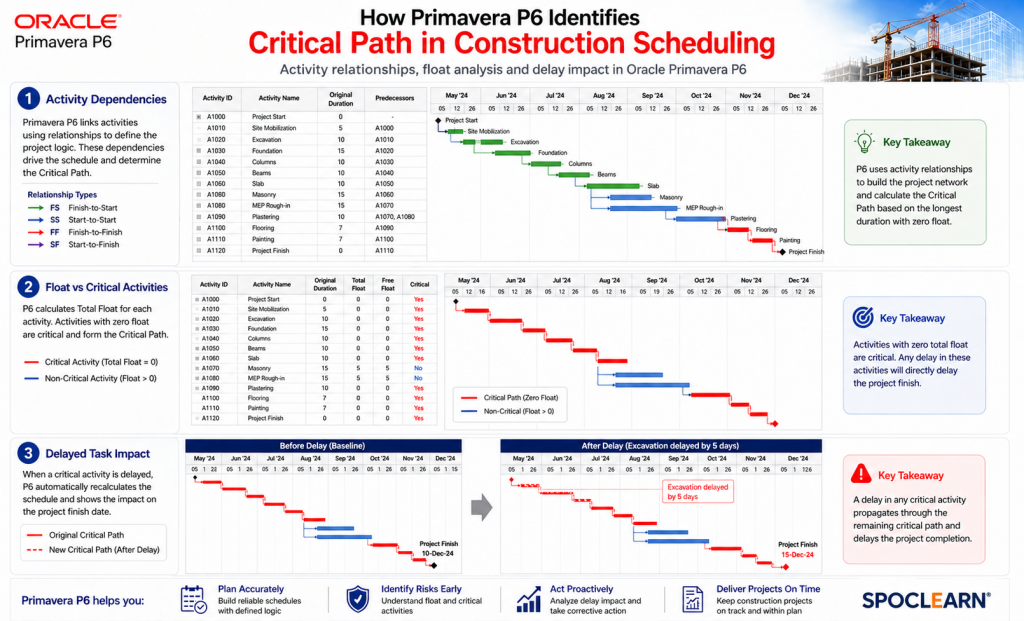
This is important because construction contracts often depend on critical path logic. If a delay occurs, project teams need to know whether it affected the completion date or only consumed available float. Primavera P6 helps planners, contractors, consultants, and clients analyze delay impact with more discipline.
3. It Improves Resource Planning
Construction projects fail when resources are planned unrealistically. A schedule may look good on paper, but if the same crane, supervisor, design engineer, or subcontractor is required in two places at once, the plan will collapse.
Primavera P6 helps companies assign resources to activities, identify overloads, and align manpower and equipment with the execution plan. This is especially valuable in regions facing labor shortages. McKinsey has noted that labor shortages are causing delays and cost increases across infrastructure projects.
4. It Strengthens Portfolio-Level Decision-Making
Global infrastructure companies rarely manage only one project. They often manage portfolios of highways, airports, tunnels, power plants, industrial facilities, data centers, hospitals, and public works. Oracle positions Primavera P6 EPPM as a platform for managing projects, programs, and portfolios.
This helps executives compare projects based on schedule health, risk exposure, resource demand, and strategic importance. Instead of reacting to individual project problems, leadership can prioritize investment and support where it matters most.
5. It Supports Contractual Reporting and Claims Management
In construction, documentation is power. If a contractor claims an extension of time, the owner will ask for proof. If the owner delays approvals, the contractor needs evidence. If a subcontractor misses milestones, the main contractor must show schedule impact.
Primavera P6 supports baseline schedules, progress updates, variance reporting, and delay analysis. These capabilities help organizations create a reliable project record. In disputes, a well-maintained Primavera P6 schedule can become an important source of evidence.
6. It Creates a Common Language Between Stakeholders
Infrastructure projects involve owners, consultants, contractors, subcontractors, suppliers, regulators, and lenders. Each stakeholder may look at the project differently. Primavera P6 creates a common planning structure that helps everyone discuss dates, dependencies, float, milestones, and delay risks using the same project schedule.
This reduces confusion and improves accountability. A project meeting becomes more productive when every party can see which activities are late, which dependencies are blocking work, and which decisions are needed.
Practical Examples of Primavera P6 in Global Infrastructure
| Project Type | Primavera P6 Use Case | Business Benefit |
|---|---|---|
| Airport Expansion | Coordinate terminal construction, baggage systems, runway works, and commissioning | Reduces interface risk between civil and systems teams |
| Metro Rail Project | Track tunneling, station works, rolling stock, signaling, and testing | Improves milestone control and handover readiness |
| Oil and Gas Facility | Manage engineering, procurement, fabrication, construction, and shutdown windows | Protects critical commissioning dates |
| Data Center Construction | Align design, equipment procurement, MEP works, testing, and client handover | Supports fast-track delivery |
| Highway Program | Track land acquisition, earthworks, bridges, pavement, and toll systems | Improves progress visibility across packages |
| Power Plant Project | Control boiler, turbine, electrical, civil, and commissioning activities | Reduces delay risk in high-value equipment sequencing |
Primavera P6 and the Future of Digital Construction
The construction industry is moving toward digital delivery, data-driven project controls, AI-assisted planning, and integrated portfolio management. Oracle’s construction and engineering portfolio now includes solutions for planning, scheduling, resource management, risk management, collaboration, cost, contracts, and document control.
However, technology alone does not solve construction problems. KPMG’s 2025/2026 survey highlights that construction firms are investing not only in technology but also in talent, culture, and leadership. This is why Primavera P6 training is important. A company gets the best value from Primavera P6 when planners, project managers, engineers, contract managers, and leadership teams understand how to use it correctly.
A famous project management quote often attributed to Dwight D. Eisenhower says, “Plans are worthless, but planning is everything.” The message fits construction perfectly. The software is valuable, but the real advantage comes from disciplined planning, regular updates, honest reporting, and timely decisions.
Solution Guide: How Companies Can Use Primavera P6 Better
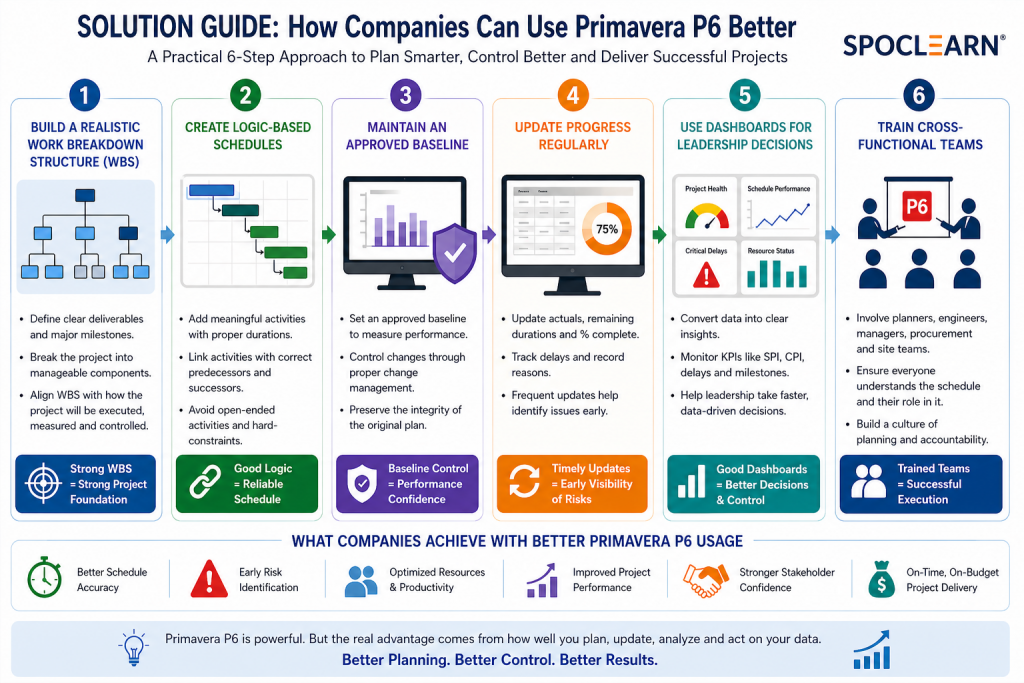
Global companies gain the greatest value from Primavera P6 when they combine structured planning, disciplined controls, and cross-functional adoption. The framework below outlines a practical six-step model for maximizing Primavera P6 performance.
Step 1: Build a Realistic Work Breakdown Structure
Before adding thousands of activities, companies should define a clear Work Breakdown Structure. The WBS should reflect how the project will be executed, reported, and controlled. For example, a bridge project can be structured by design, procurement, foundations, substructure, superstructure, deck works, utilities, testing, and handover.
Step 2: Create Logic-Based Schedules
Every major activity should have meaningful predecessors and successors. Avoid open-ended activities and artificial dates. A strong Primavera P6 schedule should explain how the project will move from start to finish.
Step 3: Maintain an Approved Baseline
The baseline acts as the original commitment. Without a baseline, project teams cannot measure delay accurately. Companies should approve the baseline early and control changes carefully.
Step 4: Update Progress Regularly
A schedule that is not updated becomes useless. Weekly or biweekly updates help teams identify slippage early. The update should include actual start dates, actual finish dates, remaining durations, percentage progress, and delay reasons.
Step 5: Use Dashboards for Leadership Decisions
Executives do not need to see every activity. They need milestone status, critical delays, risk areas, resource issues, and recovery actions. Primavera P6 data should support leadership dashboards that drive decisions.
Step 6: Train Cross-Functional Teams
Primavera P6 should not remain only with the planning engineer. Project managers, contract managers, site engineers, procurement teams, and leadership should understand how schedules affect delivery, claims, cash flow, and client commitments.
Who Should Learn Oracle Primavera P6?
Oracle Primavera P6 Certification Training is highly useful for:
| Audience | Why It Matters |
|---|---|
| Planning Engineers | Build, update, and control project schedules |
| Project Managers | Monitor progress, risks, and milestone performance |
| Construction Managers | Coordinate site execution and work fronts |
| Civil Engineers | Understand sequencing and activity dependencies |
| EPC Professionals | Manage engineering, procurement, and construction integration |
| Contract Managers | Support delay analysis and extension-of-time claims |
| Project Controls Teams | Track baselines, progress, resources, and reporting |
| Infrastructure Owners | Monitor portfolio performance and contractor commitments |
| Consultants | Review schedules and advise clients on delivery risk |
FAQs
1. Why is Oracle Primavera P6 widely used in construction?
Oracle Primavera P6 is widely used because it supports complex scheduling, critical path analysis, baseline management, resource planning, and portfolio-level project control. Large construction and infrastructure projects involve thousands of activities and multiple stakeholders. Primavera P6 gives project teams a structured way to plan work, monitor progress, identify delays, and support contractual reporting.
2. Is Primavera P6 better than Microsoft Project for infrastructure projects?
Microsoft Project is useful for simpler project schedules, but Primavera P6 is often preferred for large construction, EPC, oil and gas, utility, and infrastructure projects. Primavera P6 handles complex activity coding, multiple baselines, large schedules, advanced resource planning, and portfolio-level reporting more effectively for enterprise project controls.
3. Can Primavera P6 help reduce project delays?
Primavera P6 does not automatically remove delays, but it helps teams identify delay risks early. By using critical path analysis, baseline comparison, progress updates, and resource planning, project teams can detect slippage, understand its impact, and take corrective action before delays become expensive.
4. Who should attend Oracle Primavera P6 training?
Oracle Primavera P6 training is ideal for planning engineers, project managers, civil engineers, construction managers, project controls professionals, quantity surveyors, contract managers, EPC professionals, and infrastructure consultants. It is also valuable for fresh engineering graduates who want to enter construction planning and project controls roles.
5. Is Oracle Primavera P6 useful for global infrastructure companies?
Yes. Global infrastructure companies depend on Primavera P6 because it supports multi-project planning, portfolio visibility, resource coordination, schedule control, and executive reporting. It helps organizations manage large capital projects across regions, contractors, packages, and delivery timelines.
Conclusion
Global construction and infrastructure companies depend on Oracle Primavera P6 because modern capital projects demand more than basic planning. They require accurate schedules, strong critical path control, resource visibility, baseline discipline, delay analysis, portfolio reporting, and better coordination between owners, contractors, consultants, and suppliers.
As global infrastructure spending grows, project teams must manage higher complexity, rising costs, labor shortages, sustainability expectations, and tighter delivery timelines. Primavera P6 gives organizations the structure needed to plan confidently, monitor performance, and make decisions before risks become failures.