


Projects rarely fail in one dramatic moment. Most start slipping quietly.
A deadline moves by two weeks. A supplier changes a delivery date. A team works from three different priority lists. Finance asks why costs are rising faster than expected. Leadership hears one version of the status, while the delivery team lives another. What began as a strategic initiative slowly turns into firefighting.
This is the reality many organizations face across IT, construction, banking, healthcare, manufacturing, telecom, and public-sector transformation. The challenge is not a lack of effort. It is a lack of structure, visibility, and decision discipline.
That is exactly where PMP frameworks matter.
Project Management Professional (PMP) practices, grounded in PMI’s standards and exam framework, help organizations move from reactive execution to controlled delivery. They bring planning discipline, stakeholder alignment, measurable performance, risk visibility, governance, and change control into one operating model. PMI’s current direction also reflects modern delivery reality: predictive, agile, and hybrid approaches now sit side by side rather than in separate silos.
In simple terms, PMP frameworks do not just help teams “manage projects.” They help organizations reduce confusion, control cost drift, protect deadlines, and improve the odds that projects produce value worth the effort and expense. PMI’s latest research makes that point strongly: 64% of projects were delivered on time and on budget, 69% delivered a valuable or useful outcome, and 74% achieved both execution and outcome together. At the same time, only 48% of projects were rated fully successful, which shows how much room remains for better project discipline.
Why project chaos happens in the first place
Most organizations do not struggle because people are incapable. They struggle because projects are launched faster than systems are matured.
Common causes of project chaos include vague scope, poor stakeholder alignment, weak estimation, fragmented ownership, uncontrolled changes, late risk identification, and inconsistent reporting. When these problems stack together, the result is predictable: delays, overruns, rework, and leadership mistrust.
The wider business environment makes this worse. The World Economic Forum says employers expect 39% of workers’ core skills to change by 2030, while PMI forecasts a possible global talent gap of up to 30 million project professionals by 2035. That means organizations are managing more change, with greater execution pressure, while also facing capability gaps.
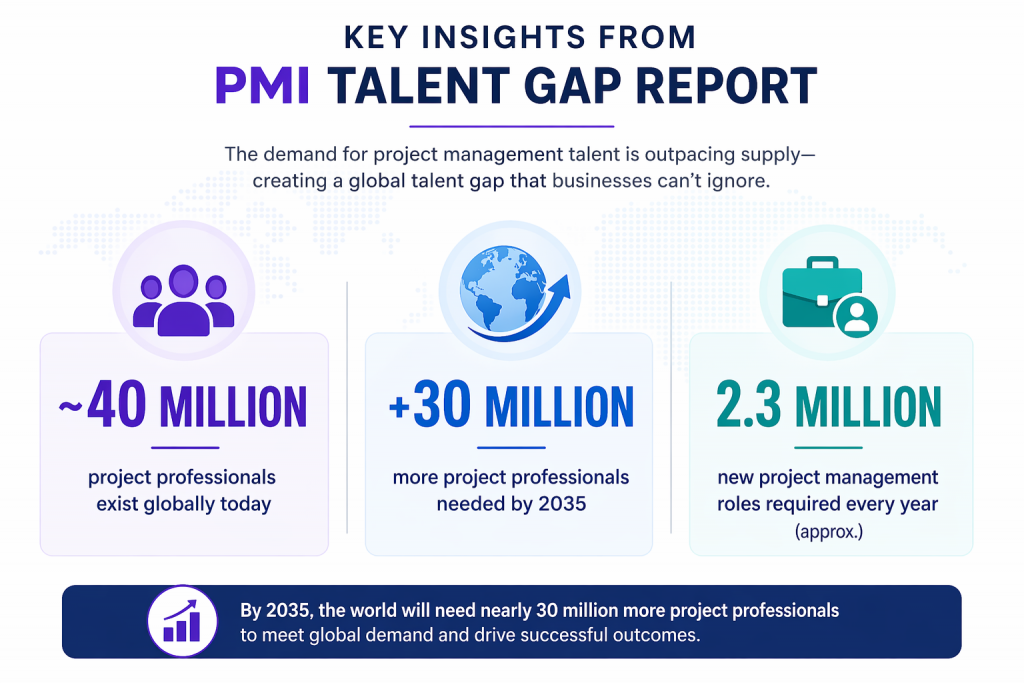
Source: Global Project Management Talent Gap
So the real question is not whether organizations need project management. It is whether they have a practical framework strong enough to handle uncertainty without losing control.
What PMP frameworks really give an organization
PMP is often misunderstood as just an individual certification. In practice, it represents a way of thinking about project delivery that can improve how teams plan, govern, communicate, monitor, and adapt.
PMI’s current PMP framework reflects real-world delivery. The updated 2026 exam content outline allocates 33% to People, 41% to Process, and 26% to Business Environment. It also states that roughly 40% of the exam reflects predictive approaches, while the remaining 60% is divided between adaptive/agile and hybrid approaches. That is important because modern organizations rarely run only one style of project anymore.
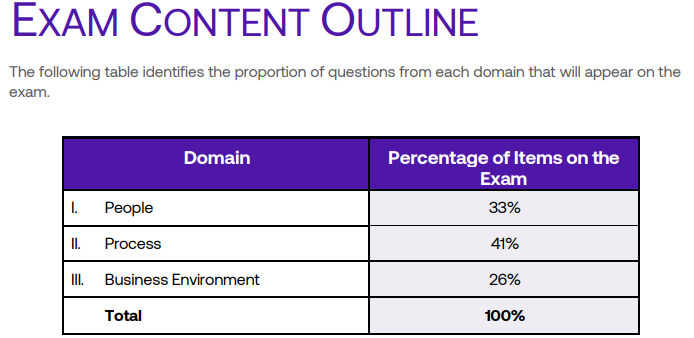
Source: The updated 2026 exam content outline
This matters for enterprises because project success today depends on balancing three things at once:
- team leadership,
- execution control,
- business alignment.
That balance is why PMP frameworks remain relevant across sectors.
Latest data points organizations should pay attention to
The numbers below show why structured project management is now a business necessity, not just a PMO preference.
| Metric | Latest signal |
|---|---|
| Projects delivered on time and on budget | 64% |
| Projects delivering a valuable/useful outcome | 69% |
| Projects achieving both execution and outcome | 74% |
| Projects rated fully successful | 48% |
| Projects rated failures | 12% |
| Global Net Project Success Score (NPSS) | 36 |
| Employers expecting core skills to change by 2030 | 39% |
| Potential global talent gap in project professionals by 2035 | Up to 30 million |
These figures show two things clearly. First, many organizations are getting partial success. Second, too many still fail to connect execution discipline with business value.
How PMP frameworks turn chaos into control
1. They define scope before scope defines the team
One of the fastest ways a project loses money is through unclear boundaries. Teams start work before requirements are stable. Stakeholders assume different outcomes. New requests enter informally. The project becomes a moving target.
PMP frameworks reduce this by emphasizing structured scope definition, requirement clarity, stakeholder alignment, and change control. Instead of letting work grow in every direction, the project team creates a shared definition of what is included, what is excluded, and what success looks like.
That step alone saves time and budget because it reduces confusion early, when correction is cheaper.
2. They convert deadlines into planned delivery, not hope
Many organizations confuse target dates with actual schedules. A date on a slide is not a delivery system.
PMP practices push teams to build schedules through defined activities, dependencies, sequencing, estimation logic, milestone control, and critical-path thinking. This changes the conversation from “Can we do it by June?” to “What has to happen, in what order, with what risks, to deliver by June?”
That shift is powerful because realistic plans help leaders make trade-off decisions earlier instead of paying for surprises later.
3. They make cost visible before overruns become political
Budget overruns often become visible only when they are already serious. By then, the organization is not managing a project problem. It is managing an executive confidence problem.
PMP-based cost management creates clearer budgeting, forecasting, baseline comparison, and performance tracking. Teams begin to ask: Are we consuming contingency too quickly? Are scope additions being costed properly? Are we still aligned with the approved value case?
This is where control becomes measurable rather than emotional.
4. They make risk management continuous
Strong project teams do not pretend uncertainty will disappear. They plan for it.
PMI’s success research shows that projects with well-established measurement systems and risk monitoring perform materially better. On average, 81% of projects had risk monitoring in place and showed an NPSS of 41, versus only 14 where risk monitoring was absent. Projects that combined key measurement practices and added risk monitoring raised NPSS from 49 to 53.
That is one of the clearest arguments for disciplined project governance. Risk logs, trigger points, contingency planning, and escalation thresholds do not slow projects down. They protect delivery.
5. They improve stakeholder trust
Many delayed projects are actually communication failures disguised as execution failures.
PMP frameworks strengthen stakeholder mapping, communication cadence, escalation paths, decision ownership, and sponsor engagement. When stakeholders understand what is happening, what changed, and what decisions are needed, they are more likely to support corrective action.
This is especially important in matrix organizations, where teams do not always control all resources directly.
6. They connect delivery to business value
PMI’s current thinking on project success is no longer limited to the old triangle of time, cost, and scope. The institute now frames success more broadly around whether a project delivered value worth the effort and expense.
That shift is critical for modern organizations. A project can hit schedule and budget but still fail strategically. PMP frameworks help teams keep business outcomes in view through benefits thinking, value alignment, governance reviews, and stakeholder outcome measurement.
A short line from PMI’s 2026 PMP update captures the direction well: the focus is on “delivering value” and “making a real impact on business outcomes.”
The measurement advantage of PMP-led execution
One of the strongest lessons from PMI’s recent research is that success improves when organizations measure the right things in the right way.
PMI found that:
- 84% of projects defined success criteria upfront; those projects achieved an NPSS of 41, versus 20 when success criteria were not defined upfront.
- 81% of projects had a well-established measurement system; those projects achieved an NPSS of 43, versus just 6 when no such system existed.
- 53% measured performance along the way; those projects achieved an NPSS of 40, versus 36 when they did not.
- Only 37% did all three, but those projects achieved an NPSS of 49, versus 27 when any one of those elements was missing.
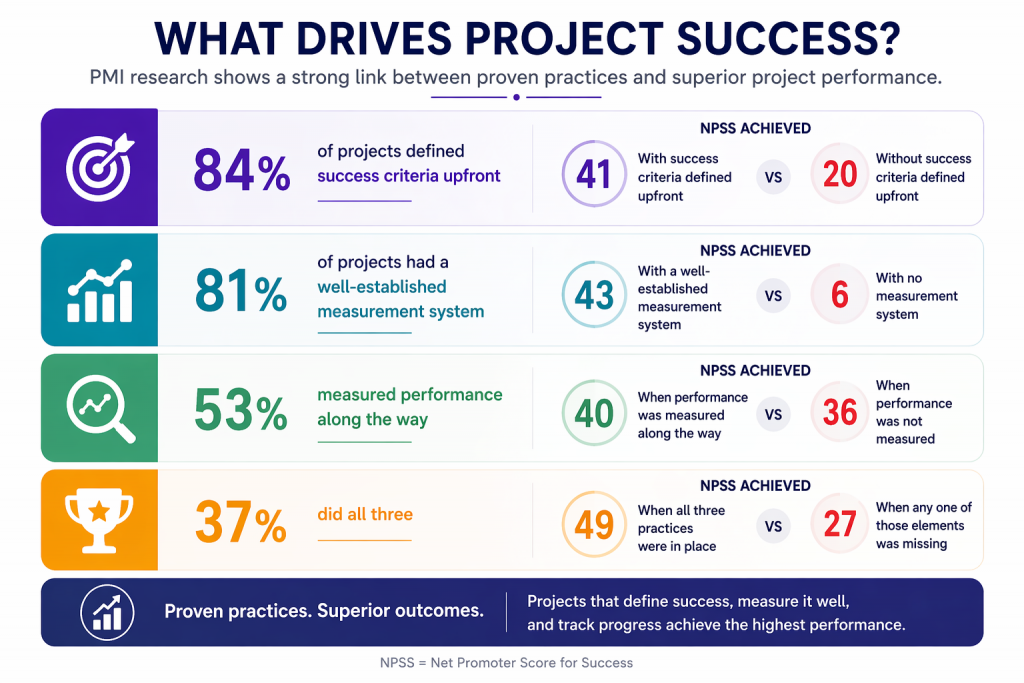
That is the real control layer.
Projects improve when teams define success early, measure consistently, and adjust while work is still in motion.
Example: how this looks inside an organization
Imagine a mid-sized financial services company launching a customer onboarding transformation across digital, compliance, operations, and service teams.
Without a PMP-style framework:
- scope expands after kickoff,
- compliance joins late,
- vendors work from outdated assumptions,
- reporting hides risk until month four,
- the budget absorbs unapproved changes.
With a PMP-style framework:
- success criteria are agreed at the start,
- stakeholders are mapped by influence and decision role,
- scope is baselined,
- schedule dependencies are visible,
- cost and risk are reviewed at regular governance intervals,
- change requests are documented and evaluated before approval,
- executive reporting is based on real status, not optimism.
The difference is not theory. It is operating discipline.
Why organizations are increasing investment in PMP capability
This is also why PMP capability matters at the workforce level.
As skills shift and project work becomes more cross-functional, organizations need leaders who can work across people, process, and business context. PMI’s PMP certification remains aligned to that reality, and PMI’s broader standards continue to emphasize practical performance domains rather than rigid one-size-fits-all rules. PMI’s PMBOK page highlights six core principles, seven performance domains, and expanded coverage of AI, PMOs, and procurement.
For enterprises, this means PMP training is not just exam support. It is a capability-building investment.
Where Spoclearn fits in
For organizations that want stronger project outcomes, training quality matters.
As a Premier ATP of PMI, Spoclearn can be positioned as a high-trust training partner for organizations seeking structured PMP learning backed by PMI-approved standards and delivered by expert project management instructors across regions and sectors. PMI states that Authorized Training Partners deliver PMI-approved, instructor-led learning and can support organizations with high-quality training customized to business needs.
That matters because many companies do not need theory alone. They need project managers, PMO teams, and delivery leaders who can apply PMP frameworks to live business environments involving cost pressure, changing priorities, hybrid work, agile delivery, governance demands, and executive reporting.
In that context, Spoclearn’s value can be described in four practical ways:
- it helps build a common project language across teams,
- it improves readiness for PMP certification and real-world application,
- it supports enterprise capability building across sectors,
- it brings expert-led instruction that connects PMI concepts to actual delivery problems.
FAQs
1. How do PMP frameworks help reduce project delays?
PMP frameworks reduce delays by improving planning, dependency mapping, stakeholder alignment, risk control, and change management. They help teams identify what may slow delivery early, so action can be taken before a deadline becomes unmanageable.
2. Can PMP practices help organizations control project budgets?
Yes. PMP practices improve budget control through cost estimation, baselining, monitoring, forecasting, and formal change control. This makes cost movement visible earlier and helps leaders decide whether to adjust scope, schedule, or funding before overruns become severe.
3. Is PMP still relevant for agile and hybrid projects?
Yes. PMI’s current PMP framework explicitly includes predictive, adaptive/agile, and hybrid approaches. The 2026 exam content outline states that predictive, agile, and hybrid approaches are all reflected in the certification, which keeps PMP relevant in modern delivery environments.
4. Why do organizations invest in PMP certification training for teams?
Organizations invest in PMP certification training because project work is growing more complex and the talent gap is widening. Structured PMP capability improves execution discipline, stakeholder communication, risk visibility, and decision quality across enterprise projects.
5. What makes a PMI Premier ATP useful for enterprises?
A PMI Premier ATP gives organizations access to PMI-approved training delivered by qualified instructors. That matters for enterprises that want consistent standards, credible exam preparation, and practical project management capability that can be applied across teams and industries.
Conclusion
Project chaos usually begins where clarity ends. When scope is unclear, success is undefined, risks are informal, and reporting is inconsistent, even experienced teams struggle to deliver on time and within budget. PMP frameworks help organizations replace that uncertainty with planning discipline, governance, accountability, and measurable control. That is why project management, PMP certification, and project delivery best practices remain some of the most important global search pathways for professionals and enterprises looking to improve execution.
For organizations that want stronger delivery capability, better stakehold
er confidence, and more predictable results, PMP Certification Training is not just a learning milestone. It is a business capability decision. With Spoclearn as a Premier ATP of PMI, enterprises can build that capability through structured, PMI-aligned learning delivered by expert instructors worldwide.