Trending Now

CRISC® Certification Guide 2026: Syllabus, Exam Pattern, Salary & Career Growth Explained
PMI-PBA® Certification in 2026: Complete Guide, Career Scope, Salary & Industry Demand
CISA Exam Changes & Syllabus Breakdown (2026 Update + Study Strategy)
CISM Certification Roadmap 2026: Step-by-Step Guide to Becoming a Security Manager
Lean vs Six Sigma vs Lean Six Sigma: What’s the Difference and When to Use Each?
AI and PRINCE2 7th Edition: What PMs Must Know
Performance Max Campaign Performance Dropped? Here’s the Real Reason (And Fix)
ITIL v5 Trends: What IT Leaders Must Know About the Next Phase of ITSM
Why Oracle Primavera P6 Certification Is Becoming Essential for Project Managers in 2026
PRINCE2 7 Roles & Responsibilities: Who Does What (Project Board to Team Manager)
Stakeholder Engagement Strategies That Actually Deliver Results
The Future of Project Management: Trends Reshaping 2025–2030 
Lean Six Sigma Templates Pack: SIPOC, CTQ, Fishbone, Control Plan, A3 (Free Guide)
CAPM Exam Prep Strategy 2026: Practice Questions, Mock Tests, and Time Management
ITIL 4 vs ITIL (Version 5): The Global, No‑Fluff Guide to What’s New, What Stays, and How to Transition
ITIL 5 Certification Demand and Job Market Trends: Complete Career Guide (2026)
ITIL v5 Job Roles Explained: From Service Desk Analyst to IT Service Manager
PL-300 DAX Questions You Must Master in 2026 (With Patterns)
How to Write an RCA Report That Actually Prevents Repeat Incidents (Templates + Examples)
Digital Transformation Projects: Why They Fail & How to Fix Them
Oracle Primavera P6 Training Guide (2026): Skills Every Project Professional Must Master
PMI’s Late-2026 PMP® Policy Update Will Reject Most Live Training Hours — Here’s How to Protect Your 35 Contact Hours  
Why Are My Pages Not Indexed Even After Sitemap Submission? (And How to Fix It)
Minitab for Lean Six Sigma (2026): The Only Functions Most Belts Actually Need
Top 10 Project Scheduling Tools for PMP & PRINCE2 Aspirants (2026 Guide)
SIPOC Made Simple: How to Map a Process in 20 Minutes (with Examples)
PL-300 vs DP-600 vs DP-500 in 2026: Which Certification Should You Take First?
Portfolio Management Mastery: Why PfMP and PgMP Are Rising in Demand (2026)
How to Build a “Closed-Loop” CAPA System Using RCA (So Fixes Don’t Die in Docs)
Yellow Belt vs Green Belt vs Black Belt: Which Lean Six Sigma Level Should You Choose in 2026?
DMAIC Explained (2026): The Step-by-Step Method to Fix Any Process
PRINCE2 7 Tailoring Guide (2026): How to Adapt the Method for Any Project Size
Google Ads vs SEO in 2026: Which Should You Invest In First?
Process Mining + Lean Six Sigma: The 2026 Playbook for Faster, Data-Driven DMAIC
CAPM vs PMP in 2026: Which Certification Should You Choose (and When)?
PRINCE2 7 Certification Path: Foundation → Practitioner → Next Steps (2026 Roadmap)
Oracle Primavera P6 Training Roadmap (2026): From Beginner to Project Controls Expert
AI Overviews & AI Mode SEO: How to Win Visibility When Google Answers First
RCA vs 5 Whys vs Fishbone vs 8D vs A3: When to Use Which (Decision Framework)
PL-300 Case Study Walkthrough: From Raw Data to Executive Dashboard (End-to-End)
PRINCE2 7 Foundation: Complete Exam Guide, Format, Pass Mark, and Study Plan (2026)
Lean Six Sigma Yellow Belt: The 2026 Beginner Guide (Tools, Examples, Real Workplace Use)
Technical SEO Audit 2026: The Only Checklist That Still Matters
Content Refresh Strategy 2026: How to Update Old Pages for New Traffic
CAPM Exam Content Outline Explained: Domains, Weightage, and What to Study First
GA4 Setup Guide 2026: Step-by-Step for Accurate Tracking
From Keywords to Answers: How Search Works in 2026 
CAPM Certification 2026: The Complete Exam + Training Guide (PMI-Updated)
Traditional SEO vs Answer-First SEO: What Actually Ranks in 2026
ITSM Evolution: From Monolithic Systems to Cloud‑Centric Architectures (2026)
How to Run High-Performance Retargeting Campaigns Using AI
Project Leadership in 2026: Skills Every Successful Project Manager Needs
Technical SEO for 2026: Crawl Optimization, Log Analysis & AI Indexing Signals
Top 12 Project Management Mistakes and How to Avoid Them
PRINCE2® 7 (2026 Guide): What’s New, What Changed, and Why It Matters
Lean Six Sigma in 2026: What’s Changed (AI, Automation, Process Intelligence) & What Still Works
Root Cause Analysis in 2026: The Modern RCA Playbook for Faster, Repeatable Fixes
ITIL Is for Everyone and for Every Organization: A Deep‑Dive Playbook (2026)
Social Media Algorithms Explained (2026 Edition): What Actually Drives Reach Today
Power Query Best Practices 2026: Faster Refresh, Cleaner Models, Fewer Errors
PL-300 Exam Guide 2026: Skills Measured, Study Plan, and What’s Changed
LLMS.txt vs Robots.txt in 2026: What to Implement (and What to Avoid)
SEO in 2026: The Complete Playbook for AI Search, AEO & GEO
Google Ads Audits in 2026: A Step-by-Step Checklist to Fix Wasted Spend and Unlock Growth
AI-Driven Risk Management: Predict Risks Before They Happen
On-Page SEO 2026: New Techniques for Topical Relevance & AI Search
Hybrid Project Management: Why Organizations Are Transitioning in 2026 and Beyond
AI-Powered Project Planning: Faster, Smarter, and More Accurate Strategies 
Industry Predictions for 2026: From GenAI to Value Streams and Total Experience
PMP vs CAPM vs PRINCE2: Which Certification Offers the Best ROI in 2026?
AI in Project Management: How Intelligent Tools Are Transforming PM Workflows 
Performance Max Mastery: How to Scale ROI with Smart Automation 
What is SAFe RTE? (Release Train Engineer)
SAFe RTE: The Complete Guide to Becoming a High-Impact Release Train Engineer (2025–2026)
Time Management: How to Turn Hours into Impact
Lean Six Sigma Green Belt: Skills, Value, Demand & Global Trends 2026
PL-300: Microsoft Power BI Data Analyst Certification for Career Growth Globally 2026
Strong & Sustained Demand for PMP Certification in 2026
Why Organizational Agility Matters: The Strategic Imperative for Big Enterprises
Building an Agility Culture Beyond IT Teams
How to Re-Engage Remote Teams: PMP Question on Motivation and Collaboration
Understanding Tuckman’s Team Development Stages - PMP Exam Question Explained
Why do Business Owners assign business value to team PI Objectives?  
Benefits of EXIN Agile Scrum Foundation Certification
Benefits of PMP Certification for Corporate and Individual Professionals in 2025
Streamlining Vaccine Development during a Global Health Crisis – An Imaginary PRINCE2 Case Study
PMBOK Guide Tips for Managing Change and Uncertainty in Projects
How to Apply PRINCE2 Methodologies in Real-World Projects
What is PRINCE2® 7? A Simple Explanation for Beginners
Project Management Certification in the United States of America
The Evolution of Project Management: From Process-Based to Principles-Based Approaches
Mastering ITIL and PRINCE2 for Enhanced Project Outcomes in Indian GCCs
Exploring the Eight Project Performance Domains in the PMBOK® Guide
PMI Best Practices for Project Management Across Different Environments
Your Ultimate Project Management Guide: Explained in Detail
Top Benefits of PRINCE2 for Small and Medium Enterprises
Best Project Management Certifications of 2025
The Importance of Tailoring PRINCE2 to Fit Your Organization's Needs
Resolve Slash URLs & Learn 301 vs. 308 Redirects Effectively
What is a standard change in ITIL 4?
CRISC-Exam-Cost-and-Job-Opportunities

CRISC Exam, Cost, and Job Opportunities

Picture of Stefan Joseph
Stefan Joseph
Stefan Joseph is a seasoned Development and Testing and Data & Analytics, expert with 15 years' experience. He is proficient in Development, Testing and Analytical excellence, dedicated to driving data-driven insights and innovation.

With cybersecurity being the hot cake of the digital era, The Bureau of Labor Statistics has stated in a report that the median salary of an Information Security Analyst is $102,600. CRISC, which stands for Certified in Risk and Information Systems Control (CRISC) certification, is one of the most in-demand and prestigious certifications in the world of cybersecurity. It enhances your skills in creating a risk management plan using the best methods for spotting, studying, ranking, and dealing with risks. Accredited by ISACA, CRISC-certified professionals are getting highly paid globally as they have to stay competitive in the risk management and security market. 

CRISC Certification Training

CRISC Exam Format

Anyone who has a sheer enthusiasm for risk and information systems control can opt for a CRISC certification. The exam pattern is nothing hectic. To be eligible for the CRISC certification, you need at least three years of proven experience in IT risk management and information security control. Unlike certain other certifications, you can’t substitute this requirement with a graduate degree or any other experience waivers. If you think you’re prepared for the exam, you can take it. Even if you don’t meet the eligibility requirements right away, you have up to five years after passing the exam to fulfill them.
CRISC Exam Format

The exam fee for ISACA members is US $575 and for non-ISACA members is US $760. The certification has four domains and multiple language options. You get four chances to pass the exam in a year. If you don’t succeed on your first try, you can retake the exam up to three more times within the next twelve months. Remember, you’ll have to pay the registration fee each time you take the exam.
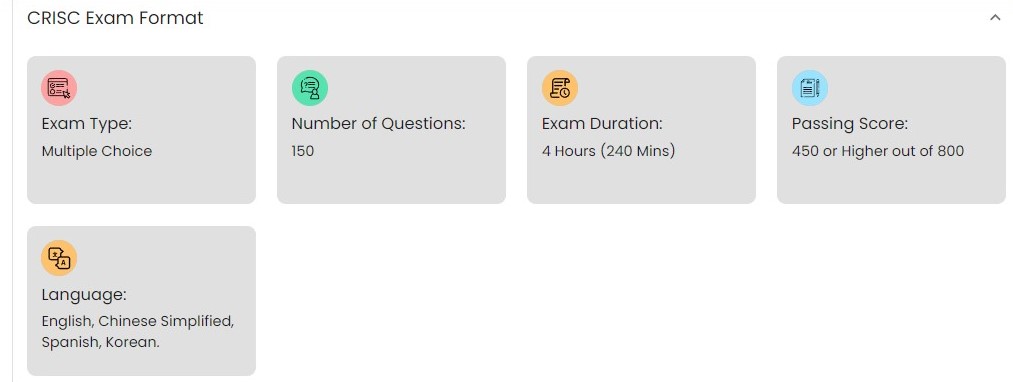
Image source: www.spoclearn.com

CRISC Exam Domain and Passing Score

SPOCLEARN’s CRISC certification accredited by ISACA has the exam module like the table below:
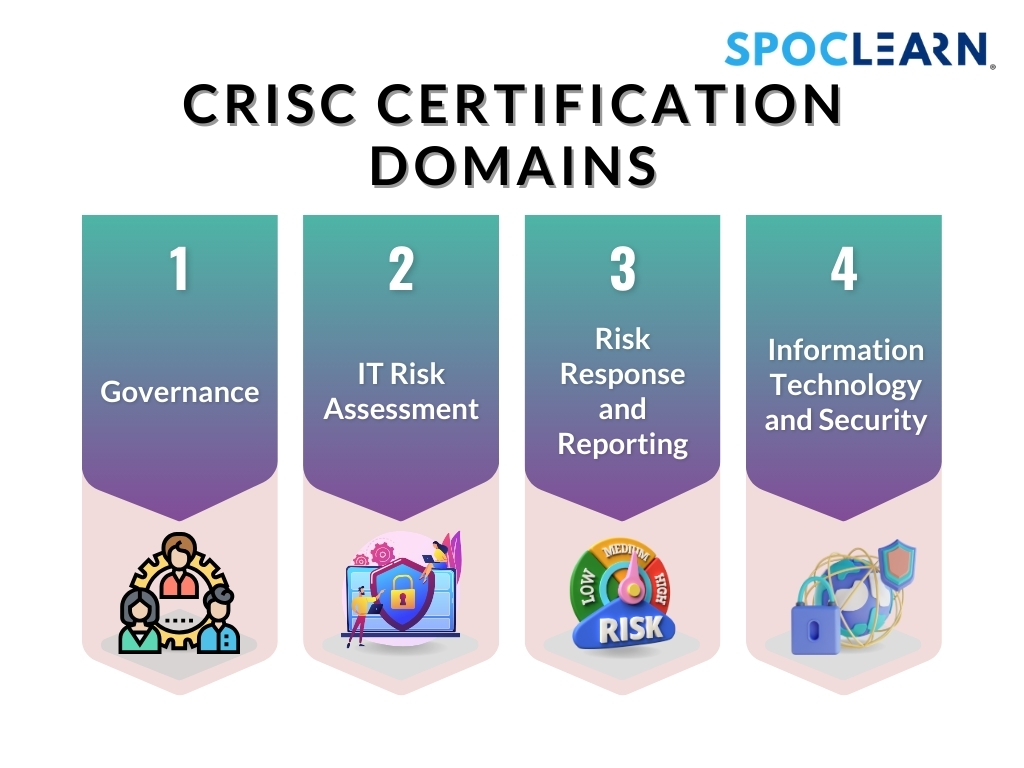
DomainTopics CoveredWeightage
Governance1. Organizational Governance
Organizational Strategy, Goals, and ObjectivesOrganizational Structure, Roles, and ResponsibilitiesOrganizational CulturePolicies and StandardsBusiness ProcessesOrganizational Assets
2. Risk Governance
Enterprise Risk Management and Risk Management FrameworkThree Lines of DefenseRisk ProfileRisk Appetite and Risk ToleranceLegal, Regulatory, and Contractual RequirementsProfessional Ethics of Risk Management
26%
IT Risk Assessment1. IT Risk Identification
Risk Events (e.g., contributing conditions, loss result)Threat Modelling and Threat LandscapeVulnerability and Control Deficiency Analysis (e.g., root cause analysis)Risk Scenario Development
2. IT Risk Analysis and Evaluation
Risk Assessment Concepts, Standards, and FrameworksRisk RegisterRisk Analysis MethodologiesBusiness Impact AnalysisInherent and Residual Risk
20%


Risk Response and Reporting
1. Risk Response

Risk Treatment / Risk Response OptionsRisk and Control OwnershipThird-Party Risk ManagementIssue, Finding, and Exception ManagementManagement of Emerging Risk

2. Control Design and Implementation

Control Types, Standards, and FrameworksControl Design, Selection, and AnalysisControl ImplementationControl Testing and Effectiveness Evaluation

3. Risk Monitoring and Reporting

Risk Treatment PlansData Collection, Aggregation, Analysis, and ValidationRisk and Control Monitoring TechniquesRisk and Control Reporting Techniques (heatmap, scorecards, dashboards)Key Performance IndicatorsKey Risk Indicators (KRIs)Key Control Indicators (KCIs)
32%
Information Technology and Security1. Information Technology Principles

Enterprise ArchitectureIT Operations Management (e.g., change management, IT assets, problems, incidents)Project ManagementDisaster Recovery Management (DRM)Data Lifecycle ManagementSystem Development Life Cycle (SDLC)Emerging Technologies

2. Information Security Principles

Information Security Concepts, Frameworks, and StandardsInformation Security Awareness TrainingBusiness Continuity ManagementData Privacy and Data Protection Principles
22%

Talking about the pass marks, exam scores are being scaled thoroughly. When a candidate’s raw score is converted to the exam’s common score, it is called a scaled score. CRISC also applies the same methodology. The scaled score ensures fairness and consistency in reporting exam results across different versions. ISACA scores exams on a scale from 200 to 800. To pass, you need a score of 450 or higher, which shows you’ve met the minimum knowledge standard.

Jobs and Salary for CRISC-Certified Professionals

Many people aim for IT certifications because they believe it will make it easier for them to find jobs and move up in their careers. But getting certified means spending time, working hard, and spending money, so some wonder if it’s worth it. Well, the answer is yes, IT certifications like CRISC are worth it.

The CRISC certification can qualify individuals for career advancement in numerous different roles, including, but not limited to:

  • CISO (Chief Information Security Officer)
  • CCO (Chief Compliance Officer)
  • Security Auditor
  • Security Director
  • System Engineer
  • Network Architect
  • Enterprise Leadership
  • Operations Manager
  • Information Control Manager
  • IT Manager
  • Security Manager
  • Risk Manager
  • Business Analyst
  • Security Analyst
  • Security Architect, and more

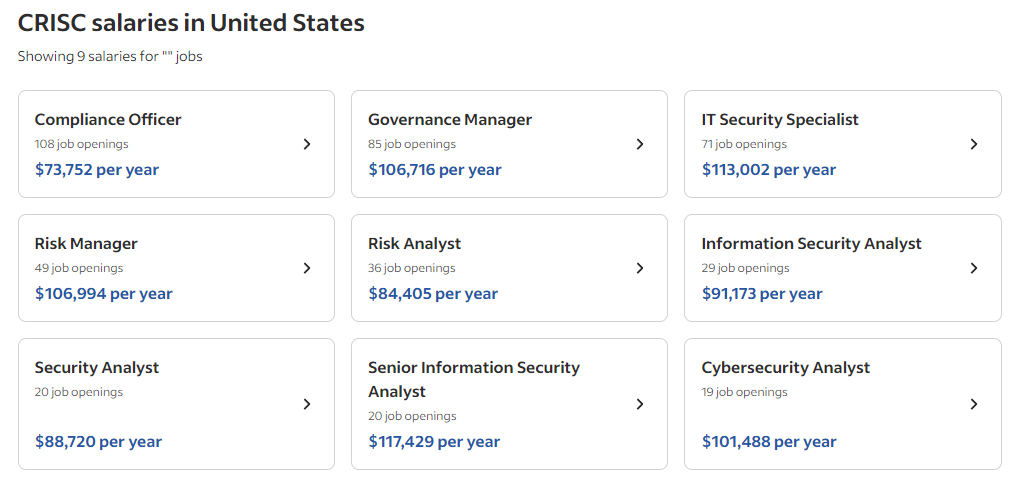
Ziprecruiter has given an approximate number on the salary of CRISC-certified professionals. They earn an average salary of $132,266 annually, with highest being at $192,000 per year.

The salary range for CRISC holders may vary because this certification applies to various security roles across diverse organizations. Attaining this certification can enable individuals to qualify for higher-paying positions or receive additional compensation in their current job. ISACA reports that the average annual salary for CRISC certification holders exceeds $151,000. As security professionals progress in their careers, they should consider pursuing additional professional certifications.

Given the current high demand for skilled cybersecurity professionals, obtaining a CRISC certification can lead to opportunities in mid-level positions. To explore further information on selecting the most suitable cybersecurity certifications, you can refer to available resources. According to Indeed, the average salaries for cybersecurity professionals in roles that often require or compensate for CRISC certification are as follows:

  • Risk manager – $88,770
  • Security engineer – $109,118
  • Senior risk analyst – $93,595
  • Security analyst – $85,269
  • Risk analyst – $81,902
CRISC Salary in united States

Conclusion

ISACA certifications are recognized everywhere in the world. They acknowledge both passing an exam and your work and educational background. With a CRISC certification, you gain the credibility needed to move forward in your career, whether it’s with your current employer or a new one.

CRISC shows employers that you’re capable of bringing value to their company by developing a risk-management program using the best methods for spotting, studying, ranking, and dealing with risks. The need for professionals who have the skills represented by a CRISC certification is increasing quickly, and companies around the world are actively looking for certified risk professionals.

Leave a Reply

Your email address will not be published. Required fields are marked *

Subscribe us