


In 2026, workflow bottlenecks are no longer just an operations problem. They are a growth problem, a cost problem, a customer experience problem, and increasingly, a people problem. Organizations are moving faster, running leaner, and layering more digital tools into daily work. Yet many teams still feel stuck. Microsoft’s 2025 Work Trend Index found that 53% of leaders said productivity must increase, while 80% of the global workforce said they lacked enough time or energy to do their work. The same research reported that employees are interrupted every two minutes during the workday, with 275 interruptions a day on average. Asana also reports that knowledge workers spend 60% of their time on “work about work” rather than skilled work, including status chasing, unnecessary meetings, duplicated tasks, and switching between tools.
That is exactly why Lean Six Sigma Green Belt, or LSSGB, matters in 2026.
Lean removes waste. Six Sigma reduces variation and defects. Green Belt professionals sit in the sweet spot between strategy and execution: they are practical problem-solvers who can identify process drag, map root causes, prioritize improvements, and help teams deliver measurable results. ASQ describes a Six Sigma Green Belt as someone who plays a critical role in improvement projects and applies data-driven problem-solving and process optimization skills.
This article explains how LSSGB helps solve workflow bottlenecks, why the approach is more relevant now than ever, and how enterprises and professionals can use it to improve speed, quality, and business performance.
Why workflow bottlenecks are getting worse in 2026
Most bottlenecks do not begin as dramatic failures. They start as small frictions: an approval that takes too long, unclear ownership, duplicate data entry, too many handoffs, rework, missed exceptions, or disconnected systems. Over time, those frictions become a pattern.
Three forces are making the problem more visible in 2026.
First, organizations are under pressure to redesign how work flows. McKinsey’s State of Organizations 2026 highlights process and workflow redesign as a key lever for reorganization, based on a global survey of more than 10,000 senior executives across 15 countries and 16 industries.
Second, companies are adopting automation and AI faster, but automation alone does not remove broken process logic. Gartner said in September 2024 that by 2026, 30% of enterprises would automate more than half of their network activities, up from under 10% in mid-2023. McKinsey’s 2025 State of AI also found that high performers are far more likely than others to fundamentally redesign workflows, not just add AI on top of old processes.
Third, the financial cost of poor process quality is still underestimated. ASQ defines Cost of Quality as a methodology that helps organizations understand how much of their resources go into prevention, appraisal, and fixing internal or external failures. ASQ also notes that only 31% of respondents fully understand the impact of quality costs on their organizations’ financial performance.
In simple terms, many businesses know they have inefficiencies. Fewer know how much those inefficiencies are costing.
What LSSGB actually solves
LSSGB is especially effective when a business has recurring delays, quality leaks, inconsistent output, or overloaded teams. A Green Belt does not guess. They define the problem, measure the current state, analyze root causes, improve the process, and then control the gains.
That is why the method works across manufacturing, healthcare, logistics, BFSI, IT services, shared services, and customer support.
Here is a simple way to understand where Green Belt thinking applies:
| Common workflow bottleneck | What it looks like in daily work | LSSGB response |
|---|---|---|
| Approval delays | Tasks sit in inboxes or queues for days | Map approval path, remove redundant sign-offs, set SLA triggers |
| Rework | Work comes back for correction repeatedly | Use root cause analysis, defect tracking, standard work |
| Handoffs | One team finishes but the next team lacks clarity | Define ownership, improve handoff criteria, create visual flow |
| Tool sprawl | Teams use too many apps and lose context | Simplify process steps, reduce duplicate inputs, standardize data |
| Capacity imbalance | Some roles are overloaded while others wait | Analyze takt time, queue time, and resource distribution |
| Inconsistent quality | Output varies by person, shift, or region | Standardize process, train to baseline, add controls |
| Firefighting culture | Teams solve symptoms but not causes | Apply DMAIC, 5 Whys, Pareto analysis, control plans |
This is not theory. It reflects real workplace pain points. Atlassian found that leaders and teams waste 25% of their time just searching for answers. Asana found the average knowledge worker spends 103 hours a year in unnecessary meetings and 209 hours on duplicative work.
Why Lean Six Sigma Green Belt is still highly relevant in an AI era
Some professionals assume LSSGB is only useful in factories. That is outdated thinking.
In 2026, the rise of AI and digital workflows has actually made LSSGB more valuable, not less. When a process is already broken, automation can make the breakage move faster. When a workflow is unclear, AI can create more noise instead of more value. McKinsey’s 2025 State of AI says most organizations are still not realizing enterprise-wide financial impact from AI, and that workflow redesign is one of the strongest contributors to meaningful business impact.
That is where Green Belt capability becomes powerful. It gives teams a disciplined way to answer questions such as:
- Where is the real constraint?
- Which step creates the longest queue?
- What is causing the error rate?
- Which approvals add value, and which only add time?
- Can this step be standardized, simplified, automated, or eliminated?
Without that discipline, organizations often invest in new tools while keeping old bottlenecks.
The LSSGB method for removing bottlenecks: DMAIC in practice
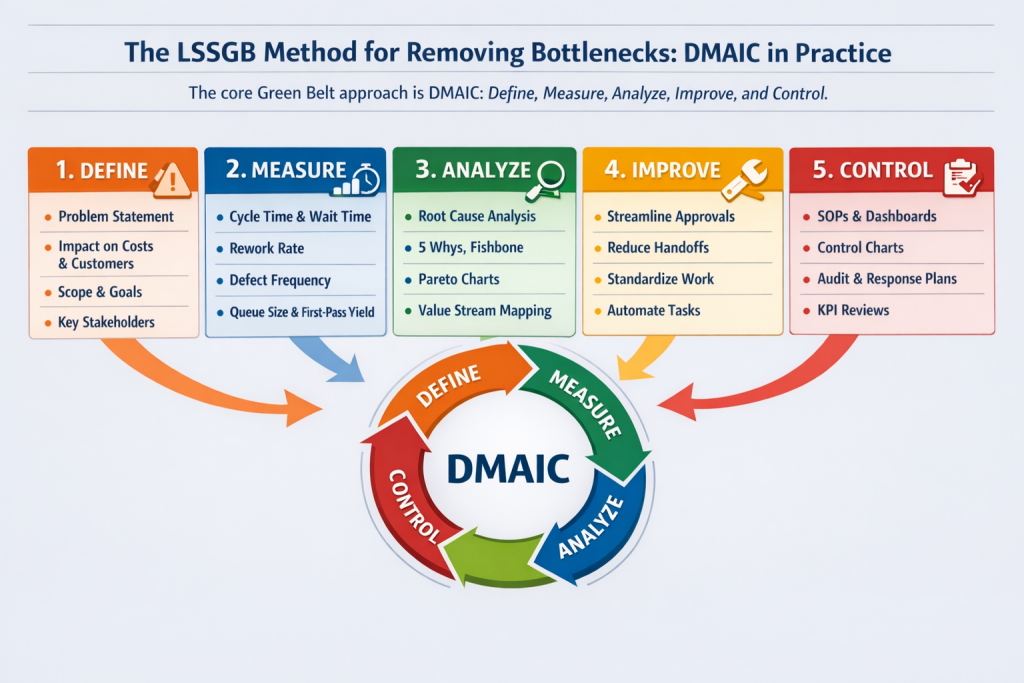
The core Green Belt approach is DMAIC: Define, Measure, Analyze, Improve, and Control.
1. Define
Start with the pain point in business language. Not “the process is slow,” but “invoice approval takes 11 days, misses vendor SLAs, and causes duplicate follow-ups.”
A strong Green Belt project defines:
- the problem statement
- the impact on cost, customer, compliance, or delivery
- the scope
- the goal
- the stakeholders
2. Measure
This is where many teams improve instantly, because they finally stop relying on assumptions.
A Green Belt measures:
- cycle time
- wait time
- touch time
- rework rate
- queue size
- first-pass yield
- defect frequency
- escalation count
The act of measurement itself often reveals the truth. What feels like “one slow process” may actually be three different problems hiding in one workflow.
3. Analyze
Now the team identifies root causes.
This may include:
- 5 Whys
- Fishbone analysis
- Pareto charts
- value stream mapping
- cause-and-effect analysis
- stratification by team, shift, product, region, or case type
Taiichi Ohno’s observation that “there is no kaizen without standards” still matters here. If the baseline is undefined, improvement becomes opinion-driven.
4. Improve
This is where bottlenecks are actually removed.
Typical Green Belt improvements include:
- removing duplicate checks
- redesigning approval paths
- reducing handoffs
- introducing standard work
- simplifying forms
- balancing workloads
- adding visual management
- mistake-proofing common failure points
- automating repeatable low-risk steps
5. Control
This is the difference between a short-lived fix and a lasting result.
A Green Belt locks in gains using:
- SOPs
- dashboards
- control charts
- response plans
- audit checks
- ownership matrix
- KPI reviews
W. Edwards Deming’s line, “The job of management is not supervision, but leadership,” fits this stage well. Sustainable process improvement needs leaders who support better systems, not just push people harder.
A practical example: how LSSGB solves a bottleneck
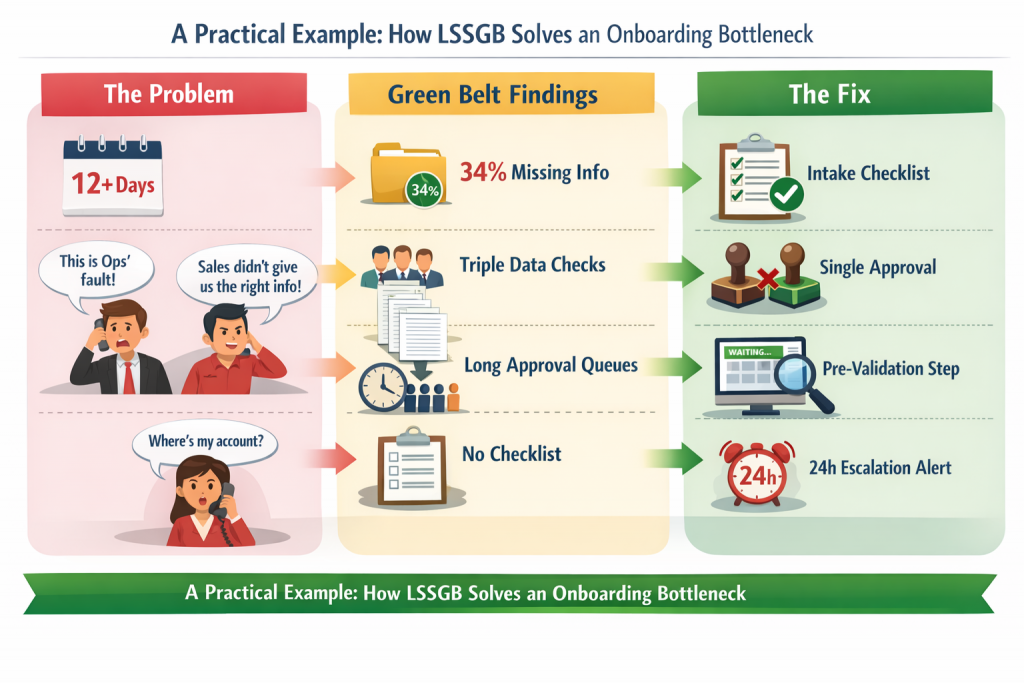
Imagine a regional service company handling customer onboarding.
The problem
Customers are promised onboarding within 5 business days, but actual completion averages 12 days. Complaints are rising. Sales blames operations. Operations blames incomplete documentation.
What a Green Belt finds
After process mapping and measurement, the Green Belt discovers:
- 34% of files are returned for missing information
- three separate teams verify the same customer data
- approvals wait in queue longer than the actual work takes
- there is no single checklist for document completeness
The fix
The project team:
- introduces a single intake checklist
- removes one redundant approval
- creates a pre-validation step before handoff
- standardizes required fields in the CRM
- sets an escalation alert for cases idle for more than 24 hours
The result
Cycle time drops, rework falls, staff frustration reduces, and customers get faster activation.
This is the real value of LSSGB. It turns vague operational pain into structured action.
Where enterprises are seeing results from process redesign
The broader market direction supports this approach. Deloitte’s 2025 smart manufacturing survey reported that respondents saw, on average, a 10% to 20% improvement in production output, a 7% to 20% improvement in employee productivity, and 10% to 15% in unlocked capacity from smart manufacturing initiatives. World Economic Forum reporting on its Global Lighthouse Network also highlights that operational leaders are scaling people-centered transformation, AI adoption, and productivity-focused redesign across more than 223 sites in over 30 countries and 40 industries.
The lesson is important: world-class operators do not just work harder. They redesign flow.
Business benefits of LSSGB for 2026
| Business area | How LSSGB helps |
|---|---|
| Productivity | Reduces waiting, duplication, and rework |
| Customer experience | Speeds up delivery and improves consistency |
| Cost control | Cuts failure costs, waste, overtime, and escalation effort |
| Employee experience | Reduces chaos, confusion, and firefighting |
| Digital transformation | Fixes process logic before automation scales it |
| Quality and compliance | Improves standardization, traceability, and control |
| Leadership capability | Builds a culture of structured problem-solving |
For professionals, the value is equally clear. ASQ says Green Belt certification is designed for professionals with at least three years of work experience who want to demonstrate expertise in Six Sigma tools, process optimization, and data-driven problem-solving.
That makes LSSGB useful for:
- operations managers
- quality professionals
- project managers
- process excellence teams
- business analysts
- supply chain professionals
- service delivery leaders
- transformation teams
What readers should do before starting an LSSGB improvement project
Before jumping into solutions, ask these five questions:
- Where does work wait the longest?
- Which step creates the most rework?
- Which metric matters most: speed, quality, cost, or customer response time?
- Is the bottleneck caused by people, process, policy, or platform?
- What one change would create the biggest flow improvement first?
This matters because not every delay is a capacity problem. Some are clarity problems. Some are design problems. Some are measurement problems.
FAQs
1. What is LSSGB and why is it useful in 2026?
LSSGB stands for Lean Six Sigma Green Belt. It is a professional capability in structured process improvement that combines waste reduction and defect reduction. In 2026, it is especially useful because teams are dealing with fragmented workflows, digital overload, rising expectations, and pressure to improve performance without increasing headcount.
2. Can Lean Six Sigma Green Belt help outside manufacturing?
Yes. LSSGB works well in IT, healthcare, logistics, BFSI, HR operations, procurement, customer support, and shared services because bottlenecks exist anywhere work flows through steps, decisions, approvals, and handoffs. ASQ’s quality and cost-of-quality framework is not limited to a single industry.
3. How does LSSGB reduce workflow bottlenecks?
It uses DMAIC to define the problem, measure delay and defects, analyze root causes, improve the process, and control the gains. Instead of treating symptoms, it addresses the system conditions that create waiting, rework, duplication, and inconsistency.
4. Is LSSGB still relevant when companies are adopting AI and automation?
Absolutely. Current research suggests workflow redesign is one of the strongest drivers of meaningful business impact from AI. If the process is poorly designed, automation may increase speed without increasing value. LSSGB helps organizations redesign flow before scaling technology.
5. What results can organizations expect from process improvement?
Results vary by sector and maturity, but common gains include lower cycle time, less rework, better first-pass quality, faster approvals, improved productivity, and more capacity. Deloitte’s 2025 smart manufacturing survey found average gains of 10% to 20% in production output, 7% to 20% in employee productivity, and 10% to 15% in unlocked capacity.
Conclusion
Workflow bottlenecks in 2026 are not simply the result of busy teams. More often, they come from broken flow, unclear ownership, poor standards, duplicated effort, and unmanaged variation. That is why Lean Six Sigma Green Belt remains such a practical and high-value capability. It gives professionals and enterprises a proven way to see waste, measure delay, analyze root causes, and build processes that are faster, cleaner, and easier to scale.
For readers, leaders, and teams trying to make sense of rising complexity, one message stands out: process improvement is no longer optional. It is a competitive advantage. And for anyone serious about solving workflow bottlenecks with a structured, data-backed approach, Lean Six Sigma Green Belt certification, workflow bottleneck reduction, and process improvement training remain among the strongest global search-intent keywords guiding both individual learners and enterprise buyers toward practical solutions.