


Introduction
Many organizations start their agile journey within software development or IT. But real competitive advantage comes when agility transcends those boundaries — when HR, finance, operations, marketing, legal, and other functions adopt an agile mindset too. Without that, agility remains a siloed capability, with limited organizational impact.
In this post, we explore why culture beyond software teams matters, what the challenges are, and how large organizations can successfully embed agility across the enterprise. We’ll draw on empirical research, transformation practice, and lessons from organizations that have gone beyond “IT agile.”
Why Agile Culture Must Extend Beyond Software Teams
Before diving into “how,” it helps to understand why this expansion is essential.
1. Avoiding the “Agile Island” Problem
When only development teams are agile, you risk creating disconnected islands. Software may ship fast, but downstream dependencies (finance, procurement, regulatory, operations) become bottlenecks. This undermines the promise of faster cycles, responsiveness, and integration.
2. Holistic Value Delivery
Enterprises deliver value not just through software — but through processes, services, customer-facing operations, supply chains, compliance, and more. To optimize end-to-end value, you must have agility embedded across those domains.
3. Cultural Sustainability
If agility is perceived as “just for IT,” other functions may resist, view it as a fad, or adopt superficial practices without the mindset shift. To make transformation sustainable, the cultural core must reach across the organization.
4. Strategic Agility & Adaptation
In volatile environments (VUCA), organizations must sense, respond, and reconfigure resources and capabilities fast. That requires agility not only in product delivery, but in strategy, finance, HR policies, and operations.
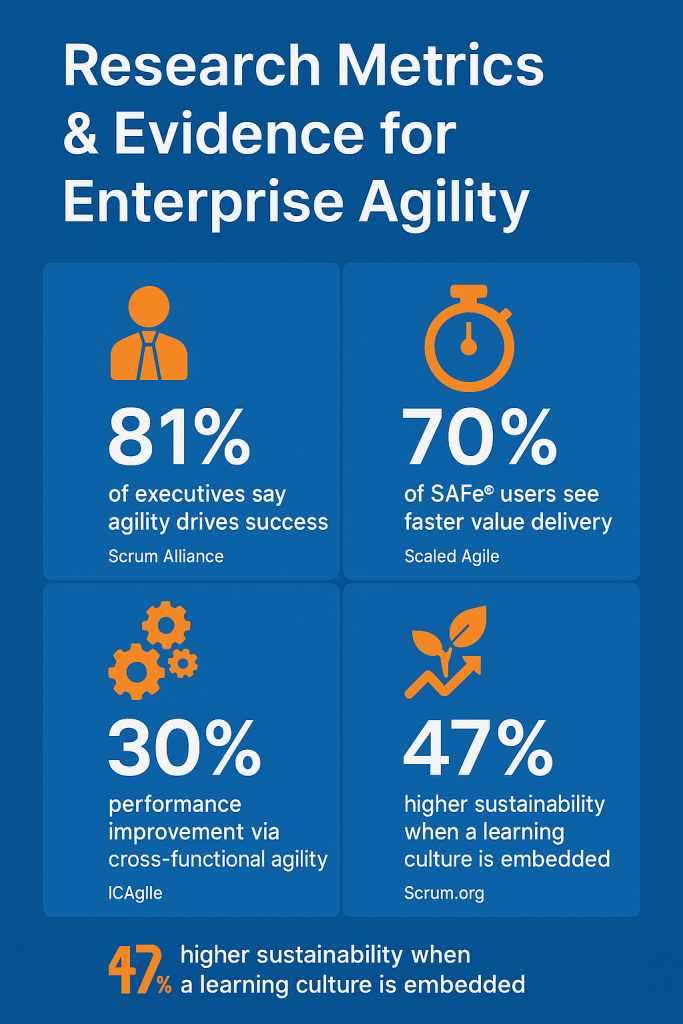
5. Evidence from Research
- A mixed-methods study on agile culture notes a crucial distinction between doing agile (practices) and being agile(mindset, values) — the latter is underrepresented in literature but critical for sustainable agility. arXiv
- In hierarchical cultures, research suggests that leadership strategies are vital in balancing agile values with structural constraints, especially when scaling into non-IT functions. Rutgers Business Review
- The Agile Project Management beyond Software Development research studied 334 projects and found that while agile was traditionally in IT, ~22% of respondents applied agile beyond software projects — indicating early but limited adoption. ResearchGate
These point to both the promise and the complexity of expanding agility into new domains.
Key Challenges & Barriers
Before transformation, it helps to surface core challenges you’ll likely meet.
- Cultural Clash with Traditional Functions
Functions like HR, finance, legal, and operations are often designed for predictability, rule-based governance, and risk control. Agile’s emphasis on flexibility, experimentation, and decentralization can conflict with existing norms. Rutgers Business Review+1 - Leadership Inconsistency / “Do as I Say, Not as I Do”
Research finds many organizations expect change from employees without embodying agile values themselves — a top barrier to cultural adoption. arXiv - Structural & Governance Misalignment
Legacy structures — central budgets, rigid approval gates, silos, command-and-control hierarchy — frequently inhibit agile adaptation across non-IT functions. arXiv+1 - Lack of Trust, Psychological Safety & Feedback Culture
Agile culture presumes trust, openness, experimenting, failing fast, transparency, and feedback. If non-IT teams lack that, transitions will falter. In one study, “humans in an organization not allowed to make mistakes” was a strong barrier. arXiv - Skill Gaps & Mindset Resistance
Many roles are not used to iterative planning, customer-centric thinking, cross-functionality, and continuous learning. Resistance arises when skills, incentives, and performance systems remain unchanged. - Fragmented Implementation / Inconsistent Adoption
If functions adopt agile in patchwork fashion without coordination or alignment, you may see conflicting practices, confusion, and lack of coherence. - Overemphasis on “Doing Agile” vs. Embedding Values
Many transformations focus on ceremonies, tools, processes — but neglect the deeper shift to values and principles. This often leads to superficial adoption and regression. arXiv+1
Understanding and anticipating these challenges helps you design mitigation strategies up front.
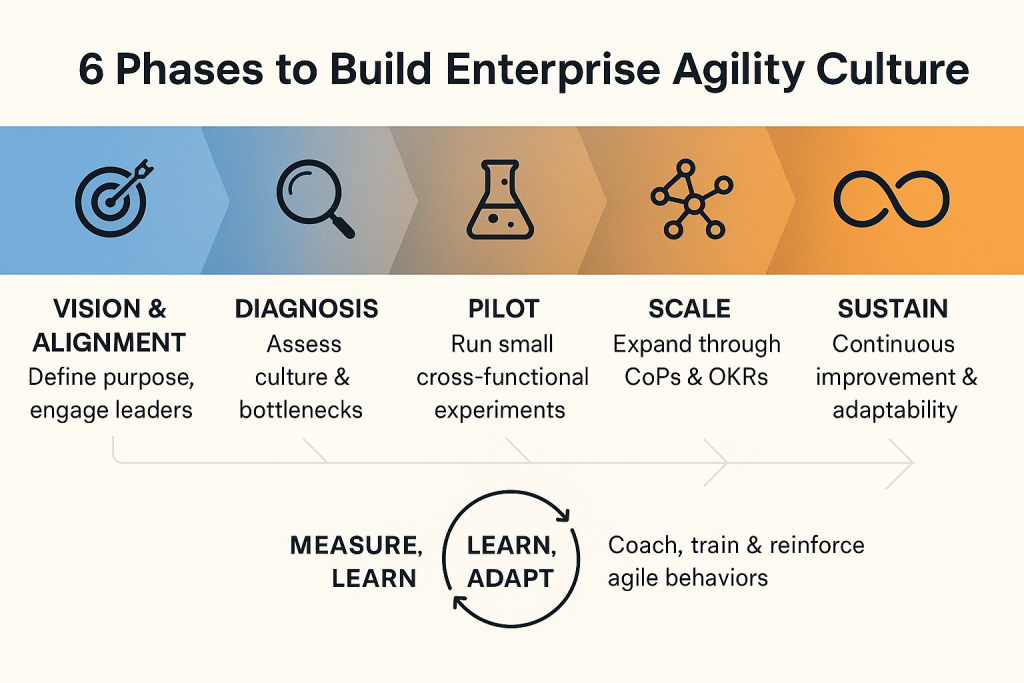
How to Establish an Agility Culture Across the Enterprise
Here is a structured approach, blending best practices and transformation learnings.
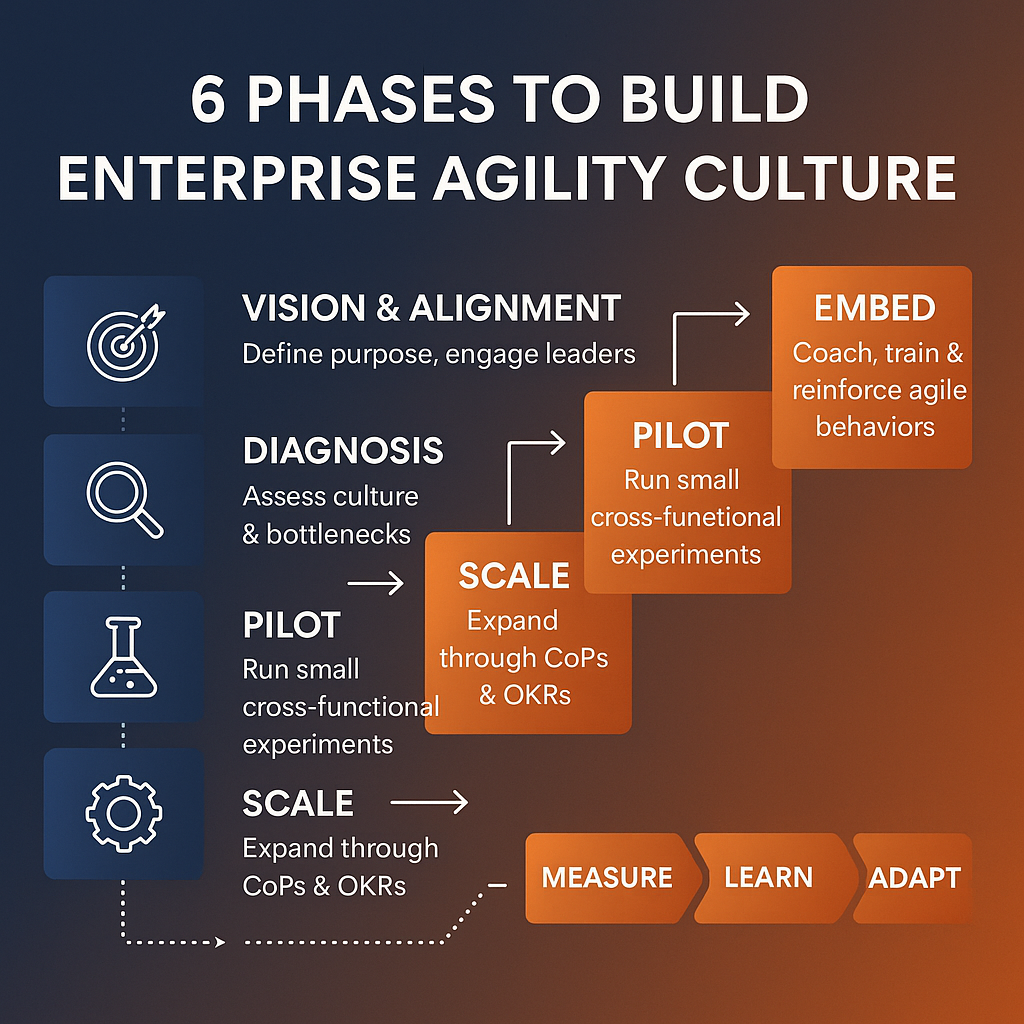
Phase 1: Executive Alignment & Vision Setting
- Develop a unified, compelling narrative about why agility beyond IT is strategic, not optional.
- Leadership commitment and role modeling: Leaders across functions (HR, finance, operations) must embody agile values — transparency, learning, empowerment.
- Form a cross-functional transformation team including stakeholders from each domain to co-own the change.
- Define guiding principles for agility beyond software (e.g., “prioritize customer outcomes,” “learn fast,” “team autonomy,” “shared accountability”).
Phase 2: Current State Diagnosis & Culture Mapping
- Conduct cultural audits / maturity assessments across functions: measure readiness, values, feedback norms, hierarchy tolerance, psychological safety.
- Map process flows, dependencies, decision rights, hand-offs, and governance in non-IT domains.
- Identify pain points, bottlenecks, and culture gaps that impose friction on agility adoption.
Phase 3: Pilots & Probing Interventions
Start small, but with visibility:
- Choose one or two non-IT functions (e.g., HR, marketing, operations) to pilot agile ways of working.
- Define small, cross-functional “agile squads” with representatives from functional areas.
- Introduce agile practices (daily stand-ups, retrospectives, iteration planning, Kanban, visual boards) adapted to domain context.
- Emphasize inspect & adapt cycles in the pilot — learn, adapt, evolve.
Phase 4: Expansion, Scaling & Integration
- Scale pilots to adjacent teams or domains leveraging lessons learned.
- Introduce coordinating mechanisms (communities of practice, guilds, agile champions) across functions.
- Align performance systems, incentives, HR policies, and budgets to support cross-functional, outcome-focused work.
- Evolve governance frameworks (lightweight guardrails, tiered reviews) that balance autonomy and accountability.
Phase 5: Culture Reinforcement & Capability Building
- Invest in training, coaching, and mentoring in non-IT functions (e.g., HR agile, agile finance, agile operations).
- Create forums for cross-functional teams to share learnings (brown bags, internal webinars, showcase events).
- Embed mechanisms for feedback loops, transparency, empowerment, and safe experimentation.
- Promote agile leadership development for middle and senior managers outside IT.
Phase 6: Institutionalization & Continuous Evolution
- Make agility a core part of your operating model — not a separate “transformation effort.”
- Monitor leading and lagging indicators: cycle time, throughput, customer satisfaction, employee engagement, decision velocity.
- Review and evolve your culture and practices periodically.
- Stay open to adapting and evolving your agile model as the business changes.
Practical Tips & Considerations
- Tailor to domain context: HR agile looks different from finance agile. Don’t copy-paste software agile wholesale.
- Start with “low friction” functions first (e.g. marketing, digital operations), before tackling heavy regulatory or compliance units.
- Co-create change with teams: involve people from those functions in defining their agile processes — don’t impose from above.
- Use “bridge roles” or agile ambassadors: people who understand agile and the domain who can translate between worlds.
- Balance autonomy and governance: guardrails matter: ensure compliance, risk control, and standards through lightweight oversight.
- Celebrate quick wins: early success stories in non-IT functions help build momentum and overcome scepticism.
- Ensure feedback culture and psychological safety: leaders must support experimentation, failure, reflection.
- Iterate your change approach: just as agile favors iterative delivery, treat the transformation itself as an agile experiment.
Illustrative Example (Hypothetical)
Suppose a large bank wants to bring agility into its compliance and risk function:
- Pilot: Form a cross-functional squad including compliance, legal, operations, and IT. Use Kanban to manage risk assessments, schedule regular retrospectives, transparency of backlog.
- Experiment: shorten approval cycles, embed continuous compliance reviews, automate compliance checks.
- Metrics: measure lead time for compliance reviews, number of compliance defects caught late, stakeholder satisfaction.
- Expansion: once pilot stabilizes, propagate to other risk units (fraud, audit), align with finance and operations.
- Culture: leadership in compliance publicly supports experimentation, allows fast fail, encourages feedback.
Over time, compliance becomes not a bottleneck but a partner in agility, enabling faster product launches with lower risk.
Evidence & Supporting Insights
- McKinsey’s survey of ~2,000+ respondents found that many organizations pursuing agile transformation beyond team-level reported negligible business impact — often because transformations lacked scale, coherence, or culture. McKinsey & Company
- The distinction between doing and being agile is important: sustainable transformation depends on shifting values, mindsets, and behavior, not just applying practices. arXiv
- In the Agile Project Management beyond Software study, 22% of respondents’ organizations had applied agile beyond IT — showing interest is growing but adoption is still nascent. ResearchGate
- Research in hierarchical cultures emphasizes leadership strategies: incremental adoption, balancing hierarchical norms with agile values, and evolving structures gradually. Rutgers Business Review
These underscore that the journey is long, and successful expansion of agility is more about culture, leadership, and organizational design than about tools or ceremonies.
Measuring Success: Key Metrics to Track
When expanding agile culture beyond IT, look beyond traditional IT metrics. Consider:
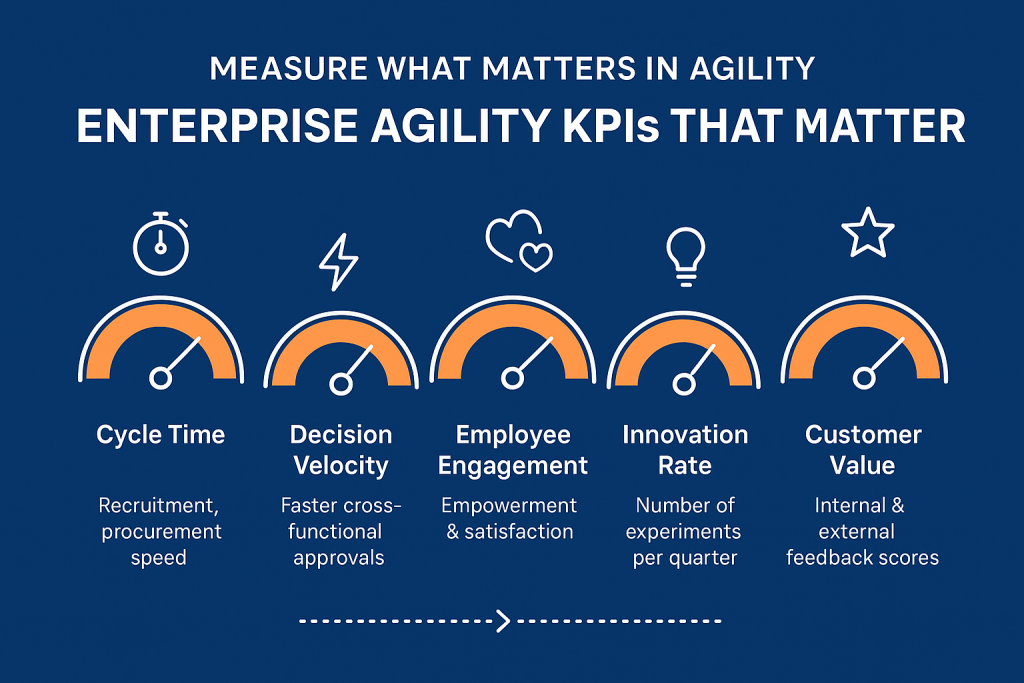
| Domain | Possible Metrics / Indicators |
|---|---|
| Cycle / Lead Time | Time taken for HR process, procurement, compliance decisions |
| Throughput / Flow | Number of items processed per iteration in non-IT teams |
| Customer / Stakeholder Satisfaction | e.g. internal partners’ feedback on responsiveness |
| Quality & Defects | Errors, rework, compliance incidents |
| Employee Engagement | Surveys measuring autonomy, feedback, learning culture |
| Decision Velocity | Time to decision on cross-functional initiatives |
| Innovation Rate | Number of experiments, new process ideas, improvements introduced |
Regularly inspect these metrics and adapt your approach.
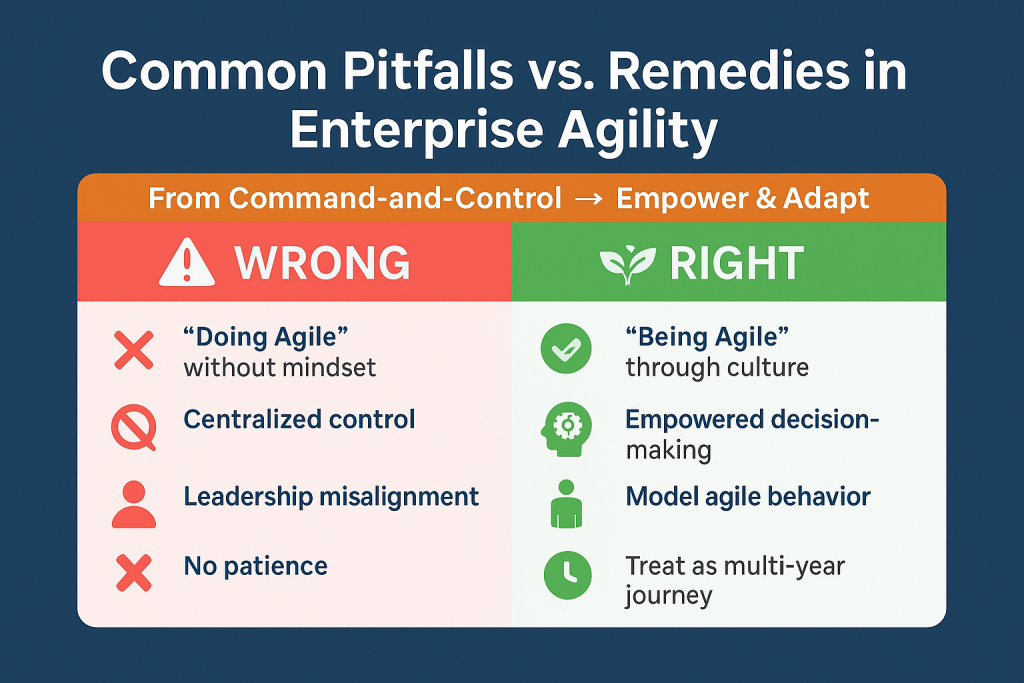
Pitfalls to Watch & How to Avoid Them
- Treating agile as a “toolbox” exercise: don’t just roll out ceremonies; foster values and behaviors.
- Ignoring resistance: functions with strong regulatory or risk concerns may resist. Engage them early, address their fears, bring them into design.
- Overcentralizing governance: don’t revert to command-and-control when things get messy — keep guardrails light and adaptive.
- Neglecting cross-functional dependencies: ensure alignment across functions, avoid misalignment or contradictory processes.
- Changing structure prematurely: let agile practices stabilize before you redesign major roles or org charts.
- Lack of patience: culture change is slow. Don’t rush or expect full transformation in 3 months.
Summary
Expanding agility beyond software teams is a sophisticated and high-leverage transformation. When done right, it enables true organizational responsiveness, cross-functional alignment, and sustained adaptability. But it requires shifting culture, leadership, practices, governance, incentives, and skills — not just transplanting agile methods into new domains.
If you’re leading such an effort:
- Begin with strong executive alignment and a compelling vision
- Diagnose culture and dependencies in non-IT functions
- Pilot thoughtfully, learn fast, scale gradually
- Invest deeply in culture, leadership, feedback loops
- Measure results, adapt continuously