
Trending Now

ITIL 4 vs ITIL (Version 5): The Global, No‑Fluff Guide to What’s New, What Stays, and How to Transition
PRINCE2 7 Foundation: Complete Exam Guide, Format, Pass Mark, and Study Plan (2026)
Lean Six Sigma Yellow Belt: The 2026 Beginner Guide (Tools, Examples, Real Workplace Use)
Technical SEO Audit 2026: The Only Checklist That Still Matters
Content Refresh Strategy 2026: How to Update Old Pages for New Traffic
CAPM Exam Content Outline Explained: Domains, Weightage, and What to Study First
GA4 Setup Guide 2026: Step-by-Step for Accurate Tracking
From Keywords to Answers: How Search Works in 2026 
CAPM Certification 2026: The Complete Exam + Training Guide (PMI-Updated)
Traditional SEO vs Answer-First SEO: What Actually Ranks in 2026
ITSM Evolution: From Monolithic Systems to Cloud‑Centric Architectures (2026)
How to Run High-Performance Retargeting Campaigns Using AI
Project Leadership in 2026: Skills Every Successful Project Manager Needs
Technical SEO for 2026: Crawl Optimization, Log Analysis & AI Indexing Signals
Top 12 Project Management Mistakes and How to Avoid Them
PRINCE2® 7 (2026 Guide): What’s New, What Changed, and Why It Matters
Lean Six Sigma in 2026: What’s Changed (AI, Automation, Process Intelligence) & What Still Works
Root Cause Analysis in 2026: The Modern RCA Playbook for Faster, Repeatable Fixes
ITIL Is for Everyone and for Every Organization: A Deep‑Dive Playbook (2026)
Social Media Algorithms Explained (2026 Edition): What Actually Drives Reach Today
Power Query Best Practices 2026: Faster Refresh, Cleaner Models, Fewer Errors
PL-300 Exam Guide 2026: Skills Measured, Study Plan, and What’s Changed
LLMS.txt vs Robots.txt in 2026: What to Implement (and What to Avoid)
SEO in 2026: The Complete Playbook for AI Search, AEO & GEO
Google Ads Audits in 2026: A Step-by-Step Checklist to Fix Wasted Spend and Unlock Growth
AI-Driven Risk Management: Predict Risks Before They Happen
On-Page SEO 2026: New Techniques for Topical Relevance & AI Search
The Future of Project Management: Trends Reshaping 2025–2030 
Hybrid Project Management: Why Organizations Are Transitioning in 2026 and Beyond
AI-Powered Project Planning: Faster, Smarter, and More Accurate Strategies 
Industry Predictions for 2026: From GenAI to Value Streams and Total Experience
PMP vs CAPM vs PRINCE2: Which Certification Offers the Best ROI in 2026?
AI in Project Management: How Intelligent Tools Are Transforming PM Workflows 
Performance Max Mastery: How to Scale ROI with Smart Automation 
What is SAFe RTE? (Release Train Engineer)
SAFe RTE: The Complete Guide to Becoming a High-Impact Release Train Engineer (2025–2026)
Time Management: How to Turn Hours into Impact
Lean Six Sigma Green Belt: Skills, Value, Demand & Global Trends 2026
PL-300: Microsoft Power BI Data Analyst Certification for Career Growth Globally 2026
Strong & Sustained Demand for PMP Certification in 2026
Why Organizational Agility Matters: The Strategic Imperative for Big Enterprises
Building an Agility Culture Beyond IT Teams
How to Re-Engage Remote Teams: PMP Question on Motivation and Collaboration
Understanding Tuckman’s Team Development Stages - PMP Exam Question Explained
Why do Business Owners assign business value to team PI Objectives?  
Benefits of EXIN Agile Scrum Foundation Certification
Benefits of PMP Certification for Corporate and Individual Professionals in 2025
Streamlining Vaccine Development during a Global Health Crisis – An Imaginary PRINCE2 Case Study
PMBOK Guide Tips for Managing Change and Uncertainty in Projects
How to Apply PRINCE2 Methodologies in Real-World Projects
What is PRINCE2® 7? A Simple Explanation for Beginners
Project Management Certification in the United States of America
The Evolution of Project Management: From Process-Based to Principles-Based Approaches
Mastering ITIL and PRINCE2 for Enhanced Project Outcomes in Indian GCCs
Exploring the Eight Project Performance Domains in the PMBOK® Guide
PMI Best Practices for Project Management Across Different Environments
Your Ultimate Project Management Guide: Explained in Detail
Top Benefits of PRINCE2 for Small and Medium Enterprises
Best Project Management Certifications of 2025
The Importance of Tailoring PRINCE2 to Fit Your Organization's Needs
Resolve Slash URLs & Learn 301 vs. 308 Redirects Effectively
What is a standard change in ITIL 4?
Which practice provides a single point of contact for users?
What is the first step of the guiding principle 'focus on value'?
Which is a benefit of using an IT service management tool to support incident management?
A service provider describes a package that includes a laptop with software, licenses, and support. What is this package an example of?
What should be included in every service level agreement?
What are the two types of cost that a service consumer should evaluate?
The Business Case for SAFe®: Solving Modern Challenges Effectively
Which ITIL concept describes governance?
How does ‘service request management’ contribute to the ‘obtain/build’ value chain activity?
Which practice is the responsibility of everyone in the organization?
How Kaizen Can Transform Your Life: Unlock Your Hidden Potential
Unlocking the Power of SAFe®: Achieving Business Agility in the Digital Age
What is DevOps? Breaking Down Its Core Concepts
Which is a purpose of the ‘service desk’ practice?
Identify the missing word(s) in the following sentence.
Which value chain activity includes negotiation of contracts and agreements with suppliers and partners?
How does categorization of incidents assist incident management?
What is the definition of warranty?
Identify the missing word in the following sentence.
Which two needs should ‘change control’ BALANCE?
Which value chain activity creates service components?
Kaizen Costing - Types, Objectives, Process
What Are ITIL Management Practices?
What are the Common Challenges in ITIL Implementation?
How Do You Align ITIL with Agile and DevOps Methodologies?
How Can ITIL Improve IT Service Management?
What is DevSecOps? A Complete Guide 2025
How to do Video Marketing for Audience Engagement?
What is Site Reliability Engineering (SRE)?
The History of DevOps: Tracing Its Origins and Growth
Mastering Business Agility: A Deep Dive into SAFe®
Which statement is true about a Value Stream that successfully uses DevOps?
How Do I Prepare for the ITIL 4 Foundation Exam?
What is the Purpose of the ITIL Foundation Certification?
SIAM Global Survey 2023 Insights: The Future of IT Service Management
Comprehensive Guide to ITIL 4 Key Concepts of Service Management
What is ITIL? Guide to ITIL 4, Certification, and Best Practices
Top 10 Benefits of ITIL v4 Foundation Certification
what is kaizen costing

Kaizen Costing – Types, Objectives, Process

Picture of Bharath Kumar
Bharath Kumar
Bharath Kumar is a seasoned professional with 10 years' expertise in Quality Management, Project Management, and DevOps. He has a proven track record of driving excellence and efficiency through integrated strategies.

Kaizen costing refers to the process of reducing costs during product production. It is a manufacturing process that involves identifying and eliminating waste in the manufacturing process. This method revolves around suppliers, re-designs, and waste reduction. Kaizen costing focuses on two significant verticals- one for making products and the other for taking care of things the organization owns. This blog will give thorough details of Kaizen budgeting and cost-saving Kaizen ideas.
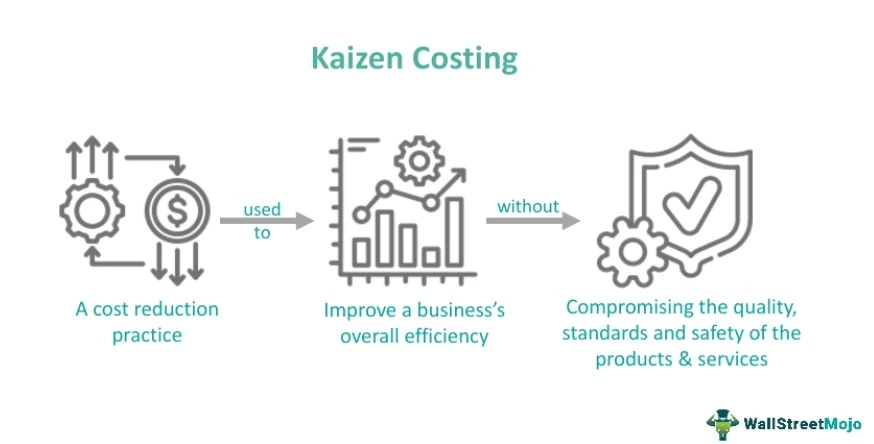
Kaizen Costing

Image Source: wallstreetmojo.com

Examine Controllable Business Costs

1. Supply Chain Costs- These costs are associated with transportation, inventory, administration, and procurement.

2. Production Costs- Costs related to machinery, equipment, labor, tools, and raw materials are known as production costs.

3. Human Resource (HR) Costs- This approach can manage the expenses associated with recruiting, training, nurturing, and retaining skilled employees.

4. Other Costs- Enterprises can employ the cost reduction strategy to oversee expenses related to obtaining licenses, patents, trademarks, and other legal formalities.

Kaizen training course

Objectives of Kaizen Budgeting or Costing

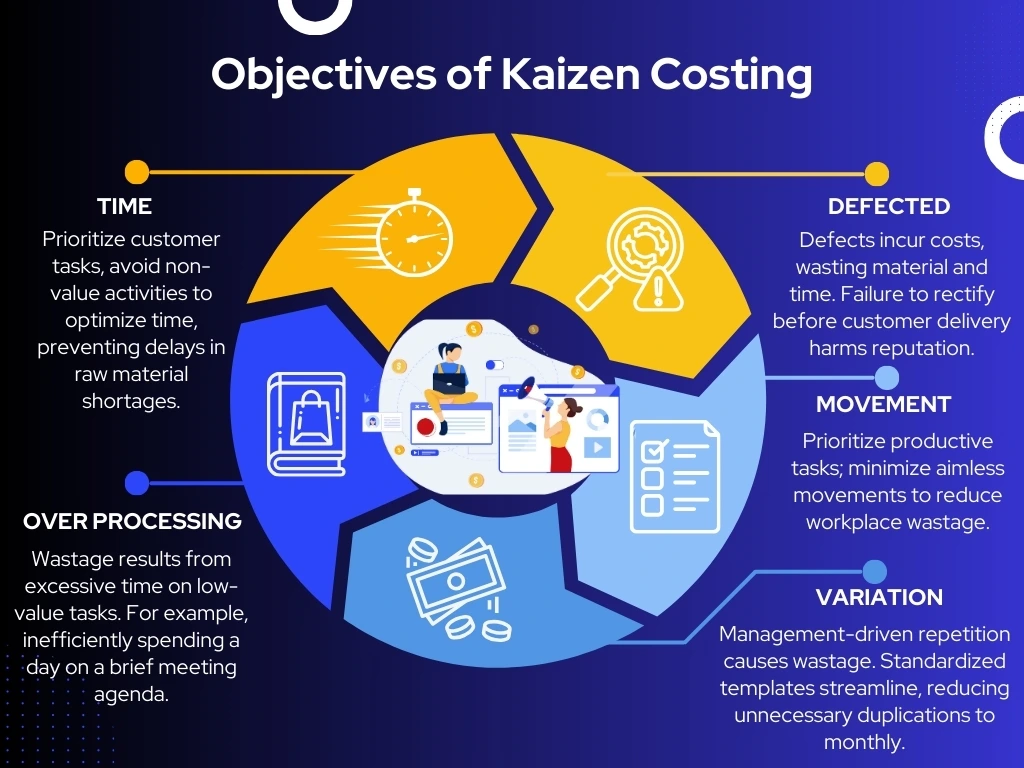
As we have discussed before, the main objective of Kaizen costing is to reduce waste and enhance cost deduction. The main agenda is to make sure that all the procedures are not time-consuming and also to reduce costs.
Objectives-of-Kaizen-Costing

1. Time

Efficient utilization of time is crucial as it equates to financial productivity. Workers should focus on tasks that add value to customers, avoiding engagement in non-value-added activities, which results in resource wastage. An example is when employees dedicate time to resolving conflicts in the working process, causing delays in completing tasks due to raw material shortages.

2. Defected

Every instance of product defects incurs costs, involving material and time wastage on rectifying the flawed item. Repairing and addressing damages may consume additional time. Failure to identify and rectify defective products before reaching customers leads to after-sale issues, necessitating compensation and potentially harming the company’s reputation.

3. Movement

While movement during working hours is common, unnecessary movements within the building contribute to wastage. It is essential to prioritize tasks that contribute to overall productivity rather than aimless movement.

4. Over-processing

Wastage occurs when excessive time is spent on a task without proportional added value. For instance, spending an entire day preparing a meeting agenda for a brief meeting is inefficient. Tasks should be allocated appropriate time, such as around 30 minutes for a concise meeting agenda that provides the same value.

5. Variation

Repetitive production of the same work due to top management requirements results in wastage. Creating a standardized template with detailed information fulfills the needs of various stakeholders. This way, reports only need preparation once a month, streamlining the process and eliminating unnecessary duplications.

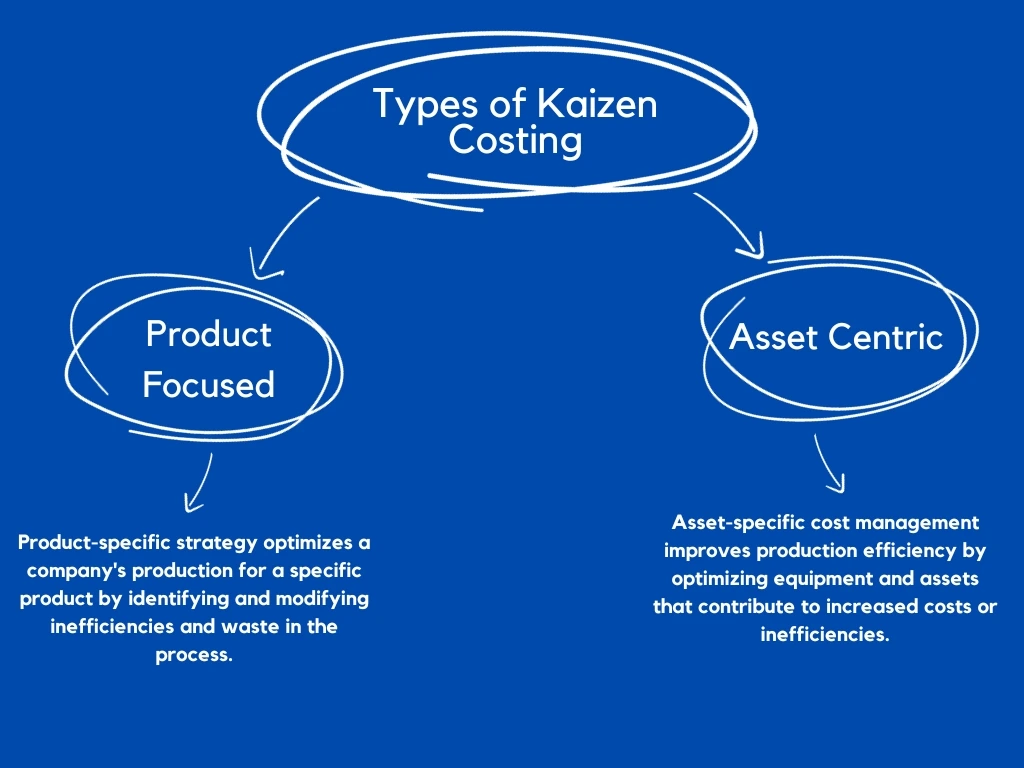
Types of Kaizen Costing
Types-of-Kaizen-Costing

1. Product-Focused

The product-specific strategy centers on optimizing the productivity and efficiency of a company’s production process for a specific product line or individual product. This method entails scrutinizing the entire production process, identifying areas of inefficiency and waste, and implementing modifications to improve the overall process.

2. Asset-Centric

The asset-specific cost management technique concentrates on improving the productivity and efficiency of specific equipment or assets used in production. This approach entails identifying assets that contribute to increased production costs or inefficiencies. Subsequently, it involves implementing changes to enhance their performance.

Learn: 5S of Kaizen Principle

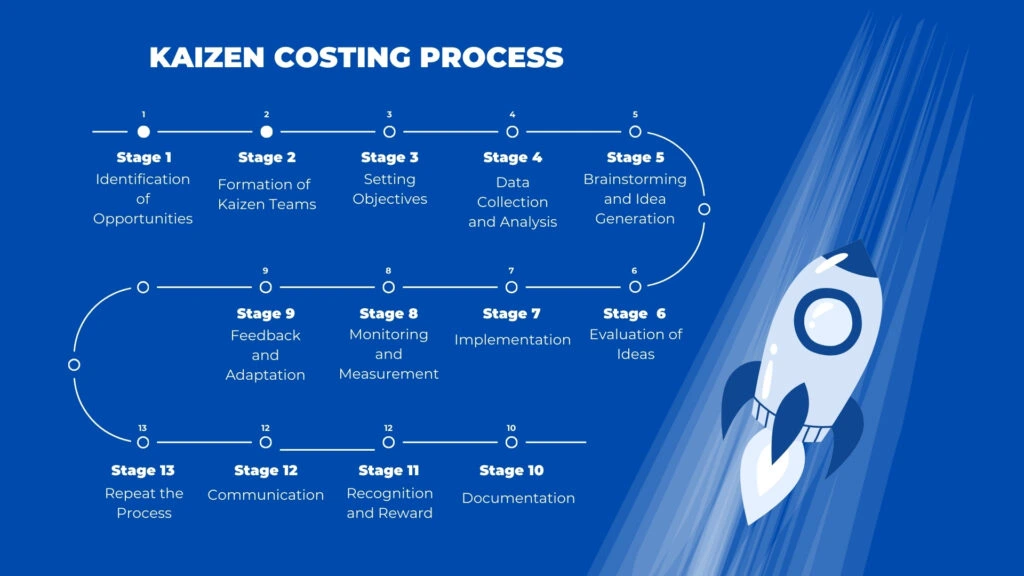
Kaizen Costing Process
Kaizen-costing-process

1. Identification of Opportunities: Identify areas for cost reduction and efficiency improvement.

2. Formation of Kaizen Teams: Create cross-functional teams with expertise in the targeted improvement areas.

3. Setting Objectives: Define specific, measurable, and realistic cost reduction objectives.

4. Data Collection and Analysis: Collect and analyze data to identify inefficiencies and areas for improvement.

5. Brainstorming and Idea Generation: Encourage creative problem-solving and idea generation for improvement.

6. Evaluation of Ideas: Prioritize ideas based on feasibility and potential impact on cost reduction.

7. Implementation: Begin implementing selected Kaizen initiatives, ensuring proper training for employees.

8. Monitoring and Measurement: Continuously monitor progress using KPIs, comparing results to set objectives.

9. Feedback and Adaptation: Gather feedback, make adjustments based on input, and continuously adapt to changing conditions.

10. Documentation: Maintain detailed records of Kaizen initiatives for future reference and share best practices.

11. Recognition and Reward: Recognize and reward employees contributing significantly to cost reduction and process improvement.

12. Communication: Share the results and success stories of Kaizen initiatives throughout the organization.

13. Repeat the Process: As a continuous improvement process, continually seek new opportunities for improvement and cost reduction in different areas.

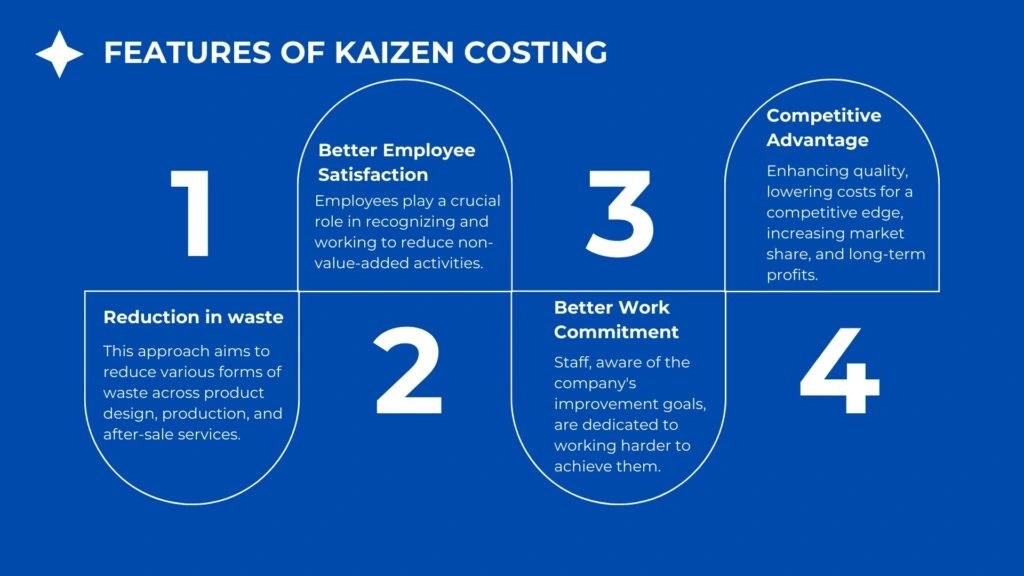
Cost-Saving Kaizen Ideas-Features
features-of-kaizen-costing

The image above explicitly explains the features of Kaizn Costing. 

This approach centers on minimizing various forms of waste throughout the entire product lifecycle, encompassing design, production, and post-sale services. Key contributors to this effort are the employees who play a crucial role in recognizing non-value-added activities and actively working towards their reduction. 

The entire staff, aligned with the company’s improvement objectives, demonstrates a strong commitment to their responsibilities. This shared dedication fosters a culture of heightened effort, ultimately leading to a competitive edge. By enhancing product quality and offering it at a more affordable price, we anticipate gaining a larger market share and achieving sustained profitability in the long run.

Conclusion

Kaizen Costing is a crucial methodology that industries have been implementing for ages to diminish unnecessary costs during production and manufacturing. This principle also adheres to strategies that boost employee productivity and the overall efficiency of the workflow. The demand for certified Kaizen professionals is quite high in the market given the utilities they’re offering. Therefore, if you’re looking for professional and top-notch Kaizen training, then Spoclearn provides this as a 1-day instructor-led Kaizen course where individuals and enterprise teams can learn the fundamentals of Kaizen and implement them in their organizations.

Leave a Reply

Your email address will not be published. Required fields are marked *

Subscribe us