

Trending Now

SIPOC Made Simple: How to Map a Process in 20 Minutes (with Examples)
PL-300 vs DP-600 vs DP-500 in 2026: Which Certification Should You Take First?
Portfolio Management Mastery: Why PfMP and PgMP Are Rising in Demand (2026)
How to Build a “Closed-Loop” CAPA System Using RCA (So Fixes Don’t Die in Docs)
Yellow Belt vs Green Belt vs Black Belt: Which Lean Six Sigma Level Should You Choose in 2026?
DMAIC Explained (2026): The Step-by-Step Method to Fix Any Process
PRINCE2 7 Tailoring Guide (2026): How to Adapt the Method for Any Project Size
Google Ads vs SEO in 2026: Which Should You Invest In First?
ITIL 5 Certification Demand and Job Market Trends: Complete Career Guide (2026)
Process Mining + Lean Six Sigma: The 2026 Playbook for Faster, Data-Driven DMAIC
CAPM vs PMP in 2026: Which Certification Should You Choose (and When)?
PRINCE2 7 Certification Path: Foundation → Practitioner → Next Steps (2026 Roadmap)
Oracle Primavera P6 Training Roadmap (2026): From Beginner to Project Controls Expert
AI Overviews & AI Mode SEO: How to Win Visibility When Google Answers First
RCA vs 5 Whys vs Fishbone vs 8D vs A3: When to Use Which (Decision Framework)
PL-300 Case Study Walkthrough: From Raw Data to Executive Dashboard (End-to-End)
ITIL 4 vs ITIL (Version 5): The Global, No‑Fluff Guide to What’s New, What Stays, and How to Transition
PRINCE2 7 Foundation: Complete Exam Guide, Format, Pass Mark, and Study Plan (2026)
Lean Six Sigma Yellow Belt: The 2026 Beginner Guide (Tools, Examples, Real Workplace Use)
Technical SEO Audit 2026: The Only Checklist That Still Matters
Content Refresh Strategy 2026: How to Update Old Pages for New Traffic
CAPM Exam Content Outline Explained: Domains, Weightage, and What to Study First
GA4 Setup Guide 2026: Step-by-Step for Accurate Tracking
From Keywords to Answers: How Search Works in 2026 
CAPM Certification 2026: The Complete Exam + Training Guide (PMI-Updated)
Traditional SEO vs Answer-First SEO: What Actually Ranks in 2026
ITSM Evolution: From Monolithic Systems to Cloud‑Centric Architectures (2026)
How to Run High-Performance Retargeting Campaigns Using AI
Project Leadership in 2026: Skills Every Successful Project Manager Needs
Technical SEO for 2026: Crawl Optimization, Log Analysis & AI Indexing Signals
Top 12 Project Management Mistakes and How to Avoid Them
PRINCE2® 7 (2026 Guide): What’s New, What Changed, and Why It Matters
Lean Six Sigma in 2026: What’s Changed (AI, Automation, Process Intelligence) & What Still Works
Root Cause Analysis in 2026: The Modern RCA Playbook for Faster, Repeatable Fixes
ITIL Is for Everyone and for Every Organization: A Deep‑Dive Playbook (2026)
Social Media Algorithms Explained (2026 Edition): What Actually Drives Reach Today
Power Query Best Practices 2026: Faster Refresh, Cleaner Models, Fewer Errors
PL-300 Exam Guide 2026: Skills Measured, Study Plan, and What’s Changed
LLMS.txt vs Robots.txt in 2026: What to Implement (and What to Avoid)
SEO in 2026: The Complete Playbook for AI Search, AEO & GEO
Google Ads Audits in 2026: A Step-by-Step Checklist to Fix Wasted Spend and Unlock Growth
AI-Driven Risk Management: Predict Risks Before They Happen
On-Page SEO 2026: New Techniques for Topical Relevance & AI Search
The Future of Project Management: Trends Reshaping 2025–2030 
Hybrid Project Management: Why Organizations Are Transitioning in 2026 and Beyond
AI-Powered Project Planning: Faster, Smarter, and More Accurate Strategies 
Industry Predictions for 2026: From GenAI to Value Streams and Total Experience
PMP vs CAPM vs PRINCE2: Which Certification Offers the Best ROI in 2026?
AI in Project Management: How Intelligent Tools Are Transforming PM Workflows 
Performance Max Mastery: How to Scale ROI with Smart Automation 
What is SAFe RTE? (Release Train Engineer)
SAFe RTE: The Complete Guide to Becoming a High-Impact Release Train Engineer (2025–2026)
Time Management: How to Turn Hours into Impact
Lean Six Sigma Green Belt: Skills, Value, Demand & Global Trends 2026
PL-300: Microsoft Power BI Data Analyst Certification for Career Growth Globally 2026
Strong & Sustained Demand for PMP Certification in 2026
Why Organizational Agility Matters: The Strategic Imperative for Big Enterprises
Building an Agility Culture Beyond IT Teams
How to Re-Engage Remote Teams: PMP Question on Motivation and Collaboration
Understanding Tuckman’s Team Development Stages - PMP Exam Question Explained
Why do Business Owners assign business value to team PI Objectives?  
Benefits of EXIN Agile Scrum Foundation Certification
Benefits of PMP Certification for Corporate and Individual Professionals in 2025
Streamlining Vaccine Development during a Global Health Crisis – An Imaginary PRINCE2 Case Study
PMBOK Guide Tips for Managing Change and Uncertainty in Projects
How to Apply PRINCE2 Methodologies in Real-World Projects
What is PRINCE2® 7? A Simple Explanation for Beginners
Project Management Certification in the United States of America
The Evolution of Project Management: From Process-Based to Principles-Based Approaches
Mastering ITIL and PRINCE2 for Enhanced Project Outcomes in Indian GCCs
Exploring the Eight Project Performance Domains in the PMBOK® Guide
PMI Best Practices for Project Management Across Different Environments
Your Ultimate Project Management Guide: Explained in Detail
Top Benefits of PRINCE2 for Small and Medium Enterprises
Best Project Management Certifications of 2025
The Importance of Tailoring PRINCE2 to Fit Your Organization's Needs
Resolve Slash URLs & Learn 301 vs. 308 Redirects Effectively
What is a standard change in ITIL 4?
Which practice provides a single point of contact for users?
What is the first step of the guiding principle 'focus on value'?
Which is a benefit of using an IT service management tool to support incident management?
A service provider describes a package that includes a laptop with software, licenses, and support. What is this package an example of?
What should be included in every service level agreement?
What are the two types of cost that a service consumer should evaluate?
The Business Case for SAFe®: Solving Modern Challenges Effectively
Which ITIL concept describes governance?
How does ‘service request management’ contribute to the ‘obtain/build’ value chain activity?
Which practice is the responsibility of everyone in the organization?
How Kaizen Can Transform Your Life: Unlock Your Hidden Potential
Unlocking the Power of SAFe®: Achieving Business Agility in the Digital Age
What is DevOps? Breaking Down Its Core Concepts
Which is a purpose of the ‘service desk’ practice?
Identify the missing word(s) in the following sentence.
Which value chain activity includes negotiation of contracts and agreements with suppliers and partners?
How does categorization of incidents assist incident management?
What is the definition of warranty?
Identify the missing word in the following sentence.
Which two needs should ‘change control’ BALANCE?
Which value chain activity creates service components?
Kaizen Costing - Types, Objectives, Process
how-to-pass-the-cissp-certification

How to Pass the CISSP Certification?

Picture of Bharath Kumar
Bharath Kumar
Bharath Kumar is a seasoned professional with 10 years' expertise in Quality Management, Project Management, and DevOps. He has a proven track record of driving excellence and efficiency through integrated strategies.

The Certified Information Systems Security Professional (CISSP) Certification is ideal for maintaining data security and cybersecurity requirements. Complex cyber threats are continuously damaging the business landscape globally, and organizations are facing vulnerabilities from hackers and scamsters regularly. In this regard, CISSP knowledge from a global governing body like ISC2 is heading in the right direction. 

Gaining knowledge of CISSP concepts is one thing, but, passing the CISSP Certification may not be everyone’s cup of tea because there are various steps that you need to remember preparing for this. This article highlights every aspect of CISSP about whether as an individual or as an enterprise team you are ready to take on the challenges faced in today’s vulnerable business landscape.

CISSP Certification: Are you Eligible?

In contrast to a typical IT graduate, a Certified Information Systems Security Professional (CISSP) accredited by ISC2 possesses enhanced and comprehensive expertise in addressing the spectrum of information security threats encountered by organizations. As a CISSP, one is proficient in formulating protocols and directives to safeguard businesses against security breaches.

CISSP Certification Training

Among the specific responsibilities undertaken by a CISSP are establishing disaster recovery strategies, designing resilient IT networks, and implementing robust security management protocols. Additionally, CISSPs are adept at crafting cryptographic frameworks and architecting network infrastructures resilient to both cyber and local threats.

Eligibility Requirement

  • Eligibility for the CISSP exam requires a minimum of five years of professional work experience.

  • Full-time employment necessitates a commitment of at least 35 hours per week for four consecutive weeks within a given month.

  • Candidates holding a four-year college degree or its equivalent, an advanced degree in information security accredited by NCAE-C, or another recognized credential listed on ISC2’s approved roster may qualify for a one-year exemption from the work experience requirement.

Experience waivers are accessible to individuals possessing college degrees and supplementary credentials, subject to approval by the (ISC). Furthermore, one can attain the status of Associate of the (ISC) and obtain CISSP certification upon fulfillment of the requisite experience criteria.

According to ISC, let’s see what are the full-time and part-time work experiences that a candidate must have to be eligible for the CISSP exam. 

Work Experience

1. Full-Time Experience: Your work experience is accrued monthly. Thus, you must have worked a minimum of 35 hours/week for four weeks to accrue one month of work experience.

2. Part-Time Experience: Your part-time experience cannot be less than 20 hours a week and no more than 34 hours a week.

  • 1040 hours of part-time = 6 months of full-time experience
  • 2080 hours of part-time = 12 months of full-time experience

3. Internship: A paid or unpaid internship is acceptable. You will need documentation on company/organization letterhead confirming your position as an intern. If you are interning at a school, the document can be on the registrar’s stationery.

Relevant Education/Certifications

You may satisfy one year of required experience by holding one of the below (you will then need four years of relevant work experience):

  • Four-Year College Degree or Regional Equivalent

You can substitute a maximum of one year of work experience if you hold one of the following:

  • A four-year college degree or regional equivalent

  • An advanced degree in information security from the U.S. National Center of Academic Excellence in Information Assurance Education (CAE/IAE).
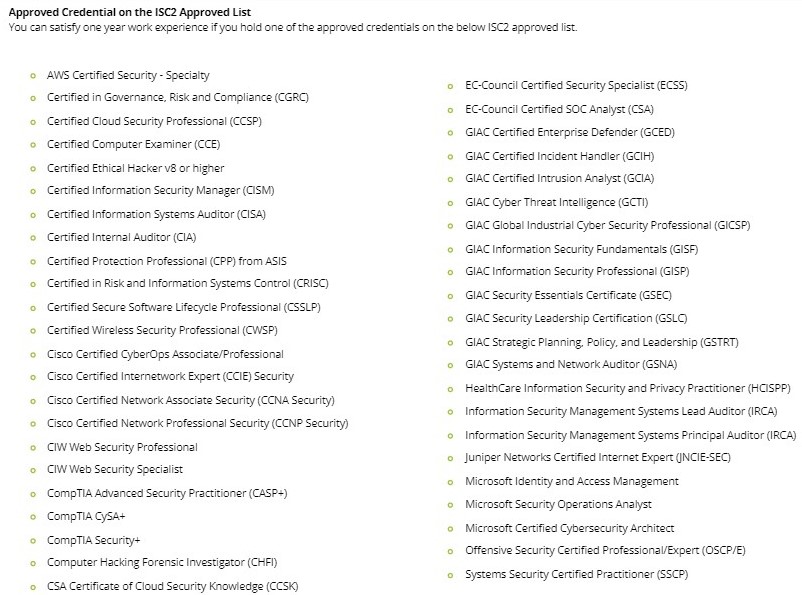
Relevant Education or Certifications

Image source: www.isc2.org

CISSP Syllabus and Exam Format

  • Domain 1: Security and Risk Management-15%
  • Domain 2: Asset Security-10%
  • Domain 3: Security and Architecture Engineering-13%
  • Domain 4: Communication and Network Security-13%
  • Domain 5: Identity and Access Management (IAM)-13%
  • Domain 6: Security Assessment and Testing- 12%
  • Domain 7: Security Operations-13%
  • Domain 8: Software Development Security-11%

The CISSP examination assesses proficiency across eight domains of security within a four-hour duration, encompassing 125 to 175 mandatory responses. These responses consist of a combination of multiple-choice questions and advanced innovative items. Attaining a score of 700 out of 1,000 is necessary for successful completion. Prospective candidates can register for the exam through Pearson VUE.

There are mainly two formats of the CISSP exam, CISSP Linear Examination and CISSP CAT Examination.
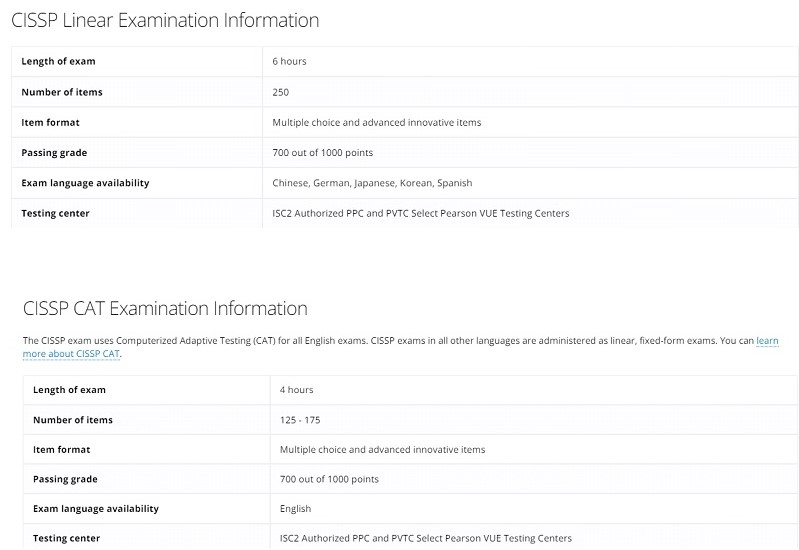
Two formats of the CISSP exam, CISSP Linear Examination and CISSP CAT Examination

According to ISC2, “Effective February 12, 2024, the CISSP exam will be available in the Chinese language in the Computerized Adaptive Testing (CAT) format. Effective April 15, 2024, the CISSP exam will be based on a refreshed exam outline. Effective April 15, 2024, the CISSP exam will only be available via CAT in the following languages: English, Chinese, German, Japanese, and Spanish. There will be no CISSP linear exams effective April 15, 2024”

How to Pass CISSP Certification on the First Attempt?

To successfully pass the CISSP certification exam on your first attempt, it’s imperative to adhere to a disciplined and strategic approach. 

  • CISSP exam outline: Begin by thoroughly comprehending the eight domains outlined in the CISSP Common Body of Knowledge (CBK), ensuring a robust understanding of each concept. Craft a meticulous study plan encompassing all exam topics, utilizing official study materials and reputable resources to bolster your knowledge base.

  • Daily practice: Regularly engage in practice exams to assess your preparedness levels and pinpoint areas requiring further focus. Hands-on experience in information security through real-world projects or lab simulations is invaluable, enhancing your practical understanding of key concepts.

  • Accredited Organizations: Consider enrolling in CISSP training courses provided by trusted organizations, offering structured learning and insights from seasoned professionals. Participation in study groups fosters collaboration and enables peer-to-peer learning, reinforcing understanding and addressing queries effectively.

  • Self-assessment: Continuously review and revise the material to solidify your comprehension, concentrating on areas of weakness identified through self-assessment. Approach the exam with confidence and composure, applying relaxation techniques to manage any anxiety.

  • Time management: During the exam, meticulously analyze each question, ensuring a clear understanding before selecting your answer. Effective time management is crucial, allowing adequate time for each section while maintaining focus and composure.
CISSP Certification Training

CISSP is one of the most sought-after IT/Cybersecurity certifications out there in the market; getting certified as an individual or as a team for your organization demonstrates your commitment to your customers globally and that you are serious about handling security incidents to the best of your knowledge and capabilities. CISSP is your shining armour that protects your customers and improves your security posture significantly in today’s ever-evolving security threats globally. You can contact us at info@spoclearn.com to get customized dates and discounts for group training programs.

Leave a Reply

Your email address will not be published. Required fields are marked *

Subscribe us