
Table of Contents
TogglePMP Question
A project manager joins a project team, replacing a manager who left. During initial meetings, the project manager realized that the team members have differing opinions about how to address technical decisions. Team members did NOT respect each other’s ideas, and the environment was becoming counterproductive. However, now with the new manager’s leadership, the team has begun to communicate more effectively and develop some processes and procedures for working together.
In what phase of development is the team now?
A. Forming
B. Storming
C. Norming
D. Performing
Objective of This Question
The goal of this PMP question is to test your understanding of Bruce Tuckman’s Model of Team Development — a critical concept under the People Domain in the PMP Exam.
This concept helps project managers analyze how teams evolve from initial formation to high performance, and what leadership style supports each phase.
Deep Explanation
In this scenario:
- The team originally struggled with differing opinions and lack of respect — signs of the Storming phase.
- Under new leadership, the team is now communicating better, establishing procedures, and working collaboratively.
This transition signals movement from conflict to cooperation, which is the hallmark of the Norming phase.
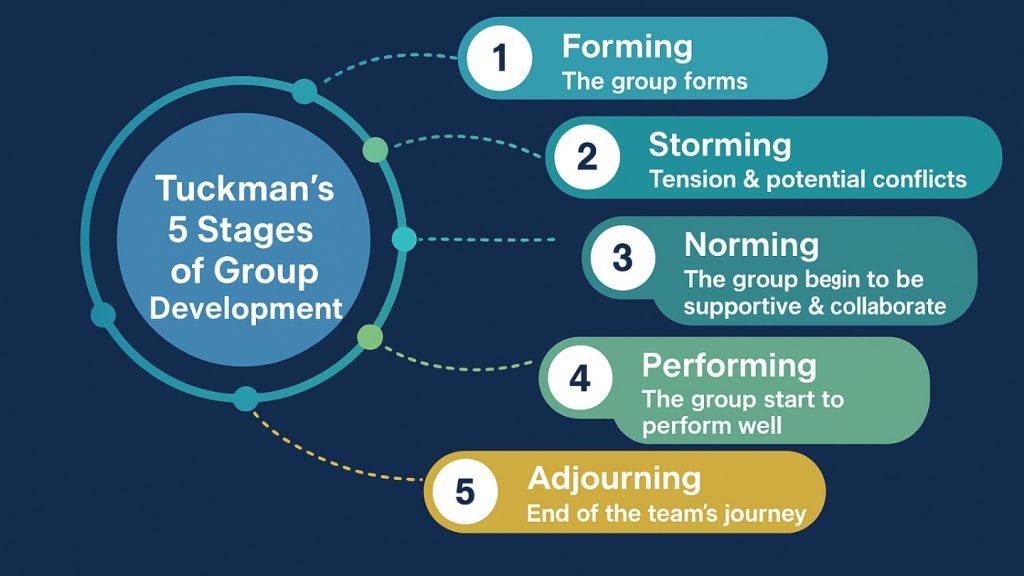
The Five Stages of Team Development
| Stage | Description | Team Behavior | Leadership Role |
|---|---|---|---|
| Forming | Team members are introduced, roles unclear | Polite, cautious, dependent on leader | Provide direction and structure |
| Storming | Conflict arises as people assert ideas | Disagreements, resistance, power struggles | Facilitate, mediate, and listen actively |
| Norming | Team develops norms, trust, and collaboration | Improved communication, shared processes | Encourage participation, reinforce norms |
| Performing | Team works efficiently with autonomy | High trust, synergy, consistent results | Delegate authority, empower team |
| Adjourning(optional) | Project ends, team disbands | Reflection, recognition | Celebrate success, closure |
Correct Answer
✅ C. Norming
Why “Norming” Is Correct
At this point:
- The team has resolved conflicts,
- Begun to establish norms and trust, and
- Developed processes and procedures for collaboration.
These characteristics directly describe the Norming phase — where the team starts to gel and operate smoothly, though not yet at peak performance (which occurs in the Performing stage).
Why Other Options Are Incorrect
| Option | Why It’s Incorrect |
|---|---|
| A. Forming | Team has moved past introductions and dependency. |
| B. Storming | Conflicts have already been addressed and reduced. |
| D. Performing | The team is not yet fully autonomous or delivering peak results. |
Key Takeaways for PMP Exam
- Look for behavioral cues in PMP questions — conflict = Storming, cooperation = Norming, autonomy = Performing.
- Leadership evolves through each phase — from directive to supportive to delegative.
- The Norming stage focuses on building trust, establishing norms, and improving communication.
- Questions like this fall under the People Domain, specifically team performance and leadership influence.
- Remember: Forming → Storming → Norming → Performing → Adjourning
Real-World Example
An Agile development team initially disagreed on sprint priorities, causing tension (Storming). With a new Scrum Master encouraging retrospectives and open discussions, the team began respecting each other’s input and defining their “working agreements.” This shift marks the Norming phase, where collaboration becomes natural and the team prepares for high performance.
Bonus Practice Questions
Question 1
A project manager observes that the team works seamlessly, self-manages tasks, and consistently delivers results with minimal oversight.
Which stage of Tuckman’s model best describes this team?
- A. Forming
- B. Norming
- C. Performing
- D. Adjourning
✅ Correct Answer: C. Performing
Explanation: The team is self-directed, collaborative, and efficient — characteristics of the Performing stage.
Question 2
During project initiation, team members are polite but reserved and unsure about their responsibilities. The project manager provides clear direction and defines roles.
Which stage is the team in?
- A. Forming
- B. Storming
- C. Norming
- D. Performing
✅ Correct Answer: A. Forming
Explanation: Early interactions, uncertainty, and dependency on the leader are indicators of the Forming stage.
Conclusion
Understanding Tuckman’s Team Development Model is vital for PMP aspirants to master team dynamics and leadership approaches. The given question tests how well you can interpret behavioral cues and apply theoretical knowledge to practical project situations.
A successful project manager recognizes where the team stands and adjusts their leadership style to move them forward — from Storming to Norming, and ultimately to Performing.
Top 10 FAQs on PMP Team Development and Tuckman Model
1. What is Tuckman’s Model of Team Development in PMP?
Tuckman’s Model describes how teams evolve through five stages — Forming, Storming, Norming, Performing, and Adjourning. Each stage represents a distinct level of maturity and collaboration. PMP candidates must understand this model to manage team dynamics, foster communication, and help teams achieve high performance effectively throughout the project lifecycle.
2. What is the main objective of the team development model in project management?
The objective is to guide project managers in understanding and improving team performance. By recognizing which stage the team is in, managers can apply the right leadership style and interventions to build trust, improve communication, resolve conflicts, and move the team toward the Performing stage for optimal productivity.
3. Which phase of Tuckman’s model involves the most conflict?
The Storming phase involves the most conflict. During this stage, team members express differing opinions, challenge authority, and compete for roles. The project manager’s role is crucial here — they must facilitate open communication, resolve disagreements, and ensure the team transitions to the Norming phase smoothly.
4. How does a project manager help the team move from Storming to Norming?
A project manager promotes trust and collaboration by clarifying roles, setting expectations, facilitating discussions, and introducing structured processes. Encouraging open dialogue, celebrating small wins, and mediating conflicts help reduce tension and lead the team toward mutual understanding and cooperation — key indicators of the Norming stage.
5. What leadership style is most effective during the Norming stage?
During the Norming stage, a facilitative and supportive leadership style works best. The project manager focuses on empowering the team, promoting self-organization, and reinforcing shared norms and values. Instead of directing tasks, the leader encourages collaboration and strengthens the sense of ownership among team members.
6. How can PMP aspirants identify team development stages in exam questions?
Look for behavioral cues in question scenarios:
- Forming: Uncertainty, introductions, lack of clarity.
- Storming: Conflict, resistance, or differing opinions.
- Norming: Improved communication, emerging cooperation.
- Performing: High efficiency, autonomy, and trust.
Identifying these cues helps select the correct development stage quickly and accurately in the PMP exam.
7. Why is the Norming stage critical in team success?
The Norming stage lays the foundation for long-term success. It’s when team members align on goals, develop trust, respect differences, and create effective working norms. Without reaching this stage, a team may struggle to achieve the unity and collaboration needed for the Performing stage’s high productivity.
8. How is the Performing stage different from the Norming stage?
In the Norming stage, teams establish mutual respect and collaboration but still rely on guidance. In contrast, during Performing, the team becomes self-sufficient, proactive, and goal-oriented. They deliver results consistently with minimal supervision. Performing reflects true team maturity and is the ultimate goal of project leadership.
9. What is the Adjourning stage in team development?
The Adjourning stage (also known as “Mourning”) occurs after project completion. The team disbands, members move to new projects, and achievements are celebrated. This stage emphasizes closure, knowledge sharing, and recognition — key aspects of project closure in the PMP framework to maintain morale and motivation.
10. How can understanding Tuckman’s model help PMP-certified professionals in real projects?
PMP-certified professionals can use Tuckman’s model to diagnose team issues, tailor communication strategies, and apply adaptive leadership. Recognizing team maturity helps manage conflicts, maintain motivation, and build high-performing project teams — directly improving stakeholder satisfaction, project delivery speed, and overall organizational success.