

Trending Now

CISM Certification Roadmap 2026: Step-by-Step Guide to Becoming a Security Manager
Lean vs Six Sigma vs Lean Six Sigma: What’s the Difference and When to Use Each?
AI and PRINCE2 7th Edition: What PMs Must Know
Performance Max Campaign Performance Dropped? Here’s the Real Reason (And Fix)
ITIL v5 Trends: What IT Leaders Must Know About the Next Phase of ITSM
Why Oracle Primavera P6 Certification Is Becoming Essential for Project Managers in 2026
PRINCE2 7 Roles & Responsibilities: Who Does What (Project Board to Team Manager)
Stakeholder Engagement Strategies That Actually Deliver Results
The Future of Project Management: Trends Reshaping 2025–2030 
Lean Six Sigma Templates Pack: SIPOC, CTQ, Fishbone, Control Plan, A3 (Free Guide)
CAPM Exam Prep Strategy 2026: Practice Questions, Mock Tests, and Time Management
ITIL 4 vs ITIL (Version 5): The Global, No‑Fluff Guide to What’s New, What Stays, and How to Transition
ITIL 5 Certification Demand and Job Market Trends: Complete Career Guide (2026)
ITIL v5 Job Roles Explained: From Service Desk Analyst to IT Service Manager
PL-300 DAX Questions You Must Master in 2026 (With Patterns)
How to Write an RCA Report That Actually Prevents Repeat Incidents (Templates + Examples)
Digital Transformation Projects: Why They Fail & How to Fix Them
Oracle Primavera P6 Training Guide (2026): Skills Every Project Professional Must Master
PMI’s Late-2026 PMP® Policy Update Will Reject Most Live Training Hours — Here’s How to Protect Your 35 Contact Hours  
Why Are My Pages Not Indexed Even After Sitemap Submission? (And How to Fix It)
Minitab for Lean Six Sigma (2026): The Only Functions Most Belts Actually Need
Top 10 Project Scheduling Tools for PMP & PRINCE2 Aspirants (2026 Guide)
SIPOC Made Simple: How to Map a Process in 20 Minutes (with Examples)
PL-300 vs DP-600 vs DP-500 in 2026: Which Certification Should You Take First?
Portfolio Management Mastery: Why PfMP and PgMP Are Rising in Demand (2026)
How to Build a “Closed-Loop” CAPA System Using RCA (So Fixes Don’t Die in Docs)
Yellow Belt vs Green Belt vs Black Belt: Which Lean Six Sigma Level Should You Choose in 2026?
DMAIC Explained (2026): The Step-by-Step Method to Fix Any Process
PRINCE2 7 Tailoring Guide (2026): How to Adapt the Method for Any Project Size
Google Ads vs SEO in 2026: Which Should You Invest In First?
Process Mining + Lean Six Sigma: The 2026 Playbook for Faster, Data-Driven DMAIC
CAPM vs PMP in 2026: Which Certification Should You Choose (and When)?
PRINCE2 7 Certification Path: Foundation → Practitioner → Next Steps (2026 Roadmap)
Oracle Primavera P6 Training Roadmap (2026): From Beginner to Project Controls Expert
AI Overviews & AI Mode SEO: How to Win Visibility When Google Answers First
RCA vs 5 Whys vs Fishbone vs 8D vs A3: When to Use Which (Decision Framework)
PL-300 Case Study Walkthrough: From Raw Data to Executive Dashboard (End-to-End)
PRINCE2 7 Foundation: Complete Exam Guide, Format, Pass Mark, and Study Plan (2026)
Lean Six Sigma Yellow Belt: The 2026 Beginner Guide (Tools, Examples, Real Workplace Use)
Technical SEO Audit 2026: The Only Checklist That Still Matters
Content Refresh Strategy 2026: How to Update Old Pages for New Traffic
CAPM Exam Content Outline Explained: Domains, Weightage, and What to Study First
GA4 Setup Guide 2026: Step-by-Step for Accurate Tracking
From Keywords to Answers: How Search Works in 2026 
CAPM Certification 2026: The Complete Exam + Training Guide (PMI-Updated)
Traditional SEO vs Answer-First SEO: What Actually Ranks in 2026
ITSM Evolution: From Monolithic Systems to Cloud‑Centric Architectures (2026)
How to Run High-Performance Retargeting Campaigns Using AI
Project Leadership in 2026: Skills Every Successful Project Manager Needs
Technical SEO for 2026: Crawl Optimization, Log Analysis & AI Indexing Signals
Top 12 Project Management Mistakes and How to Avoid Them
PRINCE2® 7 (2026 Guide): What’s New, What Changed, and Why It Matters
Lean Six Sigma in 2026: What’s Changed (AI, Automation, Process Intelligence) & What Still Works
Root Cause Analysis in 2026: The Modern RCA Playbook for Faster, Repeatable Fixes
ITIL Is for Everyone and for Every Organization: A Deep‑Dive Playbook (2026)
Social Media Algorithms Explained (2026 Edition): What Actually Drives Reach Today
Power Query Best Practices 2026: Faster Refresh, Cleaner Models, Fewer Errors
PL-300 Exam Guide 2026: Skills Measured, Study Plan, and What’s Changed
LLMS.txt vs Robots.txt in 2026: What to Implement (and What to Avoid)
SEO in 2026: The Complete Playbook for AI Search, AEO & GEO
Google Ads Audits in 2026: A Step-by-Step Checklist to Fix Wasted Spend and Unlock Growth
AI-Driven Risk Management: Predict Risks Before They Happen
On-Page SEO 2026: New Techniques for Topical Relevance & AI Search
Hybrid Project Management: Why Organizations Are Transitioning in 2026 and Beyond
AI-Powered Project Planning: Faster, Smarter, and More Accurate Strategies 
Industry Predictions for 2026: From GenAI to Value Streams and Total Experience
PMP vs CAPM vs PRINCE2: Which Certification Offers the Best ROI in 2026?
AI in Project Management: How Intelligent Tools Are Transforming PM Workflows 
Performance Max Mastery: How to Scale ROI with Smart Automation 
What is SAFe RTE? (Release Train Engineer)
SAFe RTE: The Complete Guide to Becoming a High-Impact Release Train Engineer (2025–2026)
Time Management: How to Turn Hours into Impact
Lean Six Sigma Green Belt: Skills, Value, Demand & Global Trends 2026
PL-300: Microsoft Power BI Data Analyst Certification for Career Growth Globally 2026
Strong & Sustained Demand for PMP Certification in 2026
Why Organizational Agility Matters: The Strategic Imperative for Big Enterprises
Building an Agility Culture Beyond IT Teams
How to Re-Engage Remote Teams: PMP Question on Motivation and Collaboration
Understanding Tuckman’s Team Development Stages - PMP Exam Question Explained
Why do Business Owners assign business value to team PI Objectives?  
Benefits of EXIN Agile Scrum Foundation Certification
Benefits of PMP Certification for Corporate and Individual Professionals in 2025
Streamlining Vaccine Development during a Global Health Crisis – An Imaginary PRINCE2 Case Study
PMBOK Guide Tips for Managing Change and Uncertainty in Projects
How to Apply PRINCE2 Methodologies in Real-World Projects
What is PRINCE2® 7? A Simple Explanation for Beginners
Project Management Certification in the United States of America
The Evolution of Project Management: From Process-Based to Principles-Based Approaches
Mastering ITIL and PRINCE2 for Enhanced Project Outcomes in Indian GCCs
Exploring the Eight Project Performance Domains in the PMBOK® Guide
PMI Best Practices for Project Management Across Different Environments
Your Ultimate Project Management Guide: Explained in Detail
Top Benefits of PRINCE2 for Small and Medium Enterprises
Best Project Management Certifications of 2025
The Importance of Tailoring PRINCE2 to Fit Your Organization's Needs
Resolve Slash URLs & Learn 301 vs. 308 Redirects Effectively
What is a standard change in ITIL 4?
Which practice provides a single point of contact for users?
What is the first step of the guiding principle 'focus on value'?
Which is a benefit of using an IT service management tool to support incident management?
lean six sigma certification

Lean Six Sigma Certification: Everything you need to know

Picture of Bharath Kumar
Bharath Kumar
Bharath Kumar is a seasoned professional with 10 years' expertise in Quality Management, Project Management, and DevOps. He has a proven track record of driving excellence and efficiency through integrated strategies.

Let’s imagine you are the CEO of a company that manufactures a product- say, bicycles. But of late you see that there has been a gradual decline in the sales of the bicycles manufactured by your company, leading to losses and a demotivated team. What would you do? Think of measures to cut down losses and identify where the problem lies, isn’t it? And maybe devise new ways to counter the problem at its root. Yes! You are absolutely right!

This exact situation at the Motorola Company in 1980 forced Bill Smith to devise a concept called Six Sigma. This new concept revolutionized the world, and in a short span of time, it found widespread use in the business world, with many companies using the technique to cut down losses. This concept aims to reduce the following:

  • Time
  • Defects
  • Variability

 A similar problem faced by Toyota made it design Lean manufacturing, which aims to reduce any wasteful component in any production process.

Lean Six Sigma combines both these tools to create a company, which is profitable and a great company to work for.


Lean Six Sigma Certification

Today, there are various governing bodies that deliver Lean Six Sigma certification, such as TUV SUD, EXIN, ASQ, IASSC, CSSC, KPMG, and more.

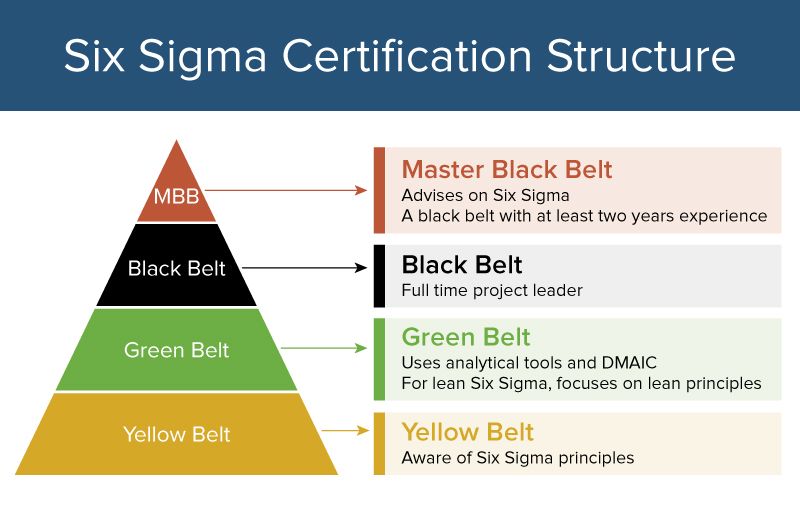
A White Belt certification is the most basic level of certification that one can possess. White Belt holders can guide the management regarding changes needed in an organization as well as accompany project teams.

The Green Belt Certificate holders possess skills to provide their services as trained team members. Green Belt holders are usually expected to work on smaller Six Sigma projects, but they don’t have a full-time commitment to the organization.

Black Belts have to look after more significant projects and also have a full-time responsibility towards the organization they look after.


Lean Six Sigma Certification Pathways
Lean Six Sigma Certification Pathways

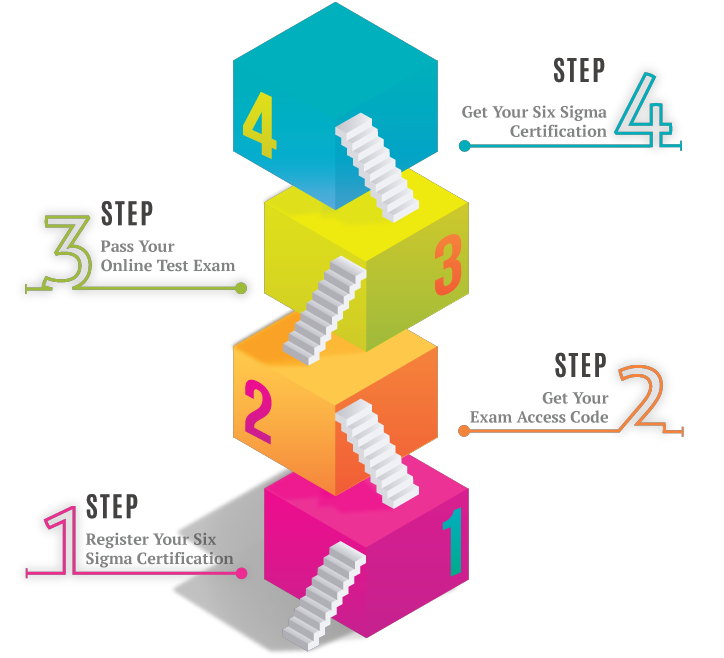
There are two different pathways through which one can achieve certification in Lean Six Sigma. First is the stepwise method, and second, by taking a single standard comprehensive certification examination.

In the first pathway, you start by using the free Self Study Guides provided by the governing bodies. You may seek help from training providers. You then sit for several exams, taking you step by step up the ladder of Lean Six Sigma certification. This pathway is beneficial to all of you who have no prior experience in this area, as it provides you with all levels of certification (white belt, green belt, yellow belt, and black belt) gradually, at no extra exam fee.

The second pathway is certification through a single standard comprehensive examination. This is intended for those of you who have a basic understanding up to the level of Green Belt and have received training before. You simply have to register for the standard comprehensive examination, pay the exam fee, and clear the exam.


Pros and cons of the two certification pathways


Pathway 1

Ideal if you want to use the self-study guides and earn different belts for a thorough understanding of the basics. It gives you the freedom to have as many attempts at the exam as you want. If you are not comfortable with a timed format of the examination, then you should definitely choose this format.


Pathway 2

You should go ahead with this pathway if you have a basic understanding of the subject or have had prior exposure and are looking to clear the exam in a quick time. In this pathway, first, you need to attend the respective training in Lean Six Sigma Yellow Belt training or Lean Six Sigma Green Belt training and later take up their respective LSSYB and LSSGB certification exams. Upon clearing those exams, you will receive an official certification credential from the respective governing body. These Lean Six Sigma certifications are globally recognized and help you to stand out from your competition and demonstrate your expertise and commitment toward a Quality Management career.


Lean Six Sigma Exam pattern
Lean Six Sigma certification training

At Spoclearn, we provide Lean Six Sigma certification training from TUV SUD, IASSC, and EXIN. Participants can choose the program according to their choice and popularity in their respective regions.

For more information on the Lean Six Sigma certification exam pattern, you can visit the official page of Lean Six Sigma Yellow Belt certification training and Lean Six Sigma Green Belt Certification training to better prepare for the training.

All Lean Six Sigma certification exams are multiple choice questions and are closed book. Participants can take up these exams either as paper-based or web online proctored examinations from exam institutes such as PeopleCert, Pearson Vue, EXIN, and other portals.


Lean Six Sigma Certification Training Eligibility Criteria

Lean Six Sigma Certifications

Different Lean Six Sigma courses have different requirements, which are mentioned below:

  • Lean Six Sigma White Belt Training– There are no prerequisites to take up this training as this is an introductory level training that is aimed at entry-level positions across sectors.

  • Lean Six Sigma Yellow Belt Training– Again, there are no prerequisites to take up this foundation-level LSSYB training program. Yellow belt is aimed at professionals with little or no experience and is aimed at quality assurance teams and professionals who serve under green belt professionals.

  • Lean Six Sigma Green Belt Training– This LSSGB is an intermediate-level quality management training program that is aimed at project managers, quality managers, product managers, and others. Lean Six Sigma Yellow Belt is not mandatory for taking up the Green Belt training. However, it would be highly beneficial if one has an LSSYB credential as one will have all the foundation-level knowledge to easily understand the more complex concepts from Lean Six Sigma Green Belt Training.

  • Lean Six Sigma Black Belt Training– This LSSBB is an advanced-level quality management certification program that is aimed at Six Sigma Project and Program managers. They are the ones who champion complex Six Sigma projects in an organization. LSSGB is a mandatory requirement for professionals taking up the LSSBB training program.

How to achieve Lean Six Sigma Certification?

To obtain the professional certificate of Lean Six Sigma Green Belt, you must clear the certification exam as mentioned above with a score of a minimum of 280 points out of a maximum of 400 points. There is no project requirement for this level of certification. However, for Lean Six Sigma Green Belt Level II, there are project participation requirements.

On clearing the examination and meeting all prerequisites, you shall be awarded a soft copy of the certificate immediately from the respective governing body. This Lean Six Sigma certificate has lifetime validity. The certificate contains a unique identification number, which is verifiable online.  

There is no need to renew the Lean Six Sigma certification. But if at any point in time, you feel the need to have a fresh certificate, you can always retake the exam successfully. For this, you shall still need to pay a fee, but the amount is lower than before.


Conclusion

Lean Six Sigma Certification is a very useful tool to increase your worth and fetch you greater roles and responsibilities in the corporate world. It is a one-time investment toward making your CV stand out from the crowd. Spoclearn is a pioneer in providing Quality Management certification training for both professionals and enterprises worldwide.

Leave a Reply

Your email address will not be published. Required fields are marked *

Subscribe us