
Table of Contents
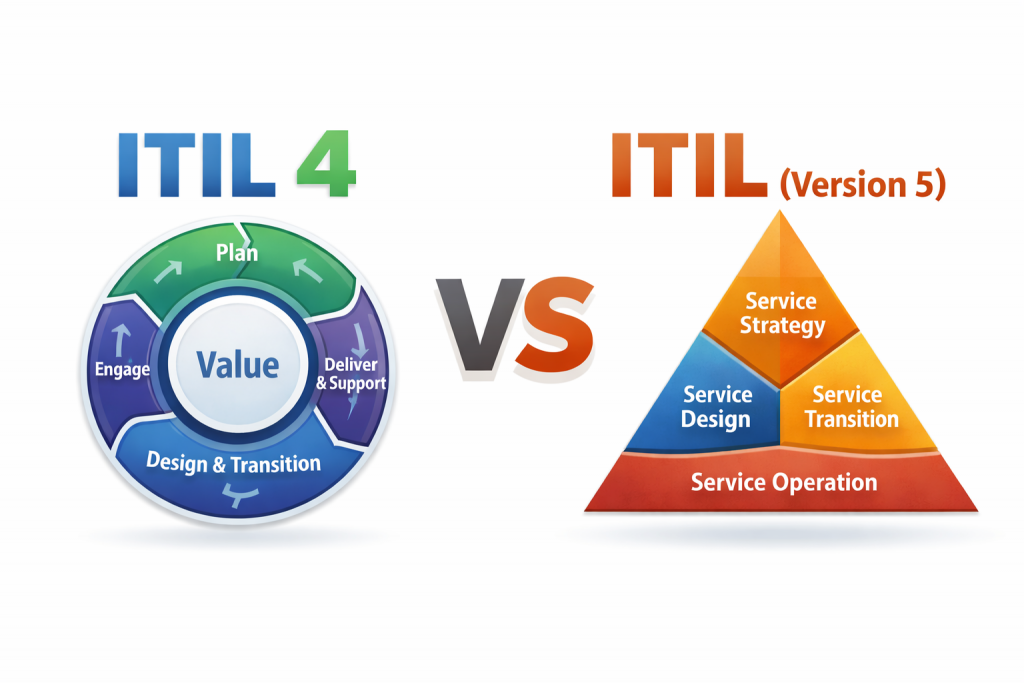
ToggleITIL (Version 5) represents a measured evolution of ITIL 4, not a reset. It retains the Service Value System (SVS) and practice-based guidance that organizations already rely on, while expanding the framework to address AI-driven, product-centric, and digital-first operating models.
Rather than discarding existing progress, ITIL 5 builds directly on ITIL 4. Current certifications, knowledge, and investments remain valid. PeopleCert has clearly indicated a low-disruption transition approach, allowing professionals and organizations to move forward gradually as new Version 5 modules are released.
Why ITIL Evolved in 2026
Modern organizations no longer operate in siloed IT environments. Instead, they manage digital products, platforms, and services supported by continuous delivery, automation, and AI-assisted decision-making.
ITIL (Version 5) responds to this reality. Official communications describe the framework as AI-native, practical, and outcome-driven, designed to connect leadership intent with day-to-day execution in fast-changing environments—without invalidating ITIL 4.
Industry explainers further note that ITIL 5 launched in early 2026 with a phased certification rollout. The revised qualification scheme includes nine core modules and an AI-focused extension, all scheduled for release across 2026.
What ITIL 4 Already Does Well—and Continues to Do
ITIL 4 remains a strong operational foundation and continues to underpin Version 5.
Key strengths that carry forward include:
- Service Value System (SVS) and Service Value Chain
A holistic view of how value is co-created, delivered, and improved—replacing the rigid ITIL v3 lifecycle.
- Practice-based guidance
Thirty-four management practices supported by refreshed Practice Guides (2023–2024), covering roles, value streams, success factors, metrics, and tooling.
- Mature certification structure
ITIL 4 Foundation, Managing Professional (MP), Strategic Leader (SL), and the Practice Manager designation for operational depth.
- Certification renewal and CPD
A three-year renewal model introduced in 2023, maintaining relevance through exams or continuing professional development.
None of these pillars disappear in ITIL 5. Instead, they form the baseline on which Version 5 is built.
ITIL 4 vs ITIL (Version 5): Key Differences Explained Simply
1. Positioning and Scope
- ITIL 4
Focuses on service management using the Service Value System, value streams, and practices. It is enterprise-ready but primarily service-oriented.
- ITIL 5
Expands the scope to digital product and service management across the organization, with stronger emphasis on experience, outcomes, and measurable value.
2. AI and Automation
- ITIL 4
Recognizes AI and automation but treats them as supporting enablers.
- ITIL 5
Takes an AI-native approach, embedding automation, decision intelligence, and governance directly into operating models. An AI governance extension addresses ethics, trust, and responsible scaling.
3. Certification and Transition
- ITIL 4
Foundation → MP / SL → Practice Manager, with a three-year renewal cycle.
- ITIL 5
Introduces a new Foundation and role-aligned modules, released in phases throughout 2026. Clear transition paths allow ITIL 4 holders to move forward without restarting.
4. Guidance Assets
- ITIL 4
Updated Practice Guides offer deep, actionable operational guidance today.
- ITIL 5
Reframes those practices around product, service, and experience flows, ensuring continuity while modernizing perspective.
Quick Comparison Snapshot
| Dimension | ITIL 4 | ITIL (Version 5) |
| Core lens | Service Value System and practices | End-to-end digital product and service lifecycle |
| AI stance | Recognized, not central | AI-native with governance extension |
| Certification | Foundation → MP/SL → Practice Manager | New Foundation, role-based modules, transition paths |
| Guidance assets | 34 Practice Guides (2023–24) | Builds on practices with product and experience focus |
| Audience | ITSM-led, extendable | Organization-wide (business, product, tech) |
Certification Strategy: What Changes and How to Decide
Where you may be today
- ITIL 4 Foundation as the entry point
- Advanced designations: Managing Professional, Strategic Leader, Practice Manager
- Mandatory renewal every three years via exam or CPD
What ITIL 5 adds
- A refreshed Foundation
- Nine core, role-relevant modules
- An AI governance extension
- Phased rollout through 2026 with efficient transition options
Practical guidance:
If you are already progressing through ITIL 4, complete your current path to realize immediate value. Then bridge to ITIL 5 using the official transition modules as they become available.
What “AI-Native” Means in ITIL 5
In ITIL 5, AI is no longer an add-on—it is a design assumption.
- Decision intelligence embedded into value streams, not limited to chatbots or ticket triage
- AI governance built-in, addressing transparency, bias mitigation, risk, and value alignment
- Human-plus-machine workflows that reshape how reliability, experience, and outcomes are measured
For global organizations, this creates a shared governance language to scale AI responsibly across regions with varying regulatory and compliance requirements.
Why the 34 ITIL 4 Practices Still Matter Most Right Now
For near-term operational gains, the updated Practice Guides remain the fastest lever for improvement. They provide:
- Clear purpose statements
- Practice Success Factors (PSFs)
- Defined roles and responsibilities
- Metrics aligned to value streams
- Tooling and integration guidance
These practices translate directly into ITIL 5’s product- and experience-centric model.
High-impact practice focus examples:
- Incident Management for rapid recovery
- Change Enablement for safe delivery velocity
- Service Desk for experience clarity
- Service Level Management for outcome alignment
- Monitoring and Event Management for intelligent observability
Migration Scenarios: Choose Your Path
Scenario A: Midway through ITIL 4 Managing Professional
Complete MP now to secure advanced capability. Transition later using ITIL 5 bridge modules when released.
Scenario B: ITIL 4 Foundation only
Advance into role-relevant ITIL 4 modules today, then transition to ITIL 5 Foundation or bridge modules when aligned with your goals.
Scenario C: AI already on your roadmap
Strengthen Monitoring, Change Enablement, and Service Level Management now. Adopt the ITIL 5 AI governance extension early to formalize controls and value realization.
Migration Scenarios: Choose Your Path
Scenario A: Midway through ITIL 4 Managing Professional
Complete MP now to secure advanced capability. Transition later using ITIL 5 bridge modules when released.
Scenario B: ITIL 4 Foundation only
Advance into role-relevant ITIL 4 modules today, then transition to ITIL 5 Foundation or bridge modules when aligned with your goals.
Scenario C: AI already on your roadmap
Strengthen Monitoring, Change Enablement, and Service Level Management now. Adopt the ITIL 5 AI governance extension early to formalize controls and value realization.
90-Day ITIL Transition Plan for Global Teams
Weeks 1–2: Establish your baseline
Map roles to ITIL 4 modules that address immediate challenges. Align training schedules across regions.
Weeks 3–6: Strengthen core practices
Define success factors, metrics, and ownership for your most critical practices using the refreshed guides.
Weeks 7–12: Design the ITIL 5 bridge
Identify early transition groups (product teams, service owners, platform teams). Build a simple migration plan covering budget, timelines, and priority modules.
FAQ’s
1. What is the difference between ITIL 4 and ITIL 5?
ITIL 4 focuses on service value systems and management practices, while ITIL 5 expands the scope to digital product management, AI-native operations, and experience-driven value delivery across the enterprise.
2. Is ITIL 5 officially released?
Yes. ITIL (Version 5) has been officially introduced as the next evolution of ITIL. It builds on ITIL 4 rather than replacing it and is being rolled out through phased modules.
3. Is ITIL 5 a replacement for ITIL 4?
No. ITIL 5 is an evolution of ITIL 4, not a replacement. Existing ITIL 4 concepts, practices, and certifications remain valid and form the foundation for ITIL 5.
4. Do ITIL 4 certifications still hold value after ITIL 5?
Yes. ITIL 4 certifications continue to hold global recognition and are part of the official transition path to ITIL 5, protecting prior learning and certification investments.
5. Do I need to retake ITIL Foundation if ITIL 5 is released?
No. Professionals with ITIL 4 Foundation do not need to retake the exam. They can move to ITIL 5 through designated upgrade or transition modules.
6. What is ITIL (Version 5) designed for?
ITIL 5 is designed for modern digital organizations managing integrated products, services, AI, automation, and customer experience at scale across business and technology teams.
7. What does “AI-native” mean in ITIL 5?
AI-native means ITIL 5 assumes AI, automation, and data-driven decision-making are embedded into everyday operations, governance, and value streams by default.
8. Does ITIL 5 include guidance on AI governance?
Yes. ITIL 5 includes explicit guidance and extension modules focused on AI governance, ethical use, transparency, trust, and responsible automation at scale.
9. Are the 34 ITIL 4 practices still relevant in ITIL 5?
Yes. All 34 ITIL 4 practices remain relevant and are carried forward, with stronger integration into product-centric and experience-driven value flows.
10. What is the best transition strategy from ITIL 4 to ITIL 5?
The best approach is to continue with ITIL 4 for immediate value, strengthen key practices, and transition to ITIL 5 using official bridge or transition modules as they are released.