


Every business that is into a product or service is trying to achieve a cult status that would stand the test of time and stay ahead of the competition. We are still in awe of yesteryear’s construction, art, and music, which we see and listen to. Similarly, organizations worldwide are creating bespoke products/services to stay ahead of the competition, and this is achieved through continuous improvement. One of the methods that has gained significant popularity over the years is Lean management.

What is Lean?
Lean is nothing but a systematic approach to process improvement that focuses majorly on eliminating waste, improving efficiency, and achieving continuous improvement. By implementing Lean principles and techniques, organizations across various sectors can optimize their operations, enhance customer satisfaction, and drive higher profitability.
What is Lean Management
Lean management was initially developed by Toyota in the 1950s was was known as Toyota Production System (TPS) in the 1950s. The main goal of TPS was to eliminate waste and achieve a smooth, efficient production flow. Through the years, these principles have been adapted and applied to various industries, including manufacturing, IT, healthcare, retail, supply chain, and more. Today, Lean has become a widely adopted methodology for achieving operational excellence and continuous improvement.
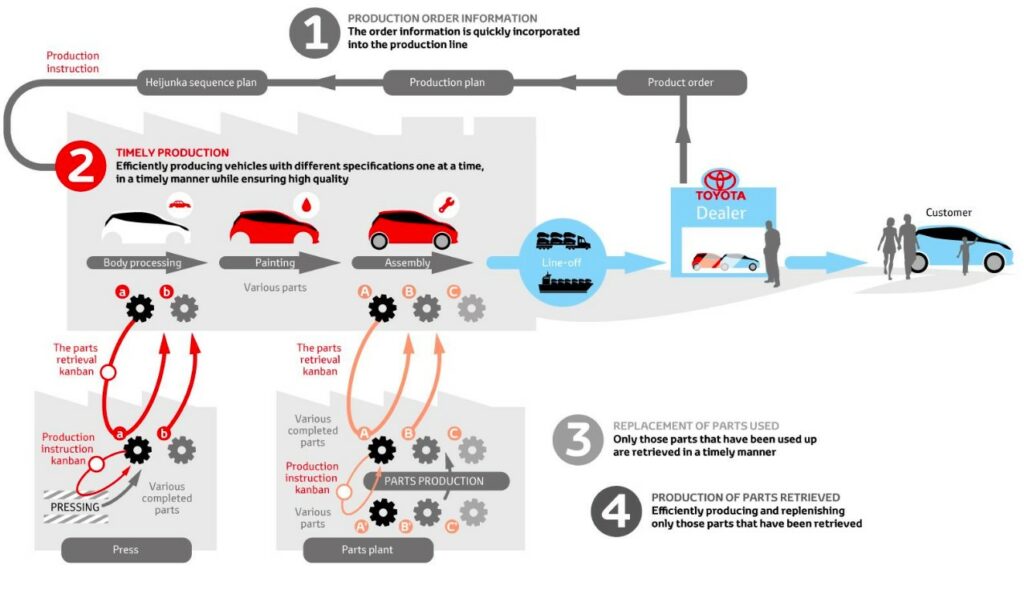
Source: Toyota UK
5 Key Principles of Lean
The five principles of Lean are key for organizations to achieve operational excellence and continuous improvement. Lean methodology helps businesses optimize processes, eliminate waste, and provide the utmost customer satisfaction. Below are the 5 principles of Lean
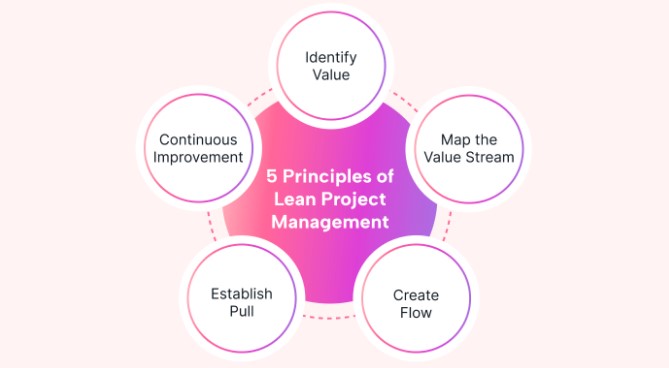
1. Identifying Value
Creating value for the customer is one of the key principles of Lean. To accomplish this, organizations must identify what customers truly value and align their processes and activities to deliver that value. By acknowledging customer needs and preferences, businesses can eliminate non-value-adding activities and allocate resources more effectively.
2. Mapping the Value Stream
The value stream represents all the steps and processes involved in delivering a product or service from the beginning to the end. Organizations need to map out the value stream and visualize the entire flow to identify areas of waste, bottlenecks, and inefficiencies. By gaining this understanding, businesses can target these areas for improvement and create a more streamlined and efficient process.
3. Creating Flow
The principle of flow emphasizes the importance of achieving a smooth and uninterrupted flow of work throughout the value stream. Individuals and enterprise teams should aim to eliminate interruptions, delays, and barriers that may impede the flow of value. By streamlining processes, reducing batch sizes, and optimizing communication and coordination, businesses can enhance efficiency, reduce lead times, and improve customer satisfaction.

4. Establishing Pull
Implementing a pull-based system enables organizations to respond directly to customer demand. Instead of producing items in anticipation of future demand, businesses should work in response to actual customer needs. By adopting a pull system, organizations can minimize waste associated with overproduction, excess inventory, and unnecessary processing. This approach ensures that resources are allocated efficiently and avoids overwhelming operations.
5. Continuous Improvement/Seeking Perfection
Continuous improvement/Seeking perfection is crucial for sustaining Lean practices and achieving long-term success. Organizations should imbibe a culture of continuous improvement, which encourages employees to identify areas for enhancement and implement changes. By using tools and methodologies such as Plan-Do-Check-Act or DMAIC, organizations can systematically identify improvement.
How does Lean help to Reduce Waste?
One of the key principles of Lean is the identification and elimination of waste. Waste can be defined as any activity or process that does not add value to the customer. The seven types of waste, often referred to as the 7 wastes of Lean, include:
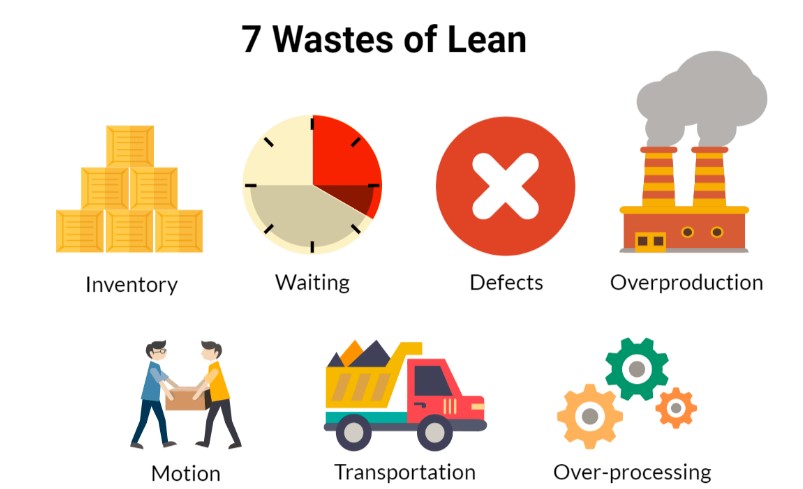
Source: Plumlogix
1. Overproduction- Producing more than what the customer requires, leading to excess inventory and wasted resources.
2. Waiting- Downtime or idle time in the production process caused by delays, equipment breakdowns, or inefficient scheduling.
3. Transportation- Unnecessary movement of goods or materials, leading to increased costs and potential damage or loss.
4. Overprocessing- Performing unnecessary or redundant steps in the production process, leading to wasted time, energy, and resources.
5. Inventory- Excess stock or raw materials that are not immediately required, tying up capital and storage space.
6. Motion- Unnecessary movement of equipment or resources within a work area, leading to wasted time and energy.
7. Defects- Errors or defects in the production process that result in rework, scrap, or customer dissatisfaction.
By identifying and eliminating these forms of waste, Lean helps organizations to improve their overall operational efficiency and reduce costs significantly. It is estimated that the average organization can achieve cost savings of 20% to 30% by implementing Lean principles.
Lean Six Sigma Green Belt Certification
In addition to waste reduction, Lean also emphasizes the importance of continuous improvement. This involves constantly seeking ways to improve existing processes, systems, and procedures. Through a systematic Plan-Do-Check-Act (PDCA) approach, organizations can identify areas for improvement, implement changes, monitor the results, and make further adjustments as necessary. This iterative approach ensures that organizations are constantly evolving and adapting to the evolving customer needs and market conditions.
Statistics have shown the positive impact of Lean implementation across various industries. For example, in manufacturing, a study by McKinsey & Company found that Lean has the potential to increase labor productivity by 10% to 20% and reduce lead times by 40% to 60%. In healthcare, Lean has been proven to decrease patient waiting times, improve patient flow, and enhance the overall quality of their care. In retail, Lean has helped organizations optimize their store layouts, reduce inventory levels, and improve customer service. This simply demonstrates the versatility and effectiveness of Lean as a methodology for achieving continuous improvement.
To successfully implement Lean principles and achieve continuous improvement, organizations need to inculcate a culture of collaboration, engagement, and empowerment. This requires providing employees with the necessary Lean Fundamentals Training and resources to understand and apply Lean tools and techniques. By involving employees at every level of the organization, organizations can harness their knowledge, creativity, and problem-solving abilities to drive process improvement. This not only enhances the effectiveness of Lean initiatives but also promotes a sense of ownership and accountability among employees.
Conclusion
Implementing Lean in an organization to achieve continuous improvement is a powerful strategy across various industry sectors. Enterprises can enhance their operational efficiency, drive higher profitability, and deliver exceptional customer value by focusing on continuous improvement, waste reduction, and process optimization. To reap the full benefits of Lean, individuals, and enterprise teams should be knowledgeable in various aspects of Quality Management training, and these can be achieved by having their workforce get upskilled or trained in industry-recognized Lean Six Sigma Yellow Belt Course and Lean Six Sigma Green Belt Course, Root Cause Analysis Training, Kaizen Training, and others. This will eventually empower organizations to stay ahead in a competitive business landscape by tapping into the full potential by implementing Lean methodology.