Infrastructure Pipeline, Construction Activity and Scheduling Complexity
UK project work creates a substantial context for scheduling and controls expertise. The National Infrastructure and Service Transformation Authority (NISTA) reported in March 2026 that its expanded UK Infrastructure Pipeline included 734 planned projects covering £718 billion of public and private investment over the next decade. The accompanying workforce modelling projected average annual construction and infrastructure workforce requirements of approximately 629,000–706,000 during the following five years. These are programme-pipeline projections, not a count of Primavera P6 users or guaranteed jobs.
The Office for National Statistics reported £139.106 billion of construction new work in Great Britain in 2025, up 1.9% in current prices, and new orders of £83.335 billion, up 16.2%. That construction series covers Great Britain, not Northern Ireland. The figures illustrate the size and variability of project activity, but no credible published source establishes what percentage of projects use P6. The requirement for competent planning must be understood separately from software market share.
Verified UK / GB indicator | Reported figure | Interpretation and source |
UK infrastructure pipeline, March 2026 | 734 projects / £718bn planned over ten years | NISTA; planned pipeline, not committed P6 spending |
Annual pipeline workforce requirement | 629,000–706,000 average (next five years) | NISTA workforce model; not P6 job vacancies |
GB construction new work, 2025 | £139.106bn; +1.9% | ONS current-price construction statistics |
GB construction new orders, 2025 | £83.335bn; +16.2% | ONS construction orders |
UK project-profession workforce, 2024 | 2.32m FTE | APM Golden Thread; all project roles |
UK project profession GVA, 2024 | £186.8bn annually | APM; broad economic measure |
Why Planning Quality Matters More Than the Software Brand
A schedule becomes useful when it represents real work. A planning engineer must establish logic from design, procurement, permits, construction, testing and handover. The project controls team must also identify which assumptions have changed and whether a delay threatens completion or merely reduces float. P6 provides the calculations and reporting structure; credible source data, informed judgement and good governance are what make the output trustworthy.
Where P6 Delivers Practical Value
Primavera P6 Career Opportunities Across the United Kingdom
Project Planning and Controls Roles
P6 skills may be useful to professionals who prepare schedules as well as those who validate them. Responsibilities differ across sectors: a planning assistant may maintain activity updates; a planning engineer can own logic and sequencing for a package; a project controls manager needs to connect schedule reporting with risk, cost and governance. Hiring managers generally look for both software evidence and understanding of the industry being planned.
Potential role | Typical contribution | Relevant UK settings |
Planning Assistant / Junior Planner | Update progress and maintain activity records | Construction and utilities |
Project Planner | Build and analyse the linked schedule | Infrastructure and manufacturing |
Planning Engineer | Model build sequence and constraints | Civil works, rail and energy |
Project Controls Engineer | Integrate plan, progress and forecast | Engineering and capital projects |
Scheduler / Schedule Analyst | Assess logic, float and changes | Multi-contractor programmes |
Planning Manager | Set programme standards and assure reports | Major contractors and clients |
Project Manager / PMO Analyst | Challenge forecasts and approve actions | Public and private portfolios |
Salary Evidence: What Is and Is Not Known
APM’s 2025 Salary and Market Trends Survey reports an average salary of £52,500 among UK project professionals, with sector and region differences. It is not a Primavera P6 salary survey and cannot establish that training causes a pay increase. The most reliable comparison for a candidate is the current pay range advertised for a specific job title, level, region and sector, with contractor day rates distinguished from permanent salaries.
Pay comparison | Suitable interpretation |
APM 2025: £52,500 average | Broad UK project-profession salary; not P6-specific |
National Careers Service: construction manager £27k–£65k | Adjacent construction role salary range, not planner benchmark |
National Careers Service: civil engineer £29k–£63k | Adjacent engineering role range, not software premium |
Live vacancy salary or day rate | Check employer, scope, location, date and employment basis |
Developing From a Tool User into a Trusted Planner
Industries Using Primavera P6 in the UK
Planning practices must be adapted to the physical and contractual constraints of each sector. A rail possession, offshore shutdown and hospital refurbishment cannot sensibly share the same working calendar or risk assumptions. P6 is most valuable when the planning model reflects these differences.
UK industry | Scheduling problem | P6 technique to apply |
Transport and rail | Access, possessions and commissioning | Calendars, milestones and links |
Construction and real estate | Multiple trades and shared workfronts | WBS and contractor activity codes |
Energy and offshore | Shutdowns and specialist equipment | Calendars, resources and critical path |
Water and utilities | Outages, permits and network interfaces | Constraints and logic review |
Defence and aerospace | Design, procurement and acceptance | Interface milestones and baselines |
Manufacturing and process plants | Equipment delivery and production readiness | Resource and handover sequencing |
NHS and public estate | Live-site refurbishment and clinical change | Phasing and progress assurance |
Ports and logistics | Facility modifications while operating | Restricted windows and look-aheads |
Telecoms and data centres | Systems integration and energisation | Testing/commissioning dependencies |
Choose the Appropriate Level of Schedule Detail
A programme created for a sponsor should not need thousands of unreadable tasks, while a construction package may require sufficient activity detail to coordinate safely. Good planners separate a management summary from the maintained control schedule, use consistent activity IDs and explain which milestones really matter. Excessive constraints and missing links can be more dangerous than a schedule with too few colours or dashboards.
Primavera P6 Training and Project-Control Opportunities in Major UK Cities
Oracle Primavera P6 Training and Project Planning in London
London project programmes can be difficult to read because the work is spread across disciplines as well as physical locations. A rail-related site might require design approval, utilities access and testing to be completed in a fixed sequence; a commercial development may face similarly tight contractor handovers. P6 is valuable when the planner records those links instead of treating milestones as isolated promises.
Local project environment | Practical P6 focus |
Rail access | Possession calendar |
Property and utilities | Contractor interface logic |
A useful London training exercise starts with a late design approval and asks which contractor activities move, whether the completion path changes and what management can realistically recover. Experienced recruiters will expect an explanation of the logic, not merely proof that a Gantt chart was exported.
Oracle Primavera P6 Training and Project Planning in Manchester
Manchester’s regeneration, transport and building programmes can have live operations sitting beside new work. That creates planning questions which a generic list of dates misses: who owns each workfront, when can access be given, and what needs signing off before the next phase opens? P6 helps turn those questions into a linked delivery programme.
Local project environment | Practical P6 focus |
Regeneration | Trade workfront sequence |
Transport and hospitals | Phased access and handover |
For Manchester planners, a phased refurbishment or transport-interface example makes the training immediately practical. Build a baseline, update one missed handover and explain why the next package has moved. The strongest portfolio evidence is the decision narrative that accompanies the schedule.
Oracle Primavera P6 Training and Project Planning in Birmingham
In Birmingham, transport, logistics and engineering projects often bring together external approvals, long-lead materials and construction windows. One procurement slip may seem minor until a detailed logic check shows that installation and testing depend on that item. This is exactly the sort of problem that structured P6 schedules should reveal early.
Local project environment | Practical P6 focus |
Transport corridors | Dependency analysis |
Engineering/logistics | Procurement-to-test schedule |
A Birmingham planning engineer can practise building an activity chain from design release through ordering, delivery, installation and commissioning. After adding an actual delay, review float and the longest path, then explain alternative recovery actions without pretending the tool has decided the contractual outcome.
Oracle Primavera P6 Training and Project Planning in Leeds
Leeds projects across utilities, public buildings and regional transport reward disciplined reporting. A programme is only useful if the site team can reconcile what happened last week with what the planner forecasts for the next four. Activity codes, clear baselines and a consistent data date can make that conversation much less argumentative.
Local project environment | Practical P6 focus |
Utilities | Outage and permit logic |
Public estates | Baseline change visibility |
A Leeds-focused exercise could begin with an unexpected service outage or delayed inspection. Learners create a four-week look-ahead, identify affected dependencies and draft a concise milestone-variance explanation for the manager. The quality of that explanation matters more than the number of rows in the schedule.
Oracle Primavera P6 Training and Project Planning in Bristol
Bristol’s aerospace, defence and advanced engineering environments are a reminder that project scheduling is not limited to building sites. Design maturity, prototype availability, supplier deliveries, validation tests and formal acceptance can all become schedule drivers. P6 gives engineering teams a way to connect these stages without concealing the uncertainty behind a single completion date.
Local project environment | Practical P6 focus |
Aerospace/defence | Review gates and test milestones |
Manufacturing | Supplier and resource interfaces |
Practise with a fabrication-to-acceptance scenario: build test and inspection gates, link supplier readiness and show the effect of a failed acceptance test. An engineer who can distinguish remaining work from completed work will contribute more to a schedule review than someone who merely knows the menus.
Oracle Primavera P6 Training and Project Planning in Edinburgh
Edinburgh has a mix of institutional estates, transport projects and commercial development where decisions may pass through several governance stages. Those decisions belong in the plan as real dependencies. A programme that ignores approval or procurement time can appear comfortably on schedule right up to the point a site cannot proceed.
Local project environment | Practical P6 focus |
Public estate | Phase and approval logic |
Infrastructure | Milestone assurance |
An Edinburgh training case might compare an approved refurbishment baseline with a revised forecast after a design decision is delayed. Learners should record the assumption, identify the next affected milestone and explain whether the programme needs a controlled change rather than quietly overwriting its original dates.
Oracle Primavera P6 Training and Project Planning in Glasgow
Glasgow’s engineering, shipbuilding and energy-related work often involves detailed fabrication sequences, specialist resources and test or commissioning hold points. A scheduling problem may arise because a crew or work area is unavailable, not because the arithmetic in the programme is wrong. P6 needs to reflect those constraints honestly.
Local project environment | Practical P6 focus |
Shipbuilding | Fabrication-to-test links |
Energy/transport | Access and outage calendars |
Try a Glasgow shutdown or fabrication sequence with a separate access calendar and shared resource. After rescheduling, investigate what became critical and whether the assumptions are credible. This is useful practice for engineers who must explain the difference between a calculated finish and a workable site plan.
Oracle Primavera P6 Training and Project Planning in Cardiff
Cardiff’s utilities, healthcare and public-asset work can involve essential services continuing while upgrades are carried out. A planned outage or ward handover cannot be moved casually. Schedules need clear work stages, isolation or access assumptions, contractor interfaces and sign-off dates. P6 can connect these events and preserve the agreed baseline.
Local project environment | Practical P6 focus |
Utilities | Service outage dependencies |
Public estate | Controlled phased delivery |
A Cardiff learner could build a phased facilities or utilities schedule, then introduce a late inspection and report the effect on service restoration. Effective planning here is as much about safeguarding operations and communicating change as it is about achieving a favourable float calculation.
Oracle Primavera P6 Training and Project Planning in Belfast
Belfast engineering and manufacturing teams may work with complex suppliers, design evidence and formal test acceptance, while port-related and public projects add their own operating constraints. Those environments make P6 sequencing useful because late information can move downstream work even when fabrication looks on target.
Local project environment | Practical P6 focus |
Aerospace | Design and test interfaces |
Port/industrial | Contractor sequencing |
A Belfast exercise might connect design release, specialist parts, assembly, inspection and customer acceptance. Save a baseline, enter real progress and ask whether the forecast is supported by the supplier record. It gives learners a better demonstration of competence than an unexplained percentage-complete report.
Oracle Primavera P6 Training and Project Planning in Liverpool
Liverpool’s ports and logistics operations illustrate a scheduling challenge that office-based programmes can overlook: the facility may have to keep running throughout construction. Work windows, access routes, equipment deliveries and handovers must be sequenced around operational commitments rather than plotted independently.
Local project environment | Practical P6 focus |
Ports/logistics | Operational access calendar |
Regeneration | Progress and handover |
A useful Liverpool case is a warehouse or port-facility upgrade with restricted installation hours. Learners can assign the correct calendar, connect contractor activities and prepare a look-ahead that operations teams could use. The lesson is to avoid treating schedule flexibility as permission to interrupt a working facility.
Oracle Primavera P6 Training and Project Planning in Aberdeen
Aberdeen is especially relevant to planners supporting offshore energy, asset maintenance and decommissioning. Vessel access, specialist crews, weather exposure, isolation requirements and shutdown windows can create genuinely different programme logic from a typical building project. A single unverified availability assumption can make an otherwise tidy schedule misleading.
Local project environment | Practical P6 focus |
Energy/offshore | Weather and access assumptions |
Decommissioning | Shutdown and handover path |
An Aberdeen case could trace equipment fabrication to marine mobilisation, installation and commissioning. Learners review access assumptions, resource demands and the effect of a delayed delivery. P6 supports the analysis, but the engineer must still validate the operating and safety requirements with the people responsible.
Oracle Primavera P6 Training and Project Planning in Newcastle
Newcastle and the wider North East have engineering and offshore-energy supply chains where fabrication, transport, installation and energisation need to meet. The danger is often hidden at the interfaces: one contractor finishes its deliverable, but the next team cannot start because an approval, test or logistics step is missing.
Local project environment | Practical P6 focus |
Clean energy | Supplier and delivery interfaces |
Infrastructure | Testing/commissioning logic |
A Newcastle training scenario can build the chain from design release to manufacture, heavy transport and site commissioning. After inserting an inspection delay, learners explain its impact on the forecast and propose realistic checks. That ability to expose dependencies is a better test of scheduling skill than producing a polished chart.
Additional UK Location Search Opportunities
Related local searches may include Primavera P6 training in Sheffield, Nottingham, Coventry, Oxford, Cambridge, Reading, Southampton, Portsmouth, Exeter and Milton Keynes. Publish dedicated city pages only when each page offers genuine local evidence, useful training availability and distinctive content. Avoid creating interchangeable copies merely to repeat place names.
How Primavera P6 Professionals Support UK Enterprises
A competent planner links physical delivery and management decisions. Good schedules help a project team discuss what can happen next, which assumptions threaten completion and what evidence supports a recovery proposal. This work includes disciplined communication with engineers, procurement teams, supervisors, cost controllers, commercial specialists and sponsors.
Enterprise Challenges and P6 Capabilities
Challenge | Planning response | Useful output |
Unclear work sequence | Build predecessor and successor logic | Reviewable network |
Changing site access | Use appropriate calendars and constraints | Updated forecast |
Late supplier delivery | Test downstream path and options | Interface impact narrative |
Poor progress visibility | Record actuals and remaining durations | Data-dated schedule update |
Unexplained slippage | Compare baseline with current forecast | Variance explanation |
Disjointed contractor plans | Agree coding and interface milestones | Integrated programme view |
Management overload | Filter critical and near-critical work | Decision-focused report |
Practical Schedule-Quality Checklist
Primavera P6 Applications in UK Public Services, Infrastructure and Engineering
Rail, Highways and Urban Transport
Transport projects require disciplined management of interfaces between design, utilities, site access, construction and safety assurance. P6 can support an integrated programme with location-specific calendars and handover milestones. Site teams still need to test whether the proposed sequence is practical and meets required permissions and contractual requirements.
NHS, Education Estates and Other Public-Sector Buildings
Healthcare and education projects often take place in operating facilities. Planners may need to phase temporary works, testing, infection control requirements, access restrictions and reopening dates. A schedule can make those dependencies explicit, but technical and clinical authorities retain responsibility for the rules governing the site.
Energy, Utilities and Industrial Shutdowns
Work on energy assets and process facilities is shaped by specialist personnel, outages, material availability and sequencing between mechanical, electrical and control-system work. A useful P6 model makes the shutdown route and commissioning interfaces visible. Where safety and statutory duties apply, specialist review always takes precedence over a favourable calculated completion date.
Benefits of Oracle Primavera P6 Training for UK Professionals
What Participants Can Apply After the Course
Different Roles, Different Practical Gains
Learner group | Immediate application |
Junior planner | Build and maintain activity information |
Site engineer | Supply accurate construction sequence and actuals |
Planning engineer | Analyse critical path and contractor interface |
Project manager | Challenge and interpret programme forecasts |
PMO professional | Set consistent update and baseline reporting |
Cost controller | Understand schedule inputs to performance reporting |
Engineering manager | Review test, commissioning and shutdown dependencies |
What 16 Hours Cannot Promise
Two days of training cannot guarantee independent competence on a major infrastructure programme, an Oracle-issued credential, a permanent software licence, a planning job or a particular salary. It introduces the software and professional decisions behind useful schedules. Continued workplace practice, peer review and further study remain essential for advanced planning and forensic schedule analysis.
Benefits of Corporate Primavera P6 Training for UK Organisations
Corporate Learning Outcomes by Team
Corporate team | Potential improvement | Follow-up activity |
Main contractor planning | Consistent linked schedule quality | Review ten sample logic links |
Engineering team | Better technical dependencies | Map design-to-test interfaces |
Site operations | More credible actual progress | Trial weekly status collection |
Project controls / PMO | Consistent baselines and update reports | Implement schedule-quality checklist |
Commercial team | Clearer programme evidence | Agree reporting assumptions |
Client programme office | Stronger forecast challenge | Review milestone movement narrative |
Practical Measures of Training Impact
A sensible company evaluation uses quality measures rather than arbitrary financial promises. Compare sample schedules before and after training; monitor the timeliness of data-date updates; review whether baseline changes are authorised; and assess whether managers receive clear explanations of schedule movement. Follow up after several weeks to establish whether new habits have continued beyond the class.
Suggested Four-Week Reinforcement Plan
Oracle Primavera P6 UK Training Schedule and Corporate Enquiries
Spoclearn’s standard Primavera P6 programme runs for two days / 16 hours. Current public-session dates, instructor availability, delivery formats and UK local time must be verified in the live booking calendar; do not reuse dates from expired batch listings. UK companies can request a private proposal for virtual or available on-site delivery, with role-specific exercises and access planning.
Booking question | What to verify before purchase |
Dates and times | Current UK batch calendar; GMT/BST as applicable |
Total duration | Two days / 16 hours of scheduled training |
Tuition fee | Live GBP price, applicable VAT and terms |
Software access | Version, authorised lab, device requirements |
Hands-on scope | Exercises, case data and follow-up materials |
Instructor | Experience on relevant engineering or capital projects |
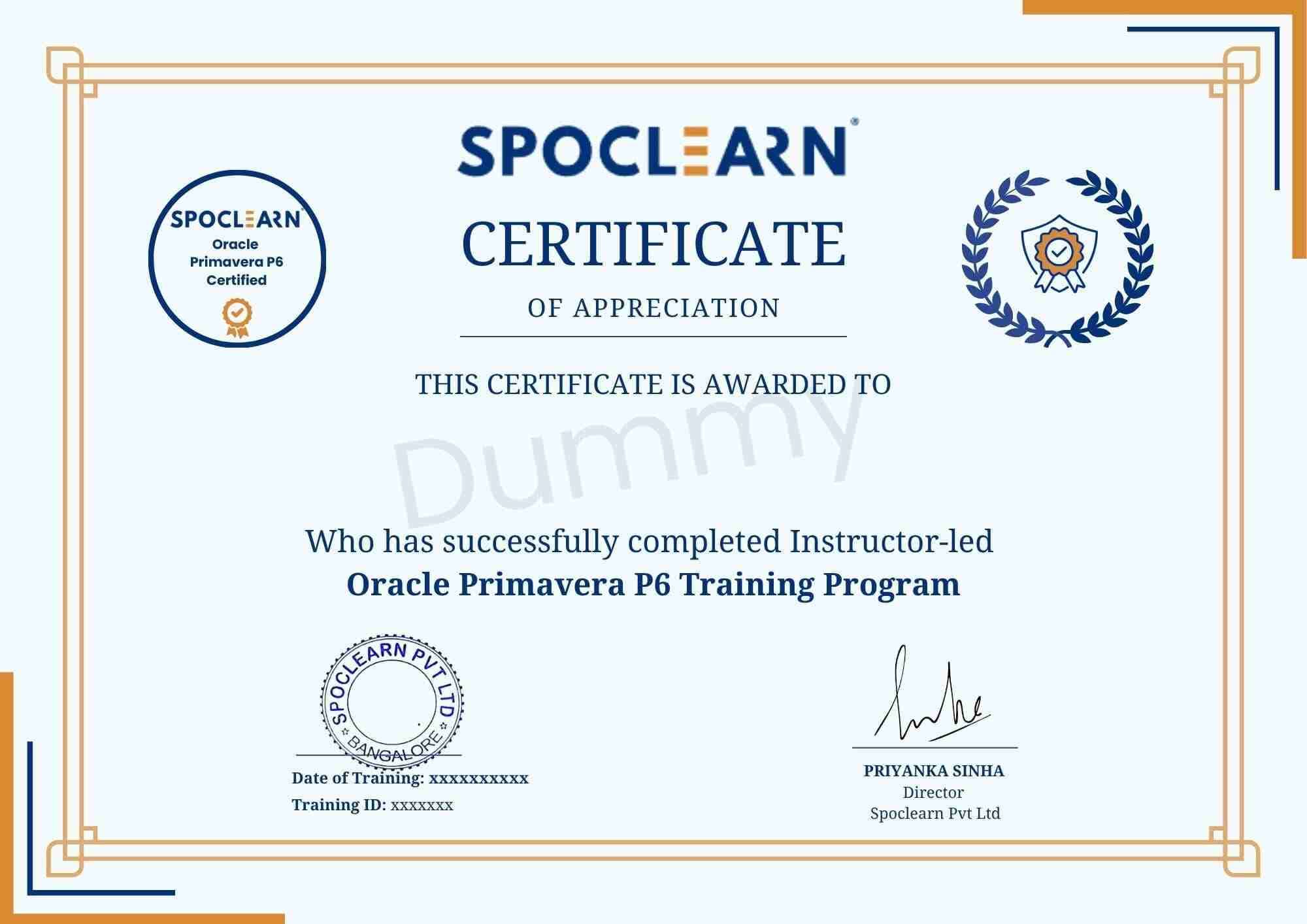
Award | Spoclearn Course Completion Certificate |
Examination | No external exam or voucher |
Corporate delivery | Class size, locations, onsite costs and data security |
Recommended CTAs: See Upcoming Primavera P6 Courses | Speak to a Training Adviser | Request a UK Corporate Proposal
Take Control of Project Schedules with Primavera P6 Training in the UK
Strong project planning is not about showing a perfect Gantt chart. It is about understanding dependencies, spotting a credible threat to completion and giving teams a workable basis for action. Spoclearn’s two-day, instructor-led Oracle Primavera P6 Training brings together the software functions and practical project-controls judgement needed to start doing that work more confidently.
Choose a scheduled UK class or discuss dedicated training for your planning and delivery team. Participants completing the programme receive a Spoclearn Course Completion Certificate. The next step is to apply what you have learned on a carefully reviewed project schedule.
 CN
 CN
 CN
 CN