
Trending Now

How Google AI Search Is Changing SEO Strategies in the United States
Top Industries Hiring PRINCE2 Certified Professionals with AI Skills in 2026
CRISC Certification Salary Guide by Country in 2026
PRINCE2 7 in Agile/Hybrid Teams: How to Combine PRINCE2 with Scrum, Kanban, SAFe (2026)
PRINCE2 7 Processes Explained (2026): A Step-by-Step Walkthrough from Start to Close
Common Root Cause Analysis Mistakes That Keep Problems Coming Back — And How to Fix Them
Lean Six Sigma Templates Pack: SIPOC, CTQ, Fishbone, Control Plan, A3 (Free Guide)
Power Query in Power BI: Top Real-World Problems, Errors & Solutions for Data Analysts
Power Query Best Practices 2026: Faster Refresh, Cleaner Models, Fewer Errors
Step-by-Step CISA Certification Roadmap for 2026 (Beginner to Expert)
Top ITIL Roles in the USA for 2026 With ITIL v5 Skills
PMP vs Agile vs PRINCE2 in the USA: Which Certification Delivers the Best Career Growth in 2026?
Agile in CAPM: What PMI Expects You to Know (Scrum, Kanban, Hybrid Basics)
Power Query vs Traditional Excel: The Future of Data Cleaning, Reporting & Automation in 2026
ITIL 4 to ITIL 5 Transition Guide: Bridge Certification, Costs, Deadlines & Strategic Upgrade Plan
CAPM Exam Mistakes to Avoid: The Top Reasons Candidates Fail and How to Fix Them
Why Global Construction and Infrastructure Companies Depend on Oracle Primavera P6
Top SRE Challenges in 2026: Toil, Tool Overload & How Organizations Can Fix Reliability Gaps
From Chaos to Control: How PMP Frameworks Help Organizations Deliver Projects On Time and Within Budget
From Beginner to Agile Pro: Step-by-Step Roadmap with Agile Scrum Foundation Certification
What Is CRISC Certification in 2026? Updated ISACA Exam, Domains, Skills & Career Value Explained
Struggling with Process Inefficiencies? How LSSGB Solves Workflow Bottlenecks in 2026
SIAM in 2026: How to Fix Multi-Vendor Chaos and Achieve End-to-End Service Accountability (EXIN SIAM BoK V3 Guide)
CISM Certification 2026 Update: What’s Changing in ISACA’s New Exam Structure (Nov 2026)
Step-by-Step Guide to Master Primavera P6 for Project Managers (2026 Edition)
Oracle Primavera P6 Training Guide (2026): Skills Every Project Professional Must Master
What’s New in PMP 2026? Key PMI Updates, Exam Pattern Changes & What It Means for Your Career
Who Should Take the ITIL V5 Bridge Course? Eligibility, Benefits & ROI Explained
PL-300 Practice Questions 2026: 60 Scenario-Based Questions with Explanations
From Beginner to Expert: The Ultimate Oracle Primavera P6 Learning Path for Project Professionals
ITIL v5 Framework Guide: Core Concepts, Principles, and Real-World Applications
Agile Scrum Foundation vs Scrum Master: Which Certification Should You Choose in 2026?
CRISC® Certification Guide 2026: Syllabus, Exam Pattern, Salary & Career Growth Explained
PMI-PBA® Certification in 2026: Complete Guide, Career Scope, Salary & Industry Demand
CISA Exam Changes & Syllabus Breakdown (2026 Update + Study Strategy)
CISM Certification Roadmap 2026: Step-by-Step Guide to Becoming a Security Manager
Lean vs Six Sigma vs Lean Six Sigma: What’s the Difference and When to Use Each?
AI and PRINCE2 7th Edition: What PMs Must Know
Performance Max Campaign Performance Dropped? Here’s the Real Reason (And Fix)
ITIL v5 Trends: What IT Leaders Must Know About the Next Phase of ITSM
Why Oracle Primavera P6 Certification Is Becoming Essential for Project Managers in 2026
PRINCE2 7 Roles & Responsibilities: Who Does What (Project Board to Team Manager)
Stakeholder Engagement Strategies That Actually Deliver Results
The Future of Project Management: Trends Reshaping 2025–2030 
CAPM Exam Prep Strategy 2026: Practice Questions, Mock Tests, and Time Management
ITIL 4 vs ITIL (Version 5): The Global, No‑Fluff Guide to What’s New, What Stays, and How to Transition
ITIL 5 Certification Demand and Job Market Trends: Complete Career Guide (2026)
ITIL v5 Job Roles Explained: From Service Desk Analyst to IT Service Manager
PL-300 DAX Questions You Must Master in 2026 (With Patterns)
How to Write an RCA Report That Actually Prevents Repeat Incidents (Templates + Examples)
Digital Transformation Projects: Why They Fail & How to Fix Them
PMI’s Late-2026 PMP® Policy Update Will Reject Most Live Training Hours — Here’s How to Protect Your 35 Contact Hours  
Why Are My Pages Not Indexed Even After Sitemap Submission? (And How to Fix It)
Minitab for Lean Six Sigma (2026): The Only Functions Most Belts Actually Need
Top 10 Project Scheduling Tools for PMP & PRINCE2 Aspirants (2026 Guide)
SIPOC Made Simple: How to Map a Process in 20 Minutes (with Examples)
PL-300 vs DP-600 vs DP-500 in 2026: Which Certification Should You Take First?
Portfolio Management Mastery: Why PfMP and PgMP Are Rising in Demand (2026)
How to Build a “Closed-Loop” CAPA System Using RCA (So Fixes Don’t Die in Docs)
Yellow Belt vs Green Belt vs Black Belt: Which Lean Six Sigma Level Should You Choose in 2026?
DMAIC Explained (2026): The Step-by-Step Method to Fix Any Process
PRINCE2 7 Tailoring Guide (2026): How to Adapt the Method for Any Project Size
Google Ads vs SEO in 2026: Which Should You Invest In First?
Process Mining + Lean Six Sigma: The 2026 Playbook for Faster, Data-Driven DMAIC
CAPM vs PMP in 2026: Which Certification Should You Choose (and When)?
PRINCE2 7 Certification Path: Foundation → Practitioner → Next Steps (2026 Roadmap)
Oracle Primavera P6 Training Roadmap (2026): From Beginner to Project Controls Expert
AI Overviews & AI Mode SEO: How to Win Visibility When Google Answers First
RCA vs 5 Whys vs Fishbone vs 8D vs A3: When to Use Which (Decision Framework)
PL-300 Case Study Walkthrough: From Raw Data to Executive Dashboard (End-to-End)
PRINCE2 7 Foundation: Complete Exam Guide, Format, Pass Mark, and Study Plan (2026)
Lean Six Sigma Yellow Belt: The 2026 Beginner Guide (Tools, Examples, Real Workplace Use)
Technical SEO Audit 2026: The Only Checklist That Still Matters
Content Refresh Strategy 2026: How to Update Old Pages for New Traffic
CAPM Exam Content Outline Explained: Domains, Weightage, and What to Study First
GA4 Setup Guide 2026: Step-by-Step for Accurate Tracking
From Keywords to Answers: How Search Works in 2026 
CAPM Certification 2026: The Complete Exam + Training Guide (PMI-Updated)
Traditional SEO vs Answer-First SEO: What Actually Ranks in 2026
ITSM Evolution: From Monolithic Systems to Cloud‑Centric Architectures (2026)
How to Run High-Performance Retargeting Campaigns Using AI
Project Leadership in 2026: Skills Every Successful Project Manager Needs
Technical SEO for 2026: Crawl Optimization, Log Analysis & AI Indexing Signals
Top 12 Project Management Mistakes and How to Avoid Them
PRINCE2® 7 (2026 Guide): What’s New, What Changed, and Why It Matters
Lean Six Sigma in 2026: What’s Changed (AI, Automation, Process Intelligence) & What Still Works
Root Cause Analysis in 2026: The Modern RCA Playbook for Faster, Repeatable Fixes
ITIL Is for Everyone and for Every Organization: A Deep‑Dive Playbook (2026)
Social Media Algorithms Explained (2026 Edition): What Actually Drives Reach Today
PL-300 Exam Guide 2026: Skills Measured, Study Plan, and What’s Changed
LLMS.txt vs Robots.txt in 2026: What to Implement (and What to Avoid)
SEO in 2026: The Complete Playbook for AI Search, AEO & GEO
Google Ads Audits in 2026: A Step-by-Step Checklist to Fix Wasted Spend and Unlock Growth
AI-Driven Risk Management: Predict Risks Before They Happen
On-Page SEO 2026: New Techniques for Topical Relevance & AI Search
Hybrid Project Management: Why Organizations Are Transitioning in 2026 and Beyond
AI-Powered Project Planning: Faster, Smarter, and More Accurate Strategies 
Industry Predictions for 2026: From GenAI to Value Streams and Total Experience
PMP vs CAPM vs PRINCE2: Which Certification Offers the Best ROI in 2026?
AI in Project Management: How Intelligent Tools Are Transforming PM Workflows 
Google AI model Gemini

Gemini Google’s AI Model to Take Down GPT-4

Picture of Stefan Joseph
Stefan Joseph
Stefan Joseph is a seasoned Development and Testing and Data & Analytics, expert with 15 years' experience. He is proficient in Development, Testing and Analytical excellence, dedicated to driving data-driven insights and innovation.

Competition in this AI-ruled era is no longer astonishing. Microsoft’s Copilot AI chatbot is now integrating OpenAI’s latest model, GPT-4 Turbo, alongside image generator DALL-E 3. Anthropic’s Claude 2.1 can analyze as many as 1,50,000 words in a single prompt, which is claimed to be an industry first. But why should Microsoft have all the fun? To give tough competition to Microsoft, Google’s CEO, Sundar Pichai inaugurates Gemini, Google’s latest large language model (LLM), which is more than a single AI model. Now available on Bard and Pixel Pro, Gemini will bring some monumental revolution and claims to de-throne GPT-4 down the line.
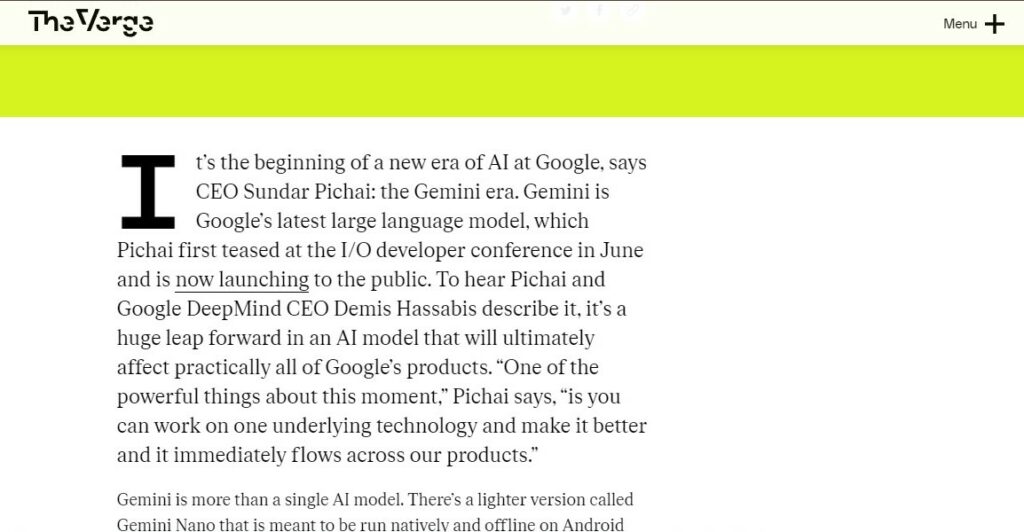

Google’s CEO Sundar Pichai on Google Gemini

Source: Google’s CEO Sundar Pichai on Google Gemini

What is Google Gemini?

Google’s next-generation foundation model, Gemini, has already been launched, and the world of artificial intelligence is going crazy! It is expected to be more capable, flexible, and better optimized for smartphones. Gemini is the first AI model to score more than 90% on the MMLU, or Massive Multitask Language Understanding as compared to OpenAI’s GPT-4 score with an 86.5% average. This consequently gives a clear picture of how well a model understands language and can proceed with problem-solving. It’s a bang-on family legacy. AlphaGo (2016), Bert (2018), LaMDA (2020), MUM (2021), and PaLM 2 (2023), its predecessors.

Moreover, Gemini uses a robust combination of 57 subjects, such as math, physics, history, law, medicine, and ethics for testing both world knowledge and critical problem-solving abilities. Another massive advantage of Google’s Gemini is that it can understand, thoroughly explain, and efficiently generate superior-quality codes that are among the world’s most significant programming languages, like Python, Java, C++, and Go. It is now available in more than 170 countries and will empower Google’s chatbot, Bard, to the next level.
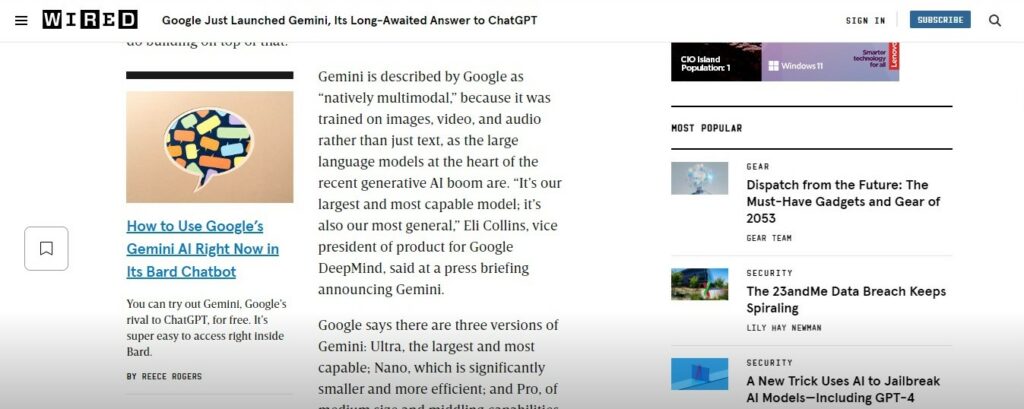
Eli Collins on Google Gemini

Source: Eli Collins on Google Gemini

Gemini 1.0 is optimized for three different sizes, Nano, Pro, and Ultra. Google Bard is integrated with Gemini Pro and Pixel 8 Pro (Android 14) users are enjoying the luxurious benefits of Gemini Nano, while the Ultra version will launch next year. Developers and enterprise customers will have access to Gemini Pro through Google Generative AI Studio or Vertex AI in Google Cloud starting on December 13th. The Gemini LLM-AI model is currently available in English but will gradually be able to take prompts in multiple languages. 
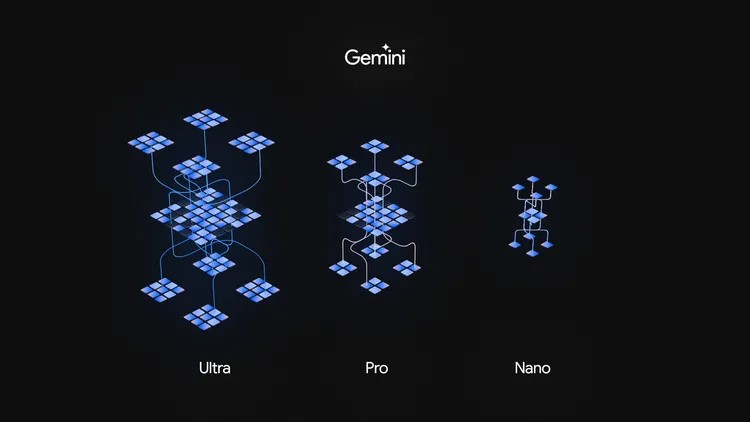
Three sizes of Google Gemini 1.0

Source: Google Images

  • Gemini Ultra — largest and most capable model for highly complex tasks
  • Gemini Pro– best for scaling across a wide range of tasks (Bard has this version)
  • Gemini Nano– most efficient model for on-device tasks
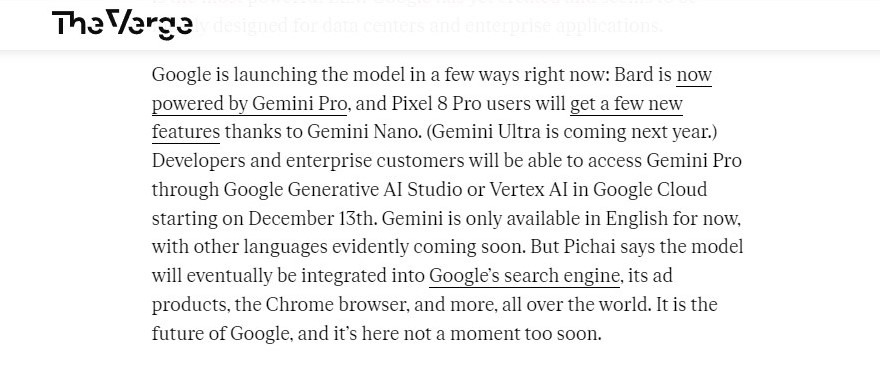
Developers and enterprise customers will be able to access Gemini Pro

Source: Developers and enterprise customers will be able to access Gemini Pro

Google has commenced testing Gemini in the Search domain, focusing on enhancing the Search Generative Experience (SGE) to provide faster performance for users. This includes a 40% reduction in latency in English in the US, along with enhancements in quality.

How to use Google Gemini for Image Generation?

Gemini is the most flexible model of Google. The primary justification for Google labeling Gemini as its most advanced model lies in the engine’s multimodal capability. To put it simply, this new technology can adeptly manage the generation and interpretation of a more diverse range of data than ever before. DALL-E 3 has been one of the most popular AI tools for image generation but with Google Gemini, things are pretty straightforward and subtle. 

If you’re one of the lucky people who can use Google’s AI image generation, getting started is super simple. First, make sure you’re part of Google’s SGE testing program. Once that’s set:

  • Just open up Google Search and type in a prompt for generating an image.
  • Wait a few seconds.
  • Check out the four image options provided by SGE.
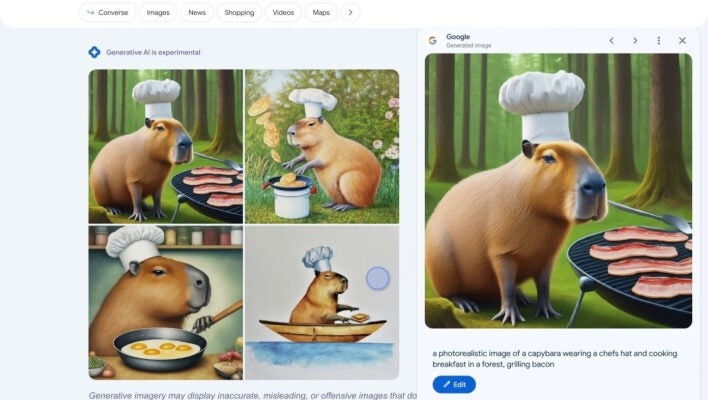
 Image generated by Google Gemini

Source: Image generated by Google Gemini

That’s it! You also get an option to make subtle changes in the images Gemini has generated. To tweak the images, you have to pick one and adjust the description to add more details. Google gives a quirky example like creating a “photorealistic image of a capybara cooking breakfast in the forest” to show how it works. You can then effortlessly edit details. If you’ve ever used ChatGPT prompts, this process will feel familiar, but it’s pretty straightforward even if you haven’t.

Why Gemini is Considered to be Superior to GPT-4?

While text generation, latency, language, etc., are already on the track, AI image generation has still been somewhat controversial given the deepfake AI content available on the internet. Gemini excels in this genre as all AI-generated images will come out with a watermark and ‘metadata labeling’ tag. This will show everyone that content was made by AI and will to some extent cease the outspread of false information. 

The table below shows a distinct difference between Gemini Ultra and GPT-4 in terms of text module:

CapabilityBenchmark (Higher is better)DescriptionGemini UltraGPT-4 (AI numbers calculated where reported numbers were missing)
GeneralMMLURepresentation of questions in 57 subjects (incl. STEM, humanities, and others)90.0%CoT@32*86.4%5-shot* (reported)
ReasoningBig-Bench HardA diverse set of challenging tasks requiring multi-step reasoning83.6%3-shot83.1%3-shot (API)
DROPReading comprehension (F1 Score)82.4Variable shots80.93-shot (reported)
HellaSwagCommonsense reasoning for everyday tasks87.8%10-shot*95.3%10-shot* (reported)
MathGSM8KBasic arithmetic manipulations (incl. Grade School math problems)94.4%maj1@3292.0%5-shot CoT (reported)
MATHChallenging math problems (incl. algebra, geometry, pre-calculus, and others)53.2%4-shot52.9%4-shot (API)
CodeHumanEvalPython code generation74.4%0-shot (IT)*67.0%0-shot* (reported)
Natural2CodePython code generation. New held out dataset HumanEval-like, not leaked on the web74.9%0-shot73.9%0-shot (API)

Source: Distinct Difference Between Gemini Ultra and GPT-4 in Terms of Text Module

Gemini was initially designed to be natively multi-modal while pre-trained on different modalities from the very beginning. Gemini, therefore, understands and deals with all kinds of inputs substantially better than existing multi-modal models. Google also claims that due to its score of 90% on the MMLU, it has the potential to solve complex issues more efficiently than GPT-4. As a result, it may take on Open AI and make Google Bard even stronger.
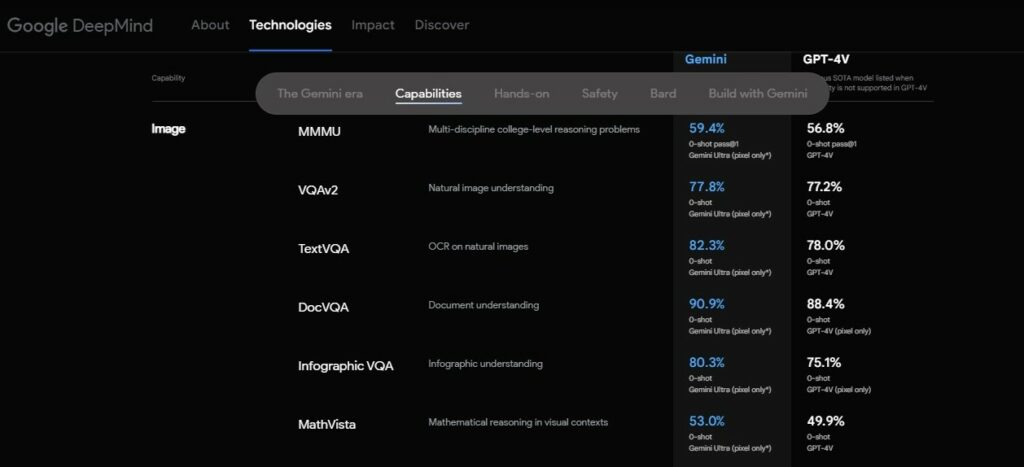
Comparison between Google Gemini and GPT-4 concerning Image generation

Source: Comparison between Google Gemini and GPT-4 concerning Image generation

What will Ultra bring that the current Gemini models don’t? It’ll have a more refined function, thanks to something called reinforcement learning from human feedback (RLHF). In 2024, Bard Advanced is going to make its public appearance and it is expected to be another magnificent scenario. It’s a Bard interface that includes the newest models, like Ultra once it’s ready. But before that, you can easily start using the Gemini Pro model right now. Just go to Bard and start chatting, just like you would with any other AI.

Conclusion

Gemini is trained using Google’s Tensor Processing Units which is quicker and more cost-effective to operate compared to Google’s earlier models such as PaLM. In addition to this new model, Google is introducing the TPU v5p, an updated version of its Tensor Processing Unit system. This computing system is specifically crafted for data center use, supporting the training and execution of extensive models at a large scale. Overall, Gemini seems to be quite promising and down the line, as claimed by the CEO, may overtake GPT-4 given its versatile features and faster actions. AI is going to be the ultimate future and Gemini’s contribution in that world will be undoubtedly impeccable!

Leave a Reply

Your email address will not be published. Required fields are marked *

Subscribe us