Why Process Efficiency Matters in Vietnam
Vietnam’s manufacturing, export, logistics and business-service operations depend on reliable handoffs between departments and suppliers. The National Statistics Office reported goods exports of approximately US$475.04 billion in 2025, with manufactured products accounting for US$421.47 billion, or 88.7% of merchandise export value. These figures show the scale of production-related activity; they do not measure how many people hold Lean credentials or guarantee demand for one particular course.
The same statistical agency estimated US$27.62 billion in disbursed foreign direct investment in 2025. Significant production investment increases the importance of operational execution, while service organizations also face pressures around speed, quality and customer expectations. Lean Fundamentals provides a shared vocabulary for investigating those challenges without assuming that a single workshop can resolve every systemic problem.
Verified economic context | 2025 figure | Interpretation |
Merchandise exports | US$475.04bn | Large export-facing operating environment |
Manufactured goods exports | US$421.47bn / 88.7% of exports | Strong manufacturing share |
Disbursed FDI | US$27.62bn | Investment backdrop, not Lean job count |
Where Lean Improvement Opportunities Commonly Appear
A factory may suffer repeated material shortages despite having ample stock overall. A bank may require the same information through several approval steps. A hotel may employ enough people but experience uneven workload and waiting during check-in. Lean asks teams to examine the whole process and its customer purpose before making changes. These examples are plausible use cases, not claims about specific Vietnamese employers.
Why Leadership and Frontline Knowledge Must Work Together
Workers know the practical details of equipment, queues and exceptions. Managers can remove barriers between departments and authorize safe experiments. Lean improvements rarely last when operators are asked to follow a new standard that has not been tested under real conditions. The most valuable outcome of an eight-hour course is a better shared conversation about work, followed by disciplined workplace practice.
Lean Fundamentals Career Opportunities Across Vietnam
Lean Fundamentals complements professional roles involving quality, production, operations, supply chain and service delivery. It is not an occupational licence and should not be presented as creating a separate job classification. People progress by combining process knowledge with relevant experience, supervision, business judgment and measurable results.
Relevant Career Opportunities
Lean-Related Career Pathways Across Vietnam
Career pathway | Typical work | Useful location examples |
Shop-floor operations | Standard work, material flow, constraints | Hai Phong, Ho Chi Minh City |
Supply chain and logistics | Replenishment, picking, dispatch | Ho Chi Minh City, Can Tho |
Service operations | Request flow and handoff delays | Hanoi, Da Nang |
Food processing | Packing, storage, rework | Can Tho |
Operational excellence | Cross-functional process improvement | Hanoi, Ho Chi Minh City |
2026 Salary Benchmarks for Related Roles
The following ranges are from Adecco Vietnam Salary Guide 2026 and are indicative gross monthly pay for occupations with one to five years of experience. They do not measure a wage premium attributable to Lean Fundamentals Training or guarantee an individual offer.
Occupation | Ho Chi Minh City / month | Hanoi / month |
Continuous Improvement Engineer / Lean Staff | VND 20–35 million | VND 23–35 million |
Lean / Operational Excellence / CI Manager | VND 50–90 million | VND 40–60 million |
Production Supervisor / Leader | VND 30–45 million | VND 28–40 million |
Quality Manager / Director | VND 60–100 million | VND 45–65 million |
Managers should interpret the table alongside actual job responsibilities, employer size and seniority. Salaries for Da Nang, Hai Phong and Can Tho are not inferred from the two-city guide. Local offers and live listings remain the more relevant evidence for those markets.
Career Progression Beyond an Eight-Hour Workshop
A technician might first practice 5S and material-flow observation, then become a shift improvement representative. A quality engineer could build expertise in measurement and root cause investigations. People who want to lead complex improvement projects may later pursue an appropriately assessed Lean Six Sigma qualification. The best pathway follows responsibilities and demonstrated work outcomes, not the number of training badges accumulated.
Industries Requiring Lean and Process Improvement Capabilities in Vietnam
Lean is useful wherever a customer-facing process contains avoidable delay, motion, inventory, rework or coordination effort. Industry examples should be used as a practical guide rather than a claim that all employers require Lean Fundamentals training.
Lean Applications Across Vietnamese Industries
Industry | Illustrative application | Relevant areas |
Electronics and industrial manufacturing | Material replenishment and line flow | Hai Phong, Ho Chi Minh City |
Garments and consumer goods | Changeover handoffs and work organization | Ho Chi Minh City |
Port and warehouse logistics | Picking, dispatch and dock queues | Hai Phong, Ho Chi Minh City |
Banking and financial operations | Approval and onboarding flow | Hanoi, Ho Chi Minh City |
Digital services | Ticket routing and handoffs | Da Nang, Hanoi |
Tourism and hospitality | Room readiness and guest service | Da Nang |
Food processing and cold chain | Packing, storage and dispatch flow | Can Tho |
Healthcare and public services | Wait times and administrative pathways | Hanoi, Ho Chi Minh City |
Choosing the Right Lean Tool
5S can address a disorganized workplace; a current-state map can expose the total waiting between process steps; Kanban may make replenishment more reliable. When a recurring defect has an unclear cause, Root Cause Analysis may be more suitable. Where process variation or complex measurement dominates, a larger Lean Six Sigma project could be warranted. Using the simplest appropriate tool is preferable to forcing every workplace issue into one methodology.
Lean Fundamentals Training Opportunities Across Vietnam’s Major Cities
Lean Fundamentals Training for Manufacturing, Warehousing, Retail and Financial Services in Ho Chi Minh City
Commercial operations combine customer-facing service processes with production, distribution and large business-support teams. Lean Fundamentals is relevant when orders wait between departments or work is repeatedly checked and re-entered.
Lean Applications in Ho Chi Minh City
Sector / team | Illustrative improvement focus |
Fulfillment centre | Map order release to dispatch; reduce picking queues |
Retail distribution | Test clearer stock-replenishment signals |
Finance operations | Remove avoidable document handoffs |
Manufacturing | Improve line-side material availability |
Each scenario is an example of how an instructor might make foundational Lean concepts concrete for the local operating environment. It is not a statement about named companies or their actual performance.
Career and Enterprise Relevance in Ho Chi Minh City
An operations coordinator could begin with a single order-to-dispatch map and ask where time disappears. Career relevance extends to warehouse supervision, quality, process analysis and operational excellence. Teams should test results against service commitments, not simply count changes.
Lean Fundamentals Training for Banking, Technology, Healthcare and Administrative Operations in Hanoi
Hanoi’s service, technology and administrative organizations coordinate processes that depend on accurate information and timely decisions. Lean concepts can help people distinguish required controls from duplicated approvals and unnecessary waiting.
Lean Applications in Hanoi
Sector / team | Illustrative improvement focus |
Banking | Map application review and handoff delays |
Enterprise IT | Improve ticket escalation pathways |
Healthcare administration | Study appointment or document queues |
Professional services | Simplify repeated document transfer |
Each scenario is an example of how an instructor might make foundational Lean concepts concrete for the local operating environment. It is not a statement about named companies or their actual performance.
Career and Enterprise Relevance in Hanoi
A department might examine a request that takes minutes to process but days to complete. Staff can compare touch time and elapsed time before proposing changes. Lean training supports careers in business operations, service delivery and process improvement without replacing sector-specific knowledge.
Lean Fundamentals Training for Digital Services, Tourism and Hospitality in Da Nang
Da Nang’s digital services and visitor-facing operations depend on effective handoffs across shifts and departments. Lean training can help staff examine service queues, routine rework and the movement of information through a customer journey.
Lean Applications in Da Nang
Sector / team | Illustrative improvement focus |
Hospitality | Study room-ready and check-in flow |
Software services | Improve support ticket routing |
Tourism operations | Reduce booking handoff delays |
Facilities services | Apply visual management to maintenance work |
Each scenario is an example of how an instructor might make foundational Lean concepts concrete for the local operating environment. It is not a statement about named companies or their actual performance.
Career and Enterprise Relevance in Da Nang
A hotel team might discover that unclear room-status updates create waiting despite sufficient staffing. A service desk may need consistent ticket categories before automating requests. These examples make Lean useful to supervisors and analysts seeking stronger operational judgment.
Lean Fundamentals Training for Industrial Quality, Electronics and Port Logistics in Hai Phong
Hai Phong’s industrial and port-related environments have visible opportunities to study material movement, inspection queues, replenishment and workstation organization. Lean thinking helps teams see interactions between production, quality, maintenance and warehouses.
Lean Applications in Hai Phong
Sector / team | Illustrative improvement focus |
Electronics assembly | Measure waiting before final testing |
Warehousing | Test fixed replenishment points |
Maintenance | Reduce tool-search time through 5S |
Port-related logistics | Observe transfer and release queues |
Each scenario is an example of how an instructor might make foundational Lean concepts concrete for the local operating environment. It is not a statement about named companies or their actual performance.
Career and Enterprise Relevance in Hai Phong
A production supervisor can trace a component from receipt to assembly and identify repeated handling before suggesting a revised layout. Engineers, team leaders and logistics professionals can apply the learning, but changes must meet engineering, safety and customer quality requirements.
Lean Fundamentals Training for Food Processing, Agriculture-Related Logistics and Regional Distribution in Can Tho
Can Tho’s food processing, regional services and distribution activities create practical opportunities around packing sequences, material availability, storage and movement between facilities. Lean is relevant to these processes without needing a high-cost technology project.
Lean Applications in Can Tho
Sector / team | Illustrative improvement focus |
Food processing | Observe queues between packing and storage |
Cold chain | Map dispatch handoffs while maintaining controls |
Agricultural distribution | Reduce picking and loading delays |
Regional services | Remove duplicated intake steps |
Each scenario is an example of how an instructor might make foundational Lean concepts concrete for the local operating environment. It is not a statement about named companies or their actual performance.
Career and Enterprise Relevance in Can Tho
A packing operation might compare actual working time with customer demand and investigate why finished goods wait for the next stage. Graduates and supervisors can use this experience to develop operations capabilities, while any product-safety requirements remain non-negotiable.
How Lean Practitioners Support Vietnamese Enterprises
People trained in Lean Fundamentals can help teams name waste, map key process steps, identify the point at which work stops flowing and participate in a controlled trial. Their contribution is most useful when evidence is shared respectfully across departments and improvement decisions remain with accountable process owners.
Enterprise Challenges and Lean Capabilities
Operating challenge | Lean perspective | Possible indicator |
Work waits between teams | See the entire value stream | Lead time |
Materials regularly run short | Understand replenishment signals | Stockout frequency |
People search for tools | Apply 5S and visual standards | Search time |
Orders return for correction | Identify rework and investigate causes | First-pass completion rate |
Overproduction fills storage | Consider pull and demand alignment | Inventory days |
Practical Contributions of Lean Fundamentals Participants
Lean Fundamentals for Digital Transformation, AI, Sustainability and Modern Operations in Vietnam
Simplify Work Before Digitizing It
Software can make status easier to view, but digitalizing repeated approvals or unnecessary data entry may simply make waste harder to see. Lean process mapping helps teams separate required controls from duplicated work before system design. In Vietnam, this approach can apply to warehouse management systems, digital service desks and finance workflows.
Using AI and Process Data Responsibly
AI-assisted summaries, demand analysis or workflow reporting can help teams identify unusual queues, but they rely on sound definitions and accurate records. Human employees still need to understand why work is delayed, whether data are representative and what operational risks a suggested change introduces. Learners should not upload customer or confidential industrial information into unapproved tools.
Waste Reduction and Sustainability
Reducing scrap, excessive transport, unnecessary stock and repeated handling can support resource-efficiency objectives. The environmental effect should be measured rather than assumed: a faster process may still consume more energy or create another type of waste. Lean fundamentals provides a starting perspective; formal sustainability reporting and engineering analysis require additional competence.
When Foundational Lean Training Is Not Enough
Complex process variation, recurring safety incidents, regulatory nonconformities or major automation decisions need appropriate specialist analysis and approval. An introductory workshop can help staff recognize and communicate the issue, but it cannot replace structured RCA, statistical project work, industrial engineering or domain-specific risk management.
Benefits of Lean Fundamentals Training for Professionals in Vietnam
The practical benefit is a clearer way to describe what makes work slow, wasteful or inconsistent. Employees gain a vocabulary they can use across departments and an introduction to simple methods for observing processes before proposing changes.
Key Professional Benefits
Lean Skills for Different Professional Groups
Participant group | Immediate application |
Production team | Observe material flow, standard work and waiting |
Warehouse / supply chain | Investigate handling and replenishment |
Banking / finance operations | Identify unnecessary approval steps |
Hospitality / customer service | Reduce avoidable customer wait |
Quality / process support | Support process mapping and improvement trials |
Benefits of Corporate Lean Fundamentals Training for Vietnamese Organizations
Corporate training creates a common starting point for people who rarely view the entire end-to-end workflow together. Organizations benefit most when the workshop is tied to one measurable problem and leaders commit to monitoring a limited improvement trial after the class.
Corporate Benefits by Department
Department | Potential benefit | How to check |
Manufacturing | Better visibility of work-in-progress | WIP and lead time |
Logistics | Reduced material searching or order delays | Pick time and dispatch accuracy |
Finance / banking | Cleaner process handoffs | Approval turnaround |
IT and service operations | Fewer unnecessary ticket transfers | Reassignment rate |
People / L&D | Shared improvement language | Observed workplace applications |
Measuring Corporate Training Effectiveness
Before a session, capture a baseline and choose a process owner. During training, participants should practice identifying waste in a realistic case. Afterwards, measure changes over an agreed time window, including any additional cost, quality risk and influence of demand variation. Avoid claiming financial savings solely from an attendance list or estimating benefits from generic industry averages.
From an Eight-Hour Workshop to Everyday Improvement
The operating routine matters more than a one-off event. Short team reviews, visible performance measures, documented trials and respectful involvement of employees allow new learning to be used. Where a problem is too complex for a small trial, management should sponsor a deeper investigation rather than press employees to deliver an unrealistic quick win.
Build Practical Lean Capabilities Across Vietnam
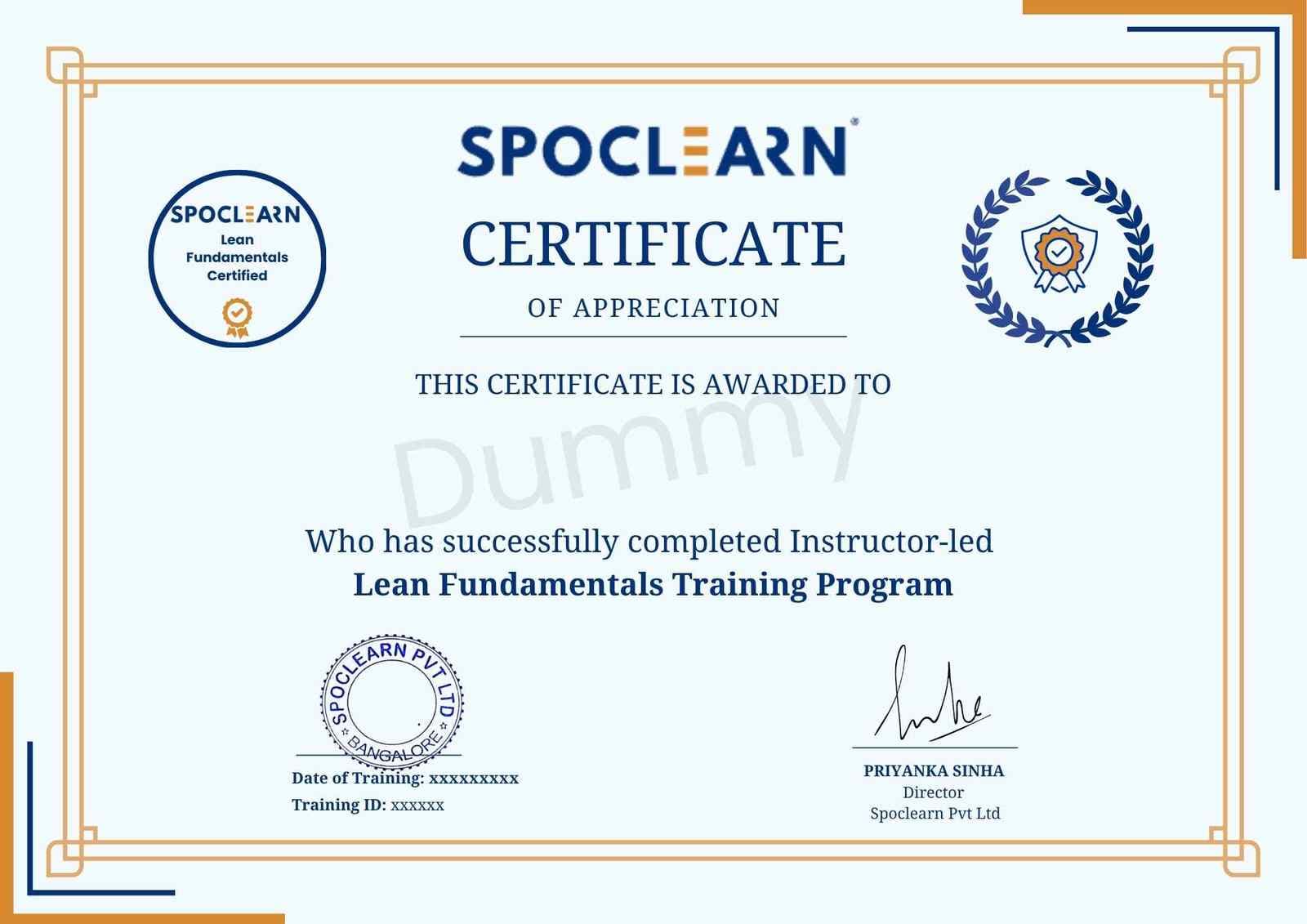
Spoclearn’s one-day Lean Fundamentals Training helps individuals and organizations learn the language of value, waste, flow and continuous improvement. Participants can choose a suitable scheduled class or discuss private corporate delivery for Ho Chi Minh City, Hanoi, Da Nang, Hai Phong, Can Tho and other locations. The program is SME-developed, has no external examination and provides a Spoclearn Course Completion Certificate on meeting course requirements.

 CN
 CN
 CN
 CN