PMP® Certification Training in Dubai

PMP® Certification Training
learners-0CNlearners-1CNlearners-2CNlearners-3CN
856+ Learners

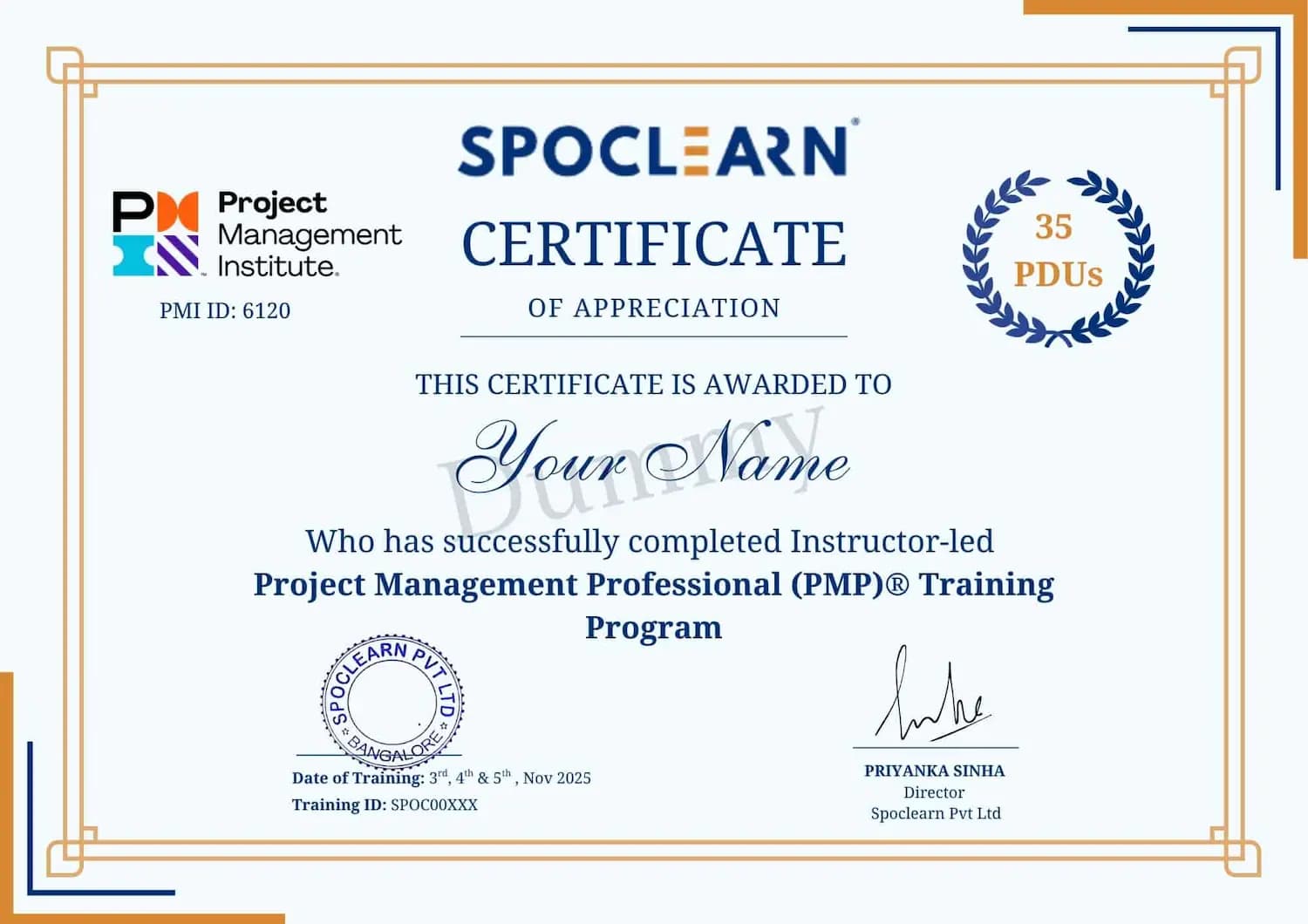
  • 35 PMI-approved PDUs/Contact Hours Certificate

  • Learn from PMI-authorized trainers across the globe

  • Access 36 hours of live instructor-led PMP® training

  • PMI-authorized PMP® training aligned with the latest PMBOK® and exam outline

  • 2000+ Sample PMP Questions and Answers

  • PMP course material prepared by SMEs

  • Case Studies with real-world examples

4.3/5
4.8/5
English
View Date and Prices
Need Customized Corporate Training? Request a Quote
Verified PMI Authorized Training Partner
PMI

PMP® Certification Training in Dubai

Course Overview

Projects have become the primary way organizations deliver innovation, execute strategy, modernize operations, and respond to changing market conditions. Whether implementing Artificial Intelligence, migrating to the cloud, launching new products, expanding infrastructure, improving healthcare systems, transforming supply chains, or driving sustainability initiatives, organizations increasingly rely on skilled project leaders to deliver measurable business outcomes. As projects become larger, more cross-functional, and globally distributed, employers seek professionals who can lead teams, manage uncertainty, align stakeholders, and ensure that every project contributes to organizational value. Reflecting these evolving business needs, the latest PMP® certification emphasizes leadership, business impact, AI-enabled project delivery, sustainability, and adaptive ways of working while continuing to validate globally accepted project management practices.

Spoclearn's PMP® Certification Training is designed to help experienced professionals prepare for the latest Project Management Professional (PMP®) certification while developing practical leadership capabilities that extend well beyond the examination. Aligned with PMI's latest Exam Content Outline (ECO), the program prepares participants to lead projects across Predictive, Agile, and Hybrid delivery environments using globally recognized project management practices. Through instructor-led learning, real-world case studies, scenario-based discussions, practical exercises, and full-length mock examinations, participants gain the confidence to manage complex projects, lead diverse teams, make informed business decisions, and deliver successful project outcomes. Whether you work in technology, manufacturing, construction, banking, consulting, healthcare, energy, telecommunications, government, pharmaceuticals, logistics, or any other project-driven industry, PMP® certification validates your ability to lead projects that create measurable value in today's rapidly evolving global business environment.

PMP® Career Path: Roles, Growth & Opportunities

PMP® Career Path & Growth Journey

PMP certification unlocks diverse leadership opportunities, helping you progress from project management to strategic leadership and business transformation.

Project Team Manager
0–2 Years

Lead project teams, coordinate tasks & drive successful delivery.

Project Coordinator
2–4 Years

Coordinate tasks, track progress & support project delivery.

Project Manager
3–5 Years

Manages projects, teams, timelines, budgets, and business goals.

Senior Project Manager
5–8 Years

Leads complex projects, teams, budgets, timelines, and strategy.

Program Manager
8–12 Years

Leads programs, teams, budgets, timelines, and strategic goals.

Portfolio Manager / Director
12+ Years

Drives strategic portfolios, projects, teams, and delivery.

Average Salary Progression (USD)

Source: Indeed

Why PMP® Certification Drives Career Growth in Dubai

Unlock High-Demand Careers
Salary
PMP Salary Insights & Demand
  • Average global PMPs earn $95K to $135K annually.

  • Senior PMP leaders earn $180,000+ globally.

  • Strong opportunities across the USA, UK, Canada, and UAE.

Job Growth
PMP Job Market and opportunities by 2030
  • 64% projected growth in project management roles

  • Rising global demand for PMP-certified professionals

  • Growing need for strategic project leadership

Job Listing
PMP Career Demand & Active Job Market
  • 2.3M PMP-related job openings each year globally

  • 100,000+ active job openings Across major platforms

  • Strong career growth for PM, PMO & Program Leaders

Top Industries Hiring
Top Industries Hiring PMP Professionals
  • Information Technology (IT)

  • Defense and Aerospace

  • Banking and Finance

great work location for professionals

Key Features of PMP® Certification Training in Dubai

Course Highlights
  • 4-Day interactive instructor-led training
  • 100% Money-Back Guarantee
  • PMP Expert trainers across the globe
  • PMP course material prepared by SMEs
  • 1000+ Sample PMP Questions and Answers
  • Case Studies with real-world examples
  • 35 PDUs/Contact Hours Certificate
  • After training coaching for real-world application
  • Future career support provided for professionals

Who Should Attend This PMP® Certification Course?

Target Audience
  • Project Managers
  • Mid-Level Project Managers
  • Senior Project Managers
  • Project Coordinators
  • Project Analysts
  • Project Leaders
  • Product Managers
  • Program Managers
  • IT Project Managers
  • Team Leads
  • Delivery Managers
  • Project Coordinators
  • Project Sponsors
  • Project Team Members
  • Program and Portfolio Managers
  • Consulting professionals
  • Functional Managers
  • Business Analysts
Target Audience

PMP® Exam Structure, Format and Scoring Explained

Exam Format
  • Exam Type: MCQ, Multiple Response, Fill in the Blanks

  • No. of Questions: 180

  • Duration: 240 Mins

  • Passing score: Psychometric Analysis (above 70%)

  • Languages: English

Exam Format

PMP® CURRICULUM: COMPLETE COURSE SYLLABUS & LEARNING PATH

Course Agenda

Task 1: Develop a common vision

  • Help ensure a shared vision with key stakeholders.​

  • Promote the shared vision.​

  • Keep the vision current.​

  • Break down situations to identify the root cause of a misunderstanding of the vision.​

Task 2: Manage conflicts

  • Identify conflict sources.​

  • Analyze the context for the conflict.​

  • Implement an agreed-on resolution strategy.​

  • Communicate conflict management principles with the team and external stakeholders.​

  • Establish an environment that fosters adherence to common ground rules.​

  • Manage and rectify ground rule violations.​

Task 3: Lead the project team

  • Establish expectations at the team level.​

  • Empower the team. • Solve problems.​

  • Represent the voice of the team.​

  • Support the team's varied experiences, skills, and perspectives.​

  • Determine an appropriate leadership style.​

  • Establish clear roles and responsibilities within the team​

Task 4: Engage Stakeholders

  • Identify stakeholders.​

  • Analyze stakeholders.​

  • Analyze and tailor communication to stakeholder needs.​

  • Execute the stakeholder engagement plan.​

  • Optimize alignment among stakeholder needs, expectations, and project objectives.​

  • Build trust and influence stakeholders to accomplish project objectives.​

Task 5: Align Stakeholder Expectations

  • Categorize stakeholders.​

  • Identify stakeholder expectations. ​

  • Facilitate discussions to align expectations.​

  • Organize and act on mentoring opportunities​

Task 6: Manage Stakeholder Expectations

  • Identify internal and external customer expectations.​

  • Align and maintain outcomes to internal and external customer expectations.​

  • Monitor internal and external customer satisfaction/expectations and respond as needed.​

Task 7: Ensure Knowledge Transfer

  • Identify knowledge critical to the project.​

  • Gather knowledge.​

  • Foster an environment for knowledge transfer.​

Task 8: Plan & Manage Communication

  • Define a communication strategy.​

  • Promote transparency and collaboration.​

  • Establish a feedback loop.​

  • Understand reporting requirements.​

  • Create reports aligned with sponsors and stakeholder expectations.​

  • Support reporting and governance processes.

Am I Eligible for PMP® ?

Option: 1

  • Four-year degree

  • 36 months leading projects

  • 35 hours of project management training/education

Option: 2 

  • A high school diploma or an associate’s degree (or global equivalent)

  • 60 months leading projects

  • 35 hours of project management training/education

Spoclearn: Training That Works for Corporates

Get tailored training programs for individuals and enterprise teams that help to maximize your training budgets

Explore Corporate Training
Tailored Programs

Customized training solutions designed to meet individual and organizational goals for maximum effectiveness.

World Class Trainers

Learn from 200+ global experts with real-world industry experience and proven expertise.

Flexible Learning

Blended training options to suit diverse learning preferences and geographically dispersed teams.

Real-world Impact

Post-training coaching ensures the practical application of skills for measurable, lasting results.


Spoclearn for corporate training
spoclearn-key-differentiators

What Makes Spoclearn Different

Spoclearn Key Differentiators
A Single Point of Contact for all your Learning needs.
Four different learning modes available
Wide range of industry-recognized courses to choose from
Accredited course materials approved by governing bodies
200+ trainers and SMEs fulfilling training requirements worldwide

PMP Project Management Templates & Practical Tools

Downloadable Resources

Download ready-to-use project management templates and worked examples designed to help you apply PMP concepts across project initiation, stakeholder engagement, communication planning, and risk management.

Project Charter Template + Worked Example

Define project objectives, scope, milestones, resources, costs, benefits, and stakeholders with a ready-to-use charter.

‎Project Risk Register Template

Identify, assess, prioritize, and document project risks along with mitigation actions and ownership.

Project Communication Plan Template

Plan what needs to be communicated, to whom, how often, through which channel, and by whom.

Project Communication Plan – Completed Example

See how communication meetings, reporting, stakeholder updates, and collaboration channels can be structured in practice.

Stakeholder Register Template

Capture stakeholder roles, interests, communication requirements, contact information, and engagement details in one place.

Frequently Asked Questions

Loading...
Have More Questions?
Our Learning Advisors are here to help you choose the right path.
  • Speak with an Expert
  • Get Personalized Guidance
  • Know More About Training
  • Request a Corporate Proposal

Why PMP® Certification Continues to Grow Worldwide

The role of the modern project manager has evolved significantly over the past decade. Organizations are no longer looking for professionals who can simply manage schedules, budgets, and project documentation. Instead, they seek leaders who can translate business strategy into successful execution, manage organizational change, align cross-functional teams, and deliver measurable business value in increasingly complex and technology-driven environments.

Across industries, organizations are investing heavily in digital transformation, Artificial Intelligence (AI), cloud computing, cybersecurity, sustainability initiatives, infrastructure development, healthcare modernization, manufacturing automation, and enterprise business transformation. Every one of these strategic initiatives is delivered through projects, making project management one of the most valuable business capabilities in today's global economy.

Recognizing this growing need, the Project Management Institute (PMI) estimates that the global economy currently employs approximately 39.6 million project professionals, while demand is expected to grow dramatically over the next decade. PMI's latest Global Project Management Talent Gap Report forecasts that organizations worldwide could require up to 29.8 million additional project professionals by 2035, representing one of the largest talent gaps across modern business functions. Construction, information technology, manufacturing, healthcare, and infrastructure are among the sectors expected to experience the strongest growth in project management demand.

Unlike many professional certifications that focus on a single discipline or methodology, PMP® certification prepares professionals to manage projects across Predictive, Agile, and Hybrid delivery environments. This flexibility has made PMP® the preferred project management credential for multinational corporations, government agencies, consulting organizations, financial institutions, healthcare providers, technology companies, manufacturers, and public sector organizations worldwide.

Global Business Trends Driving PMP® Demand

Modern organizations continue investing in initiatives that require structured project leadership.

Global Business Trend

Why PMP® Professionals Are Needed

Digital Transformation

Managing enterprise-wide technology change

Artificial Intelligence

Leading AI implementation and governance projects

Cloud Migration

Coordinating multi-team cloud transformation initiatives

Cybersecurity

Delivering security modernization programs

Industry 4.0

Managing automation, robotics, and smart manufacturing

Healthcare Modernization

Leading digital health and patient experience initiatives

Infrastructure Development

Delivering complex public and private capital projects

Sustainability & ESG

Managing environmental and business transformation programs

Enterprise PMOs

Standardizing governance and project delivery practices

Global Business Expansion

Coordinating cross-border programs and distributed teams

These initiatives require professionals who can balance competing priorities, manage stakeholder expectations, mitigate risks, and ensure projects deliver measurable business outcomes.

Why Organizations Continue Investing in PMP® Certified Professionals

Today's organizations operate in environments where projects are increasingly complex, geographically distributed, and strategically important. A single transformation initiative may involve multiple countries, hundreds of stakeholders, several technology platforms, external vendors, regulatory requirements, and significant financial investments.

As a result, organizations increasingly value project managers who demonstrate internationally recognized competencies in:

  • Strategic project planning

  • Leadership and team development

  • Stakeholder engagement

  • Governance and compliance

  • Risk and issue management

  • Benefits realization

  • Adaptive project delivery

  • Business value creation

  • Cross-functional collaboration

  • Executive communication

PMP® certification validates these competencies using globally recognized project management standards that can be applied across virtually every industry sector.

The Rise of Hybrid Project Delivery

Few organizations today rely exclusively on either traditional waterfall or purely Agile approaches. Instead, many operate in Hybrid project environments, combining structured governance with iterative delivery to meet evolving customer and business needs.

For example:

  • A manufacturing organization may manage factory construction using predictive planning while implementing Agile software for production systems.

  • A healthcare provider may follow regulatory governance for hospital expansion while adopting Agile practices for digital patient applications.

  • A financial institution may use predictive controls for compliance projects while delivering customer-facing digital products through Agile teams.

Recognizing these workplace realities, the latest PMP® certification emphasizes Predictive, Agile, and Hybrid approaches equally, preparing professionals to lead projects regardless of delivery methodology.

AI Is Transforming Project Management—Not Replacing Project Managers

Artificial Intelligence is reshaping how projects are planned, monitored, and reported. Modern AI-powered tools can assist with schedule forecasting, risk identification, resource optimization, reporting, and predictive analytics. However, successful project delivery continues to depend on human leadership.

Organizations still require experienced project professionals to:

  • Make strategic decisions

  • Lead multidisciplinary teams

  • Resolve stakeholder conflicts

  • Manage organizational change

  • Balance competing priorities

  • Interpret AI-driven insights

  • Ensure ethical and responsible project governance

Rather than replacing project managers, AI is increasingly becoming a decision-support capability that enables project leaders to focus on strategy, leadership, innovation, and business value. PMI has also emphasized that project professionals who combine leadership with AI-enabled decision-making will play a critical role in future organizational transformation.

Why PMP® Remains One of the World's Most Recognized Project Management Certifications

The continued global demand for PMP® certification is driven by its ability to validate practical project leadership rather than industry-specific technical expertise. Professionals certified through PMP® demonstrate their ability to lead diverse teams, manage complex initiatives, align projects with organizational strategy, and deliver measurable outcomes across different industries and regions.

Whether managing a software implementation in North America, a renewable energy project in Europe, a manufacturing modernization program in Asia, a healthcare transformation initiative in the Middle East, or a public infrastructure project in Africa, the core principles of effective project management remain consistent.

As organizations continue investing in innovation, digital transformation, sustainability, and operational excellence, professionals who combine practical experience with globally recognized project management capabilities will remain essential to delivering successful projects and driving long-term business growth.

Where PMP® Holders Drive Success

Explore Success Stories

Request a Call Back from Spoclearn – We’re Just a Click Away

Got questions or need help choosing the right training or consulting solution? Schedule a call back with our expert team whenever you're able. Select a time that suits your schedule, and we’ll reach out to guide you through your options.